ROMAN HOLIDAY | The ‘Mother of Hubble’, 100,000 New Worlds & NASA’s Next Great Eye in the Sky
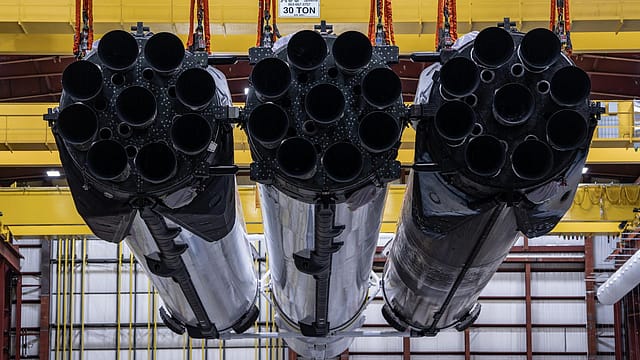
If Florida’s clouds permit, three rockets will ignite beneath a telescope on Sunday.
The central core of SpaceX’s Falcon Heavy will push towards space. Its two side boosters will peel away, turn through the atmosphere and attempt to return to Cape Canaveral. Approximately eight minutes after liftoff, their arrival could announce itself through twin sonic booms.
High above them, enclosed inside the rocket’s fairing, will be NASA’s newest cosmic eye. The Nancy Grace Roman Space Telescope stands more than 42 feet long when fully deployed. It weighs over 20,000 pounds when fuelled. Its primary mirror is 7.9 feet across, almost exactly the diameter of Hubble’s.

Zeroing In on ECI
09 Oct 2026 - Vol 05 | Issue 41
Constitutional legitimacy versus political opportunism
That similarity ends when the camera opens its eyes. Roman can photograph an area of the sky at least 100 times larger than Hubble captures in one pointing. NASA says it will survey the universe about 1,000 times faster while retaining image sharpness comparable to Hubble. A single Roman image could contain the equivalent detail of approximately 100 Hubble pictures.
During its first five years, the observatory is expected to examine billions of galaxies, hundreds of millions of stars, tens of thousands of exploding stars and more than 100,000 planets beyond the solar system. Its gaze will stretch from wandering worlds inside the Milky Way to galaxies seen when the universe was young.
The mission’s central quarry cannot be photographed directly. NASA is sending a $4-billion-plus telescope nearly 1.5 million kilometres from Earth to investigate why the universe is running away from itself.
The Universe Has Stepped on the Accelerator
The cosmos has been expanding since the Big Bang. For decades, astronomers assumed gravity would gradually slow that expansion as galaxies pulled upon one another. During the late 1990s, two teams studying distant exploding stars discovered something stranger. The expansion was accelerating.
Something appeared to be pushing space apart. Astronomers gave the unknown cause a name: dark energy. The label sounds like an explanation. It is closer to an admission. Dark energy is estimated to account for roughly 68 per cent of the universe. Dark matter, another substance that cannot be directly seen, contributes about 27 per cent. The stars, planets, people, trees, buildings and everything else made from familiar matter occupy the tiny remainder.
Humanity, therefore, claims to understand the universe while lacking a satisfactory explanation for approximately 95 per cent of it.
Roman has been built to improve that score. Its Wide Field Instrument will repeatedly survey enormous regions of the infrared sky. It will measure the distances and distribution of galaxies across billions of years, map the invisible scaffolding created by dark matter and study thousands of supernovae whose changing brightness can help reconstruct the history of cosmic expansion.
The telescope will also search for the fossilised imprint of sound waves that travelled through the infant universe. Before atoms, stars and galaxies existed, the cosmos contained a hot fluid of particles and light. Pressure waves rippled through this primordial material and left behind a preferred spacing in the way matter eventually gathered. Astronomers call these remnants baryon acoustic oscillations.
Roman will use that ancient cosmic ruler to measure how the universe expanded at different periods. Its images will provide another route into the darkness. Massive objects bend space-time, slightly distorting the appearance of galaxies behind them. By measuring millions of these tiny distortions through weak gravitational lensing, scientists can reconstruct where invisible dark matter lies and how its vast web has changed.
The different measurements can challenge one another. If supernovae, galaxy clustering and gravitational lensing all produce the same history, confidence grows. If they disagree, the disagreement could expose an error, a new property of dark energy or a weakness in the theory of gravity itself. Recent evidence has raised the possibility that dark energy may change with time rather than remain constant. Roman will reach into cosmic periods that remain insufficiently measured and test whether the force accelerating expansion has evolved.
The mission may vindicate the standard model of cosmology. It may also make the universe considerably more confusing.
A Hubble Mirror With Panoramic Vision
Hubble became famous by staring.
Its Deep Field observations fixed upon apparently empty pieces of sky for days and revealed thousands of distant galaxies hiding inside darkness. Its narrow gaze produced portraits of nebulae, colliding galaxies and dying stars that entered classrooms, films, screensavers and the human imagination. James Webb looks deeper. Its 6.5-metre mirror collects faint infrared light from some of the earliest galaxies and examines planetary atmospheres with extraordinary sensitivity.
Roman will specialise in scale.
Webb can inspect a cosmic tree with exquisite detail. Roman can map the forest and identify every unusual branch worth revisiting. Its 300-megapixel Wide Field Instrument contains 18 detectors and can image a region approximately 100 times larger than Hubble’s infrared camera in a single exposure. Roman’s pictures will be about 50 times larger than Webb’s. NASA estimates that the observatory will generate around 1.375 terabytes of data every day.
Over its five-year primary mission, the total could approach 20 petabytes. In one month, Roman may produce roughly twice the volume of data accumulated by Hubble across three decades, according to the Space Telescope Science Institute’s Roman Research Nexus. The mission will, therefore, create an astronomical problem on Earth.
How does one download, store, process, compare and interpret a sky arriving at industrial scale? Astronomers will work through a cloud-based research environment rather than depending only on traditional downloads. Roman’s data will be made available to scientists without the long proprietary periods that sometimes allow the researchers who proposed an observation to examine it first.
A supernova detected by Roman could immediately become material for researchers across continents. An astronomer in India may explore the same cosmic event as a team in the United States without waiting for the mission’s principal investigators to finish. Roman is a telescope designed for the age of data abundance. Its greatest discovery may emerge from a question nobody thought to include in the original mission.
The Telescope That Began With a Secret Eye
Roman’s journey contains a wonderfully earthly twist.
The telescope’s primary mirror came from another US government agency. NASA describes it carefully as an inherited mirror that was subsequently modified for scientific use. The hardware traces back to telescope assemblies donated by the National Reconnaissance Office, the organisation responsible for America’s intelligence satellites.
An optical system connected to watching Earth was repurposed to interrogate the universe. The mirror has the same 2.4-metre diameter as Hubble’s but weighs less than one-fourth as much. Engineers reshaped and polished it to meet Roman’s requirements, then coated it with a layer of silver less than 400 nanometres thick to reflect near-infrared light.
NASA says the average irregularity on its surface is only about 1.2 nanometres high. The mirror will direct incoming light towards Roman’s two instruments. The Wide Field Instrument supplies the panoramic view. The Coronagraph Instrument attempts one of astronomy’s most audacious acts of subtraction. A star can be billions of times brighter than a planet orbiting beside it. Trying to photograph that planet resembles attempting to see a firefly positioned beside a floodlight from a great distance.
The coronagraph blocks the star’s glare and uses deformable mirrors, sophisticated masks and extremely sensitive detectors to isolate the faint reflected light of nearby worlds. Roman’s coronagraph is officially a technology demonstration rather than a core science instrument. Its success could nevertheless determine how humanity eventually photographs planets resembling Earth.
The instrument will attempt to image older, cooler giant planets whose light is reflected from their stars. Current direct-imaging methods are generally better at seeing young, hot and massive worlds that glow strongly in infrared light. Roman could bring mature planetary systems into view and test technologies intended for NASA’s future Habitable Worlds Observatory, which is being designed to search for Earth-like planets and signs that some may support life.
Roman may not find another Earth. It could teach the telescope that does.
A Census of Planets, Including the Orphans
Most known exoplanets have been discovered when they pass in front of their stars and cause a small, periodic dip in brightness.
The transit method has transformed planetary science. It also carries a bias. Large planets orbiting close to their stars cross frequently and block more light, making them easier to detect. A distant observer using transits to study our solar system could miss several of its planets.
Roman will expand the census through gravitational microlensing. When a foreground star passes almost perfectly in front of a more distant star from Earth’s perspective, the gravity of the nearer object bends and magnifies the background star’s light. A planet orbiting the foreground star can create a brief additional spike in brightness.
The alignment may last days. The planetary signal can disappear within hours. It is unlikely to repeat. Roman will monitor hundreds of millions of stars towards the crowded centre of the Milky Way, watching for these momentary wrinkles in space-time. NASA expects microlensing to reveal more than 1,000 planets, including rocky worlds, ice giants resembling Uranus and Neptune, and planets orbiting at distances poorly represented in current catalogues.
It could also detect cosmic orphans. Some planets may have been thrown from their original systems during violent gravitational encounters. They now travel through the galaxy without orbiting any star, carrying permanent night across their surfaces. These rogue planets emit little or no light. Microlensing can find them through the momentary effect of their gravity. Roman may detect free-floating worlds as small as Mars or Earth and help astronomers determine whether the galaxy contains more orphan planets than stars.
The same observations will deliver an enormous bonus. By continuously measuring the brightness of crowded stellar fields, Roman could identify approximately 100,000 additional planets through transits. The telescope would therefore search for close-in worlds by watching starlight dim and distant worlds by watching gravity briefly make starlight brighter.
One cosmic survey. Two opposite clues.
Nancy Grace Roman Had to Put ‘Dr’ Before Her Name
The telescope carries the name of a woman who spent much of her career forcing institutions to see what they were inclined to overlook. Nancy Grace Roman was born in Nashville in 1925. At 11, she organised classmates into an astronomy club. A school counsellor reportedly questioned why a girl wanted to take algebra instead of Latin. The head of a college physics department told her he usually discouraged women from studying physics but conceded that she might succeed.
Roman earned an astronomy degree from Swarthmore College in 1946 and a doctorate from the University of Chicago three years later. She studied stars at Yerkes Observatory but concluded that academia offered little prospect of tenure to a woman. She moved into radio astronomy at the US Naval Research Laboratory and joined NASA in 1959, only months after the agency was created.
She became NASA’s first chief of astronomy and its first female executive. The designation did not always travel ahead of her. Roman recalled that she used “Dr” before her name because otherwise she struggled to get past secretaries who did not expect a woman to be the scientist entering the meeting. “If I hadn’t been stubborn, I would’ve been talked out of it years earlier,” she later said, according to NASA’s account of her life.
That stubbornness altered astronomy. Roman worked between scientists, engineers, NASA administrators and Congress to develop America’s programme of space-based observatories. She helped define the scientific case and minimum requirements for the Large Space Telescope, the project that became Hubble.
A telescope above the atmosphere could observe wavelengths blocked or distorted from the ground. It could operate without clouds, weather and daylight interfering. The ambition was obvious to astronomers and expensive to everybody holding the purse strings.
Roman became its political translator. She built committees, gathered agreement across a famously argumentative scientific community and helped persuade Washington that an orbiting observatory deserved public money. Her colleague Ed Weiler later called her the “Mother of Hubble”.
Hubble launched in 1990, more than a decade after Roman retired from NASA. Its first images were blurred because of a flaw in the primary mirror. Astronauts repaired the telescope in 1993, turning a national embarrassment into one of science’s greatest instruments. When Roman was once asked which Hubble discovery interested her most, her answer was dark energy. The telescope bearing her name will now pursue it. The symmetry is almost too tidy for reality.
The Mission Washington Tried to Kill
Roman began life under a less poetic name: the Wide Field Infrared Survey Telescope, or WFIRST. The US astronomy community ranked it as its highest-priority major space mission in the 2010 decadal survey. Construction received formal approval in 2020, the same year NASA renamed it after Roman, who had died in 2018 at 93.
Its survival was not guaranteed. Donald Trump’s first administration repeatedly proposed terminating WFIRST as NASA struggled with the escalating cost and delays surrounding James Webb. Congress restored funding.
The threat returned during Trump’s second term. The Guardian reported ahead of the launch that the telescope survived another attempt to eliminate its funding. Lawmakers again protected the mission, allowing a telescope built to study invisible cosmic forces to escape a very visible political axe.
Roman’s reported cost has reached approximately $4.3 billion. Webb cost far more and launched years late. Roman presents a rarer NASA story: a flagship observatory arriving ahead of its formal May 2027 deadline. More than 1,000 engineers and technicians assembled millions of components, frequently building and testing different sections in parallel. The completed observatory travelled to Kennedy Space Center aboard NASA’s Pegasus barge in June.
It is now attached to a Falcon Heavy at Launch Complex 39A, the same historic site from which Apollo 11 began its journey to the Moon. NASA and SpaceX completed the launch-readiness review on Friday and declared Roman “go” for flight. The latest forecast gives the mission a 60 per cent chance of acceptable weather, with cumulus clouds among the principal concerns. If Sunday’s attempt is postponed, another opportunity is scheduled for Monday.
After deployment, Roman will travel towards the second Sun-Earth Lagrange point, or L2, around 1.5 million kilometres from Earth. L2 is a gravitationally useful region where a spacecraft can orbit the Sun while remaining broadly aligned with Earth. The Sun, Earth and Moon stay on the same side of the observatory, allowing its sunshade to protect the telescope and provide a stable view of deep space.
James Webb operates there. Roman will join it. The two will not compete for cosmic territory. Roman will discover populations, panoramas and rare events. Webb can return to selected targets for deeper inspection. Roman finds the cosmic needle by photographing the haystack. Webb examines the needle.
First Comes Fire, Then Silence
The launch will provide the spectacle.
Falcon Heavy’s 27 Merlin engines will produce millions of pounds of thrust. The rocket will climb over Florida, separate its boosters and send Roman away from Earth. NASA’s live coverage begins at 3:50 pm IST, with liftoff targeted for 4:56 pm.
Then the mission becomes quieter and more dangerous. The spacecraft must deploy its solar arrays and aperture cover, establish communication, stabilise itself and begin a three-month sequence of tests and calibrations. Engineers must verify that the mirror, detectors, thermal systems, communications and instruments have survived launch.
There is no astronaut repair mission planned at L2. NASA expects to release Roman’s first science images in early 2027. Its primary mission will last five years, with fuel potentially supporting another five. Once regular observations begin, the telescope will return data at a pace astronomy has never experienced from a flagship space observatory.
Some images will show millions of galaxies. Some will contain stars exploding midway through the exposure. Some may capture light bent by black holes wandering invisibly through the Milky Way. A few pixels could reveal a planet without a sun. The most consequential measurement may be a tiny distortion repeated across millions of galaxies, suggesting that dark energy is changing or that gravity behaves differently across immense distances.
Roman will photograph the sky widely enough to make rarity routine. That may be its defining power. Hubble taught humanity to look at the universe. Webb taught it to look deeper. Roman will teach it to look everywhere at once. A girl who was advised against algebra helped place Hubble above the atmosphere. Decades later, a telescope carrying her name is waiting on the same Florida coast that launched astronauts towards the Moon.
The rocket’s engines will burn for minutes. The search Roman begins could occupy cosmology for generations.
With inputs from ANI