From VR Glasses to DNA: Meta and Anthropic Push AI Beyond the Chat Window
One company wants artificial intelligence to help you operate a computer through your glasses. Another says its AI has spotted something in genetic data that scientists should investigate.
Separate announcements from Meta and Anthropic offer a glimpse of how technology companies are extending AI beyond answering questions in a chat window. Meta has unveiled virtual reality glasses with its AI assistant integrated into the operating system. Anthropic, meanwhile, says Claude has identified previously unrecognised features of an enzyme system that could open a new avenue of biological research.
The announcements concern different stages of development: a consumer device designed for entertainment and work, and an early scientific finding whose biological function remains uncertain.
Meta Puts AI in the Frame
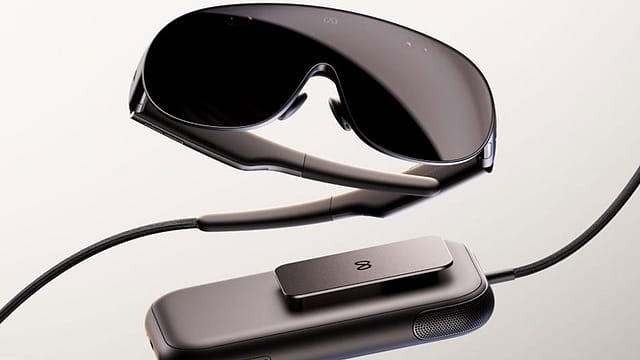
Mark Zuckerberg-led Meta describes its new “Meta VR Glasses” as its most advanced device yet, combining virtual reality with an integrated Meta AI agent.
Users can operate the glasses through voice commands, eye movements and hand gestures. According to the company, these controls allow them to open applications, search for information, play films and adjust a virtual workspace without controllers.

Zeroing In on ECI
09 Oct 2026 - Vol 05 | Issue 41
Constitutional legitimacy versus political opportunism
Meta says the glasses weigh roughly as much as a deck of cards and are five times lighter than the Quest 3. That reduction comes largely from splitting the hardware into two parts.
The glasses contain the display and sensors. A separate puck houses computing, battery and storage functions, connecting through an optical tether and clipping onto a pocket or bag. The design, therefore, shifts substantial hardware away from the user’s face.
A Private Workspace and a Virtual Cinema
Meta is positioning the glasses as both a computing platform and an entertainment device.
The company says users can create a private, multi-screen workspace and turn a flat surface into a keyboard and touchpad, allowing them to work without additional input hardware.
Its “5K Infinite Display” uses micro-OLED panels and offers 37 pixels per degree, a measure of visual detail. Meta says the display and specially designed pancake lenses improve clarity and make text easier to read.
For entertainment, the glasses support Dolby Vision, with Dolby Atmos spatial audio built into the frames. Meta also describes them as the first IMAX Enhanced-certified VR device, offering access to select films in IMAX’s expanded aspect ratio at home.
The proposed viewing library includes VR-enhanced versions of Avengers: Infinity War and Star Wars: A New Hope through the Disney Immersive Cinema by ILM app.
Meta says it is working with platforms including Prime Video, YouTube, ESPN and Tubi, while Peacock, HBO Max and Paramount+ will bring their 3D catalogues to the device. A partnership with James Cameron and Lightstorm Vision is intended to introduce additional blockbusters in 3D in 2027.
The company is also developing photorealistic digital representations of users that capture expressions and reactions for hands-free video calls.
Claude’s Finding in Genetic Data
Anthropic’s announcement takes AI into a different setting: the search for biological systems that researchers may have overlooked.
The company says Claude identified an enzyme system in the DNA of bacteriophages, viruses that infect bacteria. The system contains a reverse transcriptase, an enzyme that copies RNA into DNA, alongside an array of repeating, non-coding DNA sequences and an accessory protein whose function is unknown.
The reverse transcriptase itself had been identified in earlier studies. Anthropic’s claim is that Claude appears to have been the first to recognise the associated features that distinguish the wider system.
According to CEO Dario Amodei, Anthropic’s life sciences team suggested a broad research area. Claude then examined scientific literature and genome data, identified the system as interesting and proposed experiments to investigate it.
A Research Lead, With Its Function Still Unknown
Anthropic says the repeating DNA array bears some resemblance to CRISPR, the system that underpins widely used gene-editing tools. It also says the small number of known systems sharing these features can cut, copy and paste DNA.
That resemblance does not establish that Claude has found a working gene-editing tool.
“We don’t yet understand what this system does,” the company said.
Its possible significance will depend on establishing its biological function and whether researchers can develop useful applications from it. Amodei’s suggestion that the finding could represent a new gene-editing mechanism remains a possibility under investigation.
Anthropic hopes the work will demonstrate AI’s value in generating scientific hypotheses and wants to collaborate with researchers across genomics and other fields.
The distinction between the two announcements is instructive. Meta is proposing new ways to interact with digital tools. Anthropic is proposing new questions for scientists to test. In each case, the next measure of progress will be what the technology can reliably deliver beyond the announcement.
With inputs from ANI