A Robot Walked Into the Stock Market. Investors Lost Their Minds.
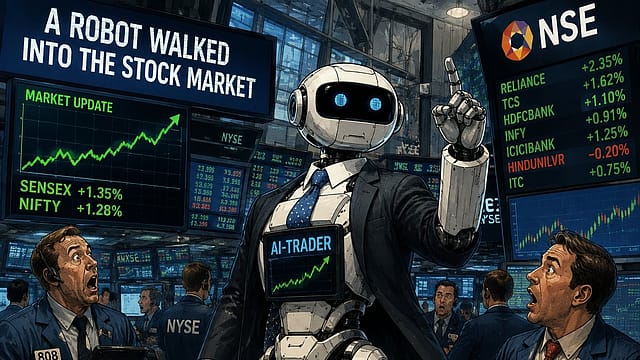
Imagine a humanoid robot walking into a stock exchange.
A little stiff. Slightly awkward. Perhaps waving at investors with that unmistakable I-have-been-programmed-to-look-friendly energy.
And then, before any human in the room can process what is happening, its shares shoot through the roof.
That, more or less, was Unitree Robotics’ stock-market debut.
The Chinese humanoid robotmaker listed on Shanghai’s STAR Market and ended its first trading session up a staggering 460.34%.
Yes, 460%.
The robots merely walked. The stock performed parkour.
And for a few breathless moments, even that looked modest.
According to the Global Times, Unitree shares opened at 1,100 yuan, compared with an issue price of just 150.80 yuan. That was a 629.44% jump straight out of the gate.

Zeroing In on ECI
09 Oct 2026 - Vol 05 | Issue 41
Constitutional legitimacy versus political opportunism
The stock eventually stopped sprinting and closed at 844.80 yuan, giving the company a market value of roughly $50.68 billion.
To put it another way, investors looked at a company that makes machines resembling humans and collectively decided: Take our money before the robots do.
Chinese Embassy in India spokesperson Yu Jing highlighted Unitree’s spectacular debut in a post on X. But spectacular may be underselling it.
Nearly 9.8 million valid retail accounts applied for the IPO, the highest participation recorded for a public offering since Shanghai launched the STAR Market.
Unitree sold 40.45 million shares, representing 10% of its post-listing equity, and raised about $899.45 million.
That is almost $900 million riding on a future in which robots do considerably more than dance at technology conferences and terrify dogs on the internet.
So, what exactly are investors buying?
Unitree is one of China’s biggest bets on “embodied intelligence”. That slightly intimidating phrase simply means giving artificial intelligence a body, arms, legs and the ability to operate in the physical world.
Think less chatbot on your laptop.
Think chatbot walking towards you.
The excitement is not entirely science fiction. Unitree’s prospectus showed that it shipped more than 5,500 humanoid robots in 2025. That gave it a 32.4% share of the global market and, reportedly, the number-one position worldwide.
More than 90% of the company’s core components are developed and manufactured in-house.
Its balance sheet has also learned a rather impressive trick.
Unitree’s revenue climbed from 159 million yuan in 2023 to nearly 1.7 billion yuan in 2025. During that period, it went from losing 18.02 million yuan to earning a profit of 591 million yuan.
So, yes, the robots may still occasionally wobble.
The business appears to have found its balance.
Chen Jing, vice president of the Technology and Strategy Research Institute, told the Global Times that investors were displaying “extreme enthusiasm” for embodied intelligence. Part of that excitement comes from scarcity: there simply are not many listed humanoid robot companies available to buy.
Unitree’s IPO could now set a pricing benchmark for the next batch of robotics companies waiting backstage. It could also help move humanoid robots out of slick laboratory videos and into factories, offices and commercial use.
But here comes the tiny flashing warning light.
A 460% debut does not automatically mean the robots have conquered the world. Unitree itself has flagged the risks of slower growth, fluctuating performance and research plans that may fail to deliver.
The real test begins once the stock-market confetti has been swept away. Unitree must turn investor excitement into better technology, paying customers and robots that can solve real problems without falling over.
For now, China’s humanoid revolution remains a work in progress.
But on the stock market, the robots have already learned the most important human skill of all:
How to make money while everyone is watching.
(With inputs from ANI)