Bubble Tea Meets EVs: Can Boba Bhai and Yulu Earn Investors’ Patience?
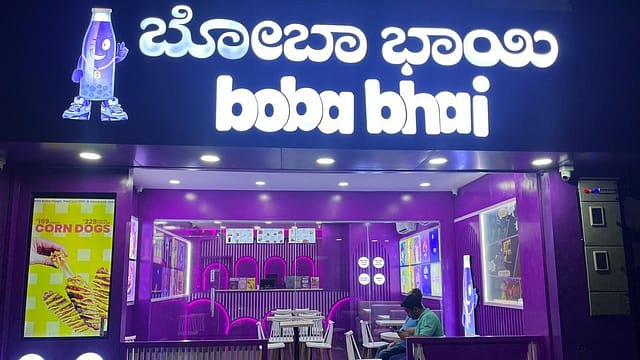
A bubble-tea outlet and an electric delivery scooter have a surprisingly similar question to answer: how much repeat business will recover the money invested in them?
Boba Bhai needs customers to return for another drink or meal. Yulu needs riders to keep renting its vehicles. Both must commit money before knowing how reliably that revenue will arrive.
Their FY26 accounts produce an unexpected numerical pairing. Yulu spent approximately ₹1.34 for every rupee of operating revenue. Boba Bhai spent ₹1.33.
The resemblance makes a useful opening. The stronger story concerns the time both businesses need to turn expansion into earnings, and the evidence investors should demand while waiting.

The Era of Forever Wars
30 Oct 2026 - Vol 05 | Issue 44
Coping with an explosive Middle East
Patience has a commercial purpose
Physical businesses cannot expand as cheaply as adding another software account. An outlet needs equipment, people and a functioning supply chain. An electric rental fleet needs vehicles, battery services and maintenance capacity.
New locations may take time to attract customers. A service network can initially support fewer vehicles than it was designed for. These are plausible reasons for costs to arrive before sufficient revenue.
Investors who insist on immediate company-wide profit could discourage investments capable of producing worthwhile returns later.
That case becomes convincing when existing stores or vehicles generate enough cash to support themselves and eventually repay their initial cost. Expansion should repeat a business whose economics are becoming clearer.
The difficult question is how much of each annual loss comes from building the next business and how much comes from running the one already built.
That distinction will become more consequential as Yulu pursues a 200,000-vehicle fleet by 2028 and Boba Bhai targets another 150–200 stores in FY27.
Yulu’s progress comes with a replacement bill
Yulu currently offers the clearer improvement in annual financial performance. Operating revenue rose 18.6% to ₹281 crore in FY26, while losses narrowed from about ₹126 crore to ₹96.6 crore. Rental income increased 30.3% to ₹262 crore.
Calculated from those figures, its loss fell from approximately 53% of operating revenue to 34%. That is meaningful progress, although the remaining shortfall is substantial.
The test now concerns the earnings of each working vehicle. More rental days can spread support costs across additional revenue. Downtime, repairs and weak demand can undermine that advantage.
Depreciation was ₹65 crore in FY26, while finance costs reached ₹15.5 crore. Depreciation allocates an asset’s cost across its useful life. It does not require a fresh cash payment each year, but vehicles ultimately need replacing.
A fleet can, therefore, approach operating profitability while still requiring substantial money to sustain and expand itself.
For riders, the calculation is immediate: can the vehicle help them earn enough after rental charges and other working costs? Investor returns ultimately depend on a service that remains economically useful to its customers.
Boba Bhai must turn curiosity into habit
Boba Bhai’s revenue increased 139% to ₹68 crore in FY26. Its loss widened from ₹9.96 crore to ₹21.8 crore.
The loss was approximately 32% of revenue, against 35% a year earlier. The direction improved modestly, even as the absolute amount investors had to absorb increased.
Bubble tea supplies the memorable identity, but the business extends further. Founder Dhruv Kohli said in April that food contributed 60–65% of revenue. He described a company-owned outlet model and said the business was profitable at store level.
“If we weren’t expanding this aggressively, we would already be profitable at a company level,” he said.
That is a proposition investors can examine.
They need to know what store-level profit includes, how older outlets perform and whether opening costs are being recovered. A store can cover its daily expenses while taking much longer to repay the money spent establishing it. Head-office costs still need funding.
The customer challenge is equally important. A first purchase may reflect curiosity about a flavour or brand. Repeat purchases depend on taste, consistency, convenience and price.
New outlets can make revenue grow even when existing ones make little progress. Investors therefore need sales and cash contribution from comparable, established locations alongside the expanding store count.
China’s tea giant offers a qualified lesson
Mixue demonstrates that inexpensive drinks can support a large, profitable enterprise. Its first-half 2026 profit was approximately RMB2.32 billion.
Its model matters. Mixue primarily earns revenue by supplying goods and equipment to franchisees, with additional franchise-related income. Boba Bhai’s disclosed company-owned model leaves it directly responsible for outlet investment and operations.
Mixue’s corporate profitability cannot establish what Boba Bhai should earn, or what every individual franchisee makes.
Even Mixue’s scale offers limited protection from pressure. Its June-end franchised network had grown to 63,951 stores, but first-half profit fell 14.7% year on year.
The lesson for investors concerns who funds expansion, who bears operating risk and how demand translates into earnings. A familiar product category can contain very different investment propositions.
Gogoro shows what measurable patience looks like
Taiwan’s battery-swapping company Gogoro provides another useful reference.
In its August results, it reported its fifth consecutive quarter of positive operating cash flow and a second-quarter net loss of $4.9 million, down from $26.5 million a year earlier.
Those outcomes can coexist. Cash generated by operations and accounting profit measure different things. Operating cash flow also needs to be assessed alongside spending on assets.
Gogoro attributed part of its improvement to lower battery-upgrade costs after completing a programme in late 2025, alongside better efficiency. Its disclosures show how equipment upkeep and replacement decisions can affect the economics of a recurring service.
The comparison gives Yulu investors useful questions about vehicle life, battery-service costs and cash left after maintaining the network. It does not establish that the two companies will follow the same trajectory.
Expansion must earn its next cheque
Both Indian companies have a reasonable argument for time. Store networks and vehicle fleets require investment before reaching their potential. A growing annual loss, considered alone, cannot establish that expansion is misguided.
The argument strengthens when older investments produce better returns.
For Boba Bhai, that means customers returning to established outlets at prices that cover the full cost of serving them. For Yulu, it means vehicles earning enough over their working lives to cover service costs, financing and eventual replacement.
Investors should also know what would cause management to slow openings, reduce vehicle deployment or leave an unpromising market. A growth plan becomes more credible when it includes conditions for changing course.
Bubble tea and electric mobility can both reward patient capital. Patient investors should be able to see what their earlier money has built before being asked to fund the next expansion.