ZERO RUNS, 171 WICKETS & 112 TO GO | How Deepti Sharma and Smriti Mandhana Became India’s Powerhouse Pair
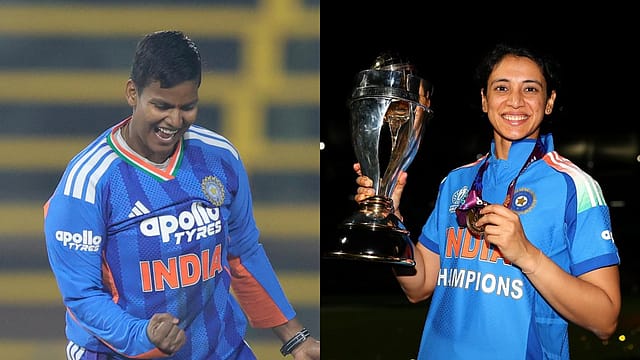
Seven balls cost Thailand nothing. They cost them three wickets and one world record.
Deepti Sharma entered India’s Women’s Asia Cup opener in Dubai with Thailand attempting to chase 160. The contest was already leaning towards India. Deepti pushed it over. Her first over produced two wickets and no runs. Naomi Hamilton was trapped in front. Nannaphat Chaihan attempted to attack and found short mid-wicket instead.
Deepti returned for one more delivery. Nannapat Koncharoenkai, who had resisted with 41, tried to cut a ball that gripped the surface and climbed. It took the shoulder of the bat. Richa Ghosh dived forward and completed the catch.
Deepti finished with 3/0 from 1.1 overs. Seven deliveries. Three wickets. No runs. Thailand were dismissed for 65 and India won by 94 runs. The third wicket took Deepti to 171 in T20 internationals, one beyond Thailand’s Thipatcha Putthawong. On the day she played her 150th T20I, Deepti became the format’s highest wicket-taker and the first Indian woman to claim three wickets without conceding a run.

Zeroing In on ECI
09 Oct 2026 - Vol 05 | Issue 41
Constitutional legitimacy versus political opportunism
At the beginning of the same match, Smriti Mandhana had walked out carrying another piece of history. She struck four boundaries, scored 19 from 10 balls and was run out. The innings looked like a cameo too brief to remember.
Nineteen was enough. Mandhana moved past New Zealand great Suzie Bates to become the second-highest run-scorer across women’s international cricket. Her aggregate reached 10,756. Only Mithali Raj, on 10,868, remained ahead. The distance was 112 runs. One Indian had climbed to the top by conceding nothing. The other was closing in by making scoring look like the most natural movement in cricket.
This is how Deepti Sharma and Smriti Mandhana have powered India for more than a decade. They perform different jobs, inhabit different visual worlds and attract different forms of attention. Mandhana provides the photograph: the raised bat, the cover drive, the flowing left-handed swing. Deepti often supplies everything required before that photograph can be taken.
The Ball That Found the Stumps
Deepti Sharma’s career reportedly began with a throw. As a child in Agra, she repeatedly asked her elder brother Sumit to take her to the Ekalavya Sports Stadium, where he trained. Sumit was a cricketer himself and had acquired the nickname “Bala” because his bowling action resembled India seamer Lakshmipathy Balaji.
One day, while Sumit practised, a ball rolled towards his younger sister. Deepti picked it up and threw it back. From approximately 50 metres away, it struck the stumps. Former India batter Hemlata Kala saw it happen. Kala initially mistook the short-haired child for a boy, called Sumit over and asked whether the child played regularly. When told that Deepti had never trained formally, Kala reportedly delivered a prediction: bring her to practise; she could play for India one day.
The lovely part of the story is the accuracy of the throw. The revealing part came afterwards.
Deepti was considered too young for state selection and was overlooked repeatedly. She attended trials without breaking through. The girl who had hit the stumps at first sight could not immediately persuade the system to let her stand beside them. Her family reorganised itself around the possibility.
Sumit reportedly left his private-sector job after completing an MBA and became central to her training. Deepti developed as a left-handed batter and right-arm off-spinner. Hours at the ground taught her more than technique. They built an understanding of angles, batters, fields and match situations.
Deepti did not emerge as a player with one spectacular gift. She became the player who could solve several problems before breakfast.
The Right-Handed Girl Who Batted Left
Smriti Mandhana’s cricket began with imitation. Born in Mumbai and raised in Madhavnagar near Sangli, she grew up in a family that discussed cricket as naturally as other households discussed school or dinner. Her father Shrinivas and brother Shravan had played at district level. Shravan went on to represent Maharashtra at Under-16 level.
Smriti followed him to practice. She collected balls, stood behind the nets and watched him bat. She also collected newspaper cuttings carrying her brother’s name and imagined seeing her own there one day.
Mandhana is naturally right-handed. She bats left-handed because Shravan did. “I learnt to bat by standing behind him in the nets,” she later explained. Her father, who admired left-handed batting, encouraged both children to play that way. The action became muscle memory before Smriti knew the technical names of the shots she was playing.
That childhood imitation produced one of cricket’s most recognisable swings. At nine, Mandhana was selected for Maharashtra’s Under-15 team. At 11, she entered the state Under-19 system. Her family protected the ambition from the routine policing reserved for sporting daughters. Mandhana has recalled people warning her parents that playing outdoors would tan their daughter and damage her marriage prospects. Her parents allowed the sun to continue its work.
In 2013, aged 17, Mandhana walked into an Under-19 one-day match against Gujarat carrying a bat that had reportedly belonged to Rahul Dravid. She scored an unbeaten 224 from 150 balls, becoming the first Indian woman to make a double-century in a one-day match. The Indian Express recorded the early landmark.
She had made her international debut earlier that year. The newspaper clipping had become too small for the story.
Beauty Can Be Brutal
Mandhana’s batting invites an aesthetic vocabulary that can understate its violence. Elegant. Graceful. Silken. Effortless. All are accurate.
None adequately describes the effect upon the bowler. A Mandhana cover drive may look like a polite redirection of the ball. It still travels to the boundary. Her pull shot has a compact cruelty. Her ability to move onto the back foot converts length deliveries into scoring opportunities before the bowler can adjust.
The beauty lies in the absence of visible strain. She does not always appear to hit the ball harder. She reaches the right position earlier, supplies timing and allows the bat’s arc to finish the argument.
That method has travelled across formats. Mandhana has scored 5,411 ODI runs at an average approaching 48, with 14 centuries. Her T20I tally stands at 4,557, placing her second among the format’s run-scorers. In only nine Tests, she has accumulated 788 runs at an average above 52, including two hundreds.
Those numbers explain why 10,756 is more than an aggregate. Women’s international cricket has not historically offered every generation the same number of fixtures. Mithali Raj played for India across 23 years. Suzie Bates built her tally through extraordinary longevity for New Zealand. Charlotte Edwards carried England through the sport’s transition from amateurism towards professionalism.
Mandhana is only 30. She is 112 runs from passing Mithali and becoming the leading run-scorer across women’s international cricket. The record appears inevitable if fitness and selection hold. Its deeper significance lies in the method of arrival. Mandhana has accumulated at scale without turning caution into her default setting. She attacks the new ball, accepts early risk and gives India’s innings its tempo. Openers usually confront the best conditions for fast bowlers. Mandhana frequently makes those conditions look decorative.
The Woman Who Does Everything
Deepti’s game produces a different form of pressure.
She can bowl in the powerplay, through the middle or near the end. She can bat when India need consolidation, acceleration or simple survival. She fields aggressively and reads the contest quickly. Her off-spin is built upon control, drift, changes of pace and an ability to judge when a batter is preparing to manufacture a shot. She does not require the ball to turn extravagantly. A slight deviation, a delayed stroke or a small error in length perception can be enough.
The scoreboard often reduces the work to a line. Four overs. Few runs. Two wickets. The contest experiences something more suffocating. A boundary option disappears. Required run rate rises. Another bowler becomes harder to attack. A batter attempts to recover the lost over and makes a mistake against somebody else.
Deepti’s value spreads across the innings. Former Australia captain Meg Lanning captured the quality after India’s 2025 World Cup triumph, observing that Deepti could influence a game with bat or ball at several different stages. There was no single route through which she had to succeed. The ICC quoted Lanning calling her a player capable of performing under pressure “at any point in the game”.
Her 171 T20I wickets now place statistical authority behind that description. Yet the number does not fully include the overs she closed without a wicket, the partnerships she repaired or the batters forced into risks at the opposite end.
All-rounders are sometimes described as offering two players in one. Deepti frequently supplies the fielder as well. Lord’s Broke Them. Navi Mumbai Repaired the Memory
Mandhana and Deepti carried the same unresolved wound for eight years. At Lord’s in July 2017, India appeared ready to win its first Women’s World Cup. England had made 228. India reached 191/3. The trophy was 38 runs away. Then the innings collapsed.
Mandhana had been dismissed for a duck. Deepti, batting at No. 6, made 14 from 31 deliveries as the lower order attempted to recover. India were bowled out for 219 and lost by nine runs. That final changed women’s cricket in India even through defeat. Millions watched. Players returned as public figures. Girls who had rarely seen Indian women play cricket now had names, faces and heartbreak to remember.
The visibility increased. The wound remained. India lost another global final to Australia at the 2020 T20 World Cup. The team became richer in talent and stronger commercially. The Women’s Premier League arrived. Contracts improved. Crowds expanded. The missing trophy continued to sit at the centre of the conversation.
Mandhana took Royal Challengers Bengaluru to the WPL title in 2024, becoming the captain who delivered the franchise’s first championship. The victory sharpened her leadership credentials and helped make 2024 one of the defining years of her career. She scored 1,602 international runs, then a record for a woman in a calendar year, and was named Wisden’s leading women’s cricketer. Reuters noted that she had made five international centuries during the year.
But the national team still needed its November night. It came in 2025.
The World Cup That Changed Their Introductions
India’s home World Cup campaign began uncertainly. Three defeats threatened to derail it. Australia remained the overwhelming power. India had experienced enough near-misses to recognise the shape of another one.
Mandhana kept scoring. She made 434 runs during the tournament, the most by an Indian in a single Women’s World Cup, overtaking Mithali Raj’s 409 from 2017. Her century against New Zealand helped secure India’s semi-final place. Her 45 in the final gave India another important start.
Deepti turned the tournament into her definitive statement. She scored 215 runs and took 22 wickets, becoming the first cricketer to combine more than 200 runs with over 20 wickets in a single Women’s World Cup. The ICC’s tournament record placed her at the head of the wicket chart.
Then she produced her masterpiece in the final against South Africa. Deepti made 58 with the bat. She took 5/39 with the ball. India won by 52 runs and became world champions for the first time. Deepti was named Player of the Tournament. Mandhana finished as India’s leading run-scorer. The trophy repaired the memory of Lord’s. It also changed the way both careers must be read.
Mandhana no longer carries the footnote that her generation failed to win a World Cup. Deepti is no longer merely the highly useful all-rounder whose contribution needs explaining to casual viewers. One supplied the runs across the campaign. The other supplied the final’s decisive arithmetic.
Fame and Its Unequal Lighting
Mandhana is one of the most recognisable women athletes in India.
She possesses the shots, records, captaincy, endorsements and social-media following that turn an elite player into a sporting celebrity. Her image travels beyond cricket audiences. Deepti’s fame has developed differently. All-round utility rarely generates a single poster image. Its beauty appears through accumulation. The correct field change. A quiet partnership. A spell in which the batter cannot locate the boundary. A return throw that prevents the second run.
There was also the 2022 run-out of Charlie Dean at Lord’s. Deepti removed the bails at the non-striker’s end after Dean had left the crease before the ball was delivered. The dismissal was lawful, but it triggered an argument shaped by cricket’s selective ideas about fairness. England players and commentators questioned its spirit. Others pointed towards the responsibility of a non-striker to remain inside the crease.
The Marylebone Cricket Club had already moved such dismissals from the “unfair play” section into the ordinary run-out law. Deepti became the face of a controversy created by doing something permitted by the rules. The episode revealed a central feature of her cricket. She watches everything. Creases. Angles. Batters’ feet. The pace of a surface. The possibility available inside an apparently routine moment. The girl who struck the stumps with her first recorded throw had never stopped looking at them.
Two Roads to the Top
Mandhana and Deepti are separated by just over a year in age. Their international careers began within months of each other. Mandhana debuted in 2013. Deepti followed in 2014. They travelled through the same transformation in Indian women’s cricket: from limited visibility and modest resources to central contracts, packed stadiums, global leagues and the WPL.
Their games developed through opposite aesthetics. Mandhana creates space. Deepti removes it. Mandhana attacks the delivery before the field can settle. Deepti studies the batter until the scoring option disappears. Mandhana’s best strokes seem to accelerate after leaving the bat. Deepti’s best deliveries appear to reconsider their destination after leaving the hand.
Both have learned to carry expectations that earlier generations helped create but rarely enjoyed commercially. They entered Indian cricket before the WPL existed. They became established while women cricketers were still fighting for basic visibility. They now play in a country that has seen its women lift the World Cup.
The ecosystem changed around them. They helped change it.
Eleven Runs Can Become History
The Thailand match will be recorded as a comfortable Indian victory.
Shafali Verma’s 64 provided its loudest innings. India’s collapse from 108/2 to 137/9 supplied concern. Nandni Sharma took 3/18. Thailand’s Nannapat Koncharoenkai fought alone.
Yet two smaller scorecard entries carried the larger story. Smriti Mandhana: 19. Deepti Sharma: 3/0. Mandhana’s 19 moved her beyond Suzie Bates. The next 112 international runs will take her past Mithali Raj, the batter whose longevity and defiance defined Indian women’s cricket before the current boom. Deepti’s three wickets moved her beyond every bowler in women’s T20 internationals.
They arrived at these positions without resembling one another. One was a natural right-hander who learned to bat left-handed by copying her brother. The other was a child watching her brother practise when a loose ball rolled into her future. One carried Rahul Dravid’s bat and made 224. The other picked up a ball from 50 metres away and found the stumps. In Dubai, Mandhana scored quickly and departed. Deepti arrived later and gave away nothing. India still won by 94 runs. That may be the cleanest description of their partnership. Smriti Mandhana ensures the innings moves. Deepti Sharma ensures the match does not escape.
(With inputs from ANI)