Left, Right & Ruthless: Cricket’s New Southpaw Assault
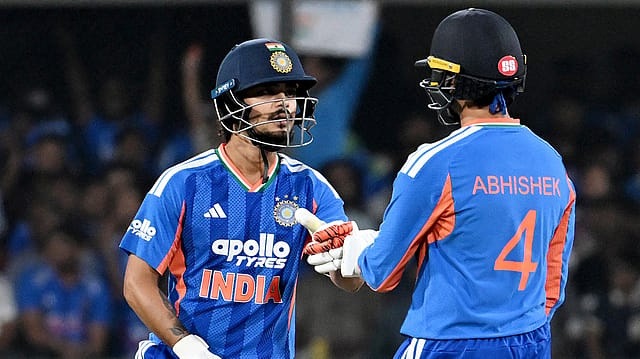
Sanju Samson was gone. India had barely started.
At Indore on Sunday, the opening wicket fell with seven runs on the board. Abhishek Sharma had a new partner, Ishan Kishan, and West Indies had an opportunity to tighten their grip.
Forty balls later, the two left-handers had added 108.
Abhishek finished with 69 from 30 deliveries. Ishan made 37 from 18. Between them, they struck 12 fours and six sixes. India’s innings would subsequently stumble, requiring contributions further down the order before the bowlers secured a 14-run victory. But the partnership had already supplied its most forceful image: two southpaws dismantling the same attack from the same side of the crease.
Afterwards, Abhishek described the approach India needed against a West Indies team capable of turning a match abruptly.
“We need to remain ruthless from here on, not let them off the hook,” he said, recalling the discussion as wickets fell during the chase.
Ruthless is a useful word for the batting, too.

Zeroing In on ECI
09 Oct 2026 - Vol 05 | Issue 41
Constitutional legitimacy versus political opportunism
Across contemporary cricket, a formidable collection of left-handed batters is making bowlers work through variations of the same problem. Abhishek’s early assault. Travis Head’s counterattack. Rachin Ravindra’s ability to build an innings. The different tempos of Yashasvi Jaiswal, Sai Sudharsan and Tilak Varma.
Their presence invites a question that is easier to ask than answer.
Is cricket experiencing a southpaw surge? And are the left-handers actually doing better?
TWO LEFTS MAKE A STATEMENT
Cricket has long valued a left-right partnership.
A single can require a bowler to adjust his line. Fielders change positions. A spinner who enjoys a favourable match-up against one batter may find the other harder to contain.
Wisden’s CricViz analysis of such combinations explains the tactical advantage: a bowling side cannot always sustain its preferred spin match-up when strike rotation brings a different-handed batter into play.
Indore offered another route.
Abhishek and Ishan did not make West Indies alternate between batting hands. Their partnership forced the attack to respond to two aggressive left-handers finding boundaries rapidly.
A batting combination’s success cannot always be explained by its geometry. Sometimes its greatest advantage is the quality of the two people occupying it.
There was a precedent in Abhishek’s franchise partnership with Head. In 2024, the Sunrisers Hyderabad pair helped produce a record T20 powerplay against Delhi Capitals, an assault documented by Wisden. Two left-handed openers had turned the first six overs into the innings’ defining event.
The contemporary southpaw story has been gathering force for several seasons.
INDIA’S MANY SHADES OF LEFT
India provides the richest starting point because its left-handed options offer such different batting personalities.
Abhishek and Ishan can attack at the top. Jaiswal brings the experience of substantial Test innings alongside his shorter-format aggression. Rishabh Pant supplies a distinctive middle-order method. Tilak and Sudharsan offer further ways of constructing an innings.
That variety is more revealing than simply counting left-handed names.
An innings can require immediate acceleration, recovery after wickets, control through the middle overs or an extended stay against a demanding attack. The current Indian pool contains left-handed batters whose strengths address different parts of that task.
Jaiswal’s emergence also gives the story a human dimension. The Guardian’s profile traced his journey from difficult circumstances in Mumbai into international cricket, placing his success within India’s expanding reservoir of young talent. His rise grew from opportunity, persistence and batting ability; the left-handed stance was one element of a much larger story.
The scoreboard reveals similar variety.
Sudharsan finished IPL 2025 with 759 runs at an average of 54.21 and a strike rate of 156.17. Abhishek scored 439 at 193.39. Both bat left-handed. Their seasons expressed markedly different balances between volume, scoring speed and dismissals.
“Southpaw” describes their stance. It cannot describe their entire game.
HEAD TAKES THE STORY GLOBAL
Head is the obvious international bridge.
His attacking white-ball batting is familiar. More recently, his move into Test opening has demonstrated how effectively that aggression can operate in a longer contest. According to the ICC, he finished the recent Ashes as the leading run-scorer with 629 runs.
His value to this story lies in that range. A discussion beginning with Abhishek’s powerplay assault can widen through Head into questions about how an attacking batter manages time, risk and opportunity in Tests.
New Zealand’s Ravindra supplies another central figure. England has Ben Duckett and the emerging Jacob Bethell. Pakistan has Saim Ayub and Fakhar Zaman. South Africa’s options include Ryan Rickelton, David Miller and Quinton de Kock. Sri Lanka brings Charith Asalanka and Kamindu Mendis; West Indies has Shimron Hetmyer and Sherfane Rutherford.
These players occupy different stages of their careers and different positions in their teams. Recent profiles, selections and reporting establish the continuing relevance of several central figures, including Ravindra, Ayub, Asalanka and Miller.
Together, they give the southpaw story a substantial international cast. Their methods, however, resist being bundled into a single movement.
Franchise cricket adds another layer.
Nicholas Pooran remains part of the left-handed batting conversation there, although he retired from international cricket in June 2025. A batter can leave his national side while continuing to influence the global T20 game.
THE RIGHT-HANDERS HAVE AN ANSWER
A compelling list of left-handers can tempt a writer into declaring a takeover.
The 2026 T20 World Cup offers a firm objection.
Its leading run-scorer was Pakistan’s right-handed Sahibzada Farhan, who made 383 at an average of 76.60. Player of the Tournament Sanju Samson, also right-handed, scored 321 in just five innings.
Ishan made 317 at a strike rate of 193.29, finishing fourth on the aggregate list and earning a place in the ICC’s Team of the Tournament.
A left-hander delivered exceptional scoring speed and a substantial aggregate. Right-handers supplied the highest aggregate and the tournament’s outstanding individual award winner.
The contest remained open.
IPL 2025 offers another useful comparison because it places players in the same competition. Sudharsan and Shubman Gill make an especially revealing pair: teammates, opening partners and almost identical scoring rates.
Sudharsan’s 759 runs came at 156.17. Gill’s 650 came at 155.88. The left-hander finished with a higher aggregate and average, while their scoring speeds were separated by less than a third of a run per 100 balls.
Elsewhere, right-hander Mitchell Marsh made 627 runs at an average of 48.23 and a strike rate of 163.71. Pooran scored 524 at an average of 43.67, but his strike rate climbed to 196.25. Abhishek’s 439 came at an average of 33.77 and a rate of 193.39.
Pooran and Abhishek occupied a faster scoring bracket. Marsh combined a substantial aggregate with a rate above those of the Gujarat openers. Sudharsan supplied the largest total among this group.
Change the measure, and the comparison changes.
Establishing an advantage for left-handers collectively would require a wider sample, with batting position, opposition and opportunity taken into account. The individual performances show how strongly southpaws feature in the contest. They do not settle it.
WHAT THE ANGLE CHANGES
There are reasons to investigate a left-handed advantage.
Research examining the 2003 World Cup found greater batting success among left-handers and linked the advantage to bowlers’ relative unfamiliarity with them. Its conclusions concern that tournament and cannot simply be transferred to every contemporary competition.
The principle remains useful: opponents practise and play against some types of batter more frequently than others. Familiarity can influence preparation.
Batting hand also affects bowling match-ups. An off-spinner’s delivery can move away from a left-hander, creating a different challenge from the one faced by a right-hander. Wisden’s historical examination of England’s options against Ravichandran Ashwin demonstrated how a batting order containing several left-handers could give a particular bowler an inviting contest.
Left-handed batting carries possibilities and vulnerabilities. Its value depends partly on the attack, the surface and the batter’s method.
There is another distinction beneath the terminology. Batting left-handed does not necessarily mean being left-hand dominant in everyday life. Research into batting stance has examined players who bat with the opposite stance to their natural handedness, suggesting that this deserves consideration alongside the conventional left-versus-right question.
The stance is visible. The reasons for success are less easily isolated.
THE OLD LINEAGE, THE NEW ASSAULT
Cricket’s left-handed greatness has a long history.
Brian Lara, Kumar Sangakkara, Adam Gilchrist, Sourav Ganguly and Chris Gayle supplied very different models of it. The current generation has inherited a tradition expansive enough to accommodate patient accumulation, extravagant strokeplay and overwhelming force.
What makes the present story compelling is the concentration of prominent left-handed batters, particularly in India, and the variety of demands they can meet.
Abhishek provides the immediate image.
A wicket had fallen early in Indore. Another left-hander joined him. In 40 balls, they added 108.
The performance demonstrated how forcefully two southpaws could impose themselves on a match. The wider scoreboards make their rivalry with right-handers more absorbing. Farhan has the World Cup runs. Samson has the award. Sudharsan has his season of accumulation. Head has carried his aggression into Test opening.
And Abhishek, asked about the approach required to keep a dangerous opposition under pressure, had a word for it. Ruthless.