Why IPL Fans Never Switch Teams: The Psychology Behind Franchise Loyalty
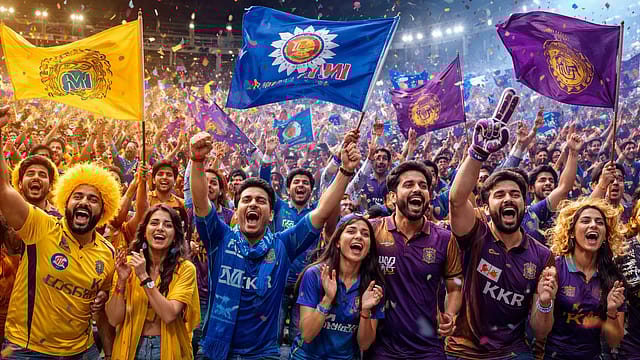
It is the last over of a do-or-die IPL eliminator. Mumbai Indians, five wickets down, need twenty-two runs. They lose. Comprehensively, embarrassingly, without drama. And yet, the following morning, millions of MI fans across the world update their profile pictures with the team's blue logo and write, simply: 'Next year.' No anger. No abandonment. No switching allegiance to a team that actually won.
This is not blind loyalty. It is not even irrational. It is, as sports psychologists and behavioural economists have spent decades documenting, one of the most deeply wired aspects of human identity. Why do fans stay? The answer is part neuroscience, part sociology, part childhood memory, and it tells us something profound about how brands, not just cricket teams, can build relationships that last a lifetime.

Zeroing In on ECI
09 Oct 2026 - Vol 05 | Issue 41
Constitutional legitimacy versus political opportunism
The Tribal Brain
We Are Wired to Pick a Side
Henri Tajfel's Social Identity Theory, developed in the 1970s, established that human beings derive a significant portion of their self-esteem from the groups they belong to. When your team wins, your brain releases dopamine - the same chemical triggered by food and social approval. You did not score that century. Rohit Sharma did. But your brain, scanning for community validation, logs it as a win for your tribe.
This is the neurological foundation of fan loyalty. Once a team becomes part of your identity, once you have said 'we' instead of 'they' when discussing Chennai Super Kings, the psychological cost of switching is enormous. It is not switching channels. It is switching sides. It feels like a betrayal of self.
Dr. Daniel Wann, a sports psychologist at Murray State University and one of the foremost researchers on fan psychology, has shown that highly identified fans experience victory and defeat almost identically to the players themselves. Their cortisol levels spike after losses. Their testosterone rises after wins. They are, in every measurable physiological sense, in the game.
The Childhood Lock-In
When You Choose a Team, You Choose for Life
Ask any passionate IPL fan when they started supporting their team. The answer is almost always rooted in childhood or adolescence. A father who watched Sachin Tendulkar bat for Mumbai. An uncle in Chennai who took you to Chepauk for the first time. A cousin who had an MS Dhoni poster. These early associations are not preferences - they are identity anchors.
Research in developmental psychology suggests that brand and team affiliations formed before the age of eighteen are extraordinarily resistant to change. The part of the brain responsible for self-concept, the medial prefrontal cortex, encodes these early associations deeply. Supporting Royal Challengers Bengaluru is not something you do. It is something you are. Manchester United has not won the Premier League since 2013. Their global fanbase has not shrunk, but it has grown. The Dallas Cowboys of the NFL have had prolonged championship droughts yet remain the most valuable sports franchise on earth. The pattern repeats across every major sport: bad seasons do not destroy loyalty because loyalty was never built on winning. It was built on identity.
The 'BIRG and CORF' Effect
Sports psychologists use two elegant acronyms to describe fan behaviour around outcomes: BIRGing (Basking in Reflected Glory) and CORFing (Cutting Off Reflected Failure). After a win, fans BIRG — they wear their jerseys, post loudly, celebrate their team's glory as their own. After a loss, fans CORF — they distance themselves slightly, say 'they lost' rather than 'we lost,' go quiet on social media.
Crucially, CORFing is not switching. It is protective distancing. The fan remains a fan. They are merely managing psychological pain. This is why IPL franchises should not interpret post-defeat social media silence as disengagement but as a fan temporarily protecting themselves before returning, as they always do, for the next match.
From Anfield to Eden Gardens: A Universal Story
Liverpool FC fans endured twenty-six years between league titles. During those decades, Anfield remained sold out. Merchandise continued to sell globally. The phrase 'You'll Never Walk Alone' was sung with undiminished conviction. The club understood that what it was selling was not trophies, it was belonging.
The Green Bay Packers of the NFL offer perhaps the most extreme example of loyalty as identity. A small-market team in Wisconsin, the Packers are community-owned and have a waiting list for season tickets estimated at over 100,000 names. People inherit spots on the waiting list. They bequeath them in wills. The team is not entertainment. It is heritage. In India, the parallel is CSK. When the franchise was suspended for two years following the 2013 spot-fixing controversy, fans did not migrate to other teams. They waited. They wore yellow. They counted down. When CSK returned in 2018, they won the championship but even if they had not, the reunion would have been celebrated with the same fervour. The bond was not transactional.
What Clubs Should — and Should Not — Do
Understanding the science of loyalty has direct implications for how IPL franchises should behave. First, they should never assume that a winning season builds loyalty, or that a losing season destroys it. Loyalty is built through consistency of identity, narrative, and community and not through the points table.
Second, franchises should invest heavily in the rituals that reinforce tribal identity: consistent colour schemes, iconic anthems, accessible legends who become ambassadors, and fan engagement that makes supporters feel genuinely seen. Mumbai Indians' 'One Family' campaign and CSK's 'Whistle Podu' are not slogans. They are identity badges.
Third, and perhaps most importantly, franchises must resist the temptation to rebuild their identity after a poor season. The worst thing a team can do is change its logo, alter its colours, or abandon its narrative in a panic response to a bad year. Fans are loyal to the identity they chose. Change the identity, and you change the contract.
The science is clear: in sports, loyalty is not earned by winning. It is earned the first time a child pulls on a replica jersey, sits with their family in front of a television, and decides, consciously or not, that this team is their team. Everything after that is just management.