VAR Under Fire Again as Argentina's FIFA World Cup Run Sparks ‘Bias Towards Messi’ Claims
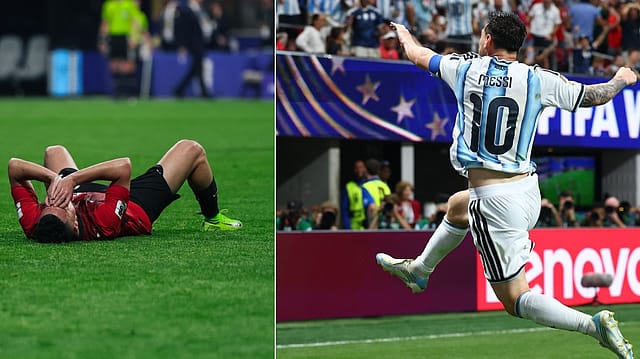
Referee controversies have followed Argentina's World Cup campaigns like a shadow that simply refuses to lift, and Tuesday's dramatic Round of 16 victory over Egypt has only deepened that shadow into something far more contentious.
Argentina scraped past Egypt 3-2, scoring three goals in the final 13 minutes to complete a stunning comeback and book their place in the quarter-finals.
But the result was quickly overshadowed by serious accusations from the Egyptian camp, who insisted the officiating had robbed them of a historic upset.
Look Who's Talking Regime Change
23 Oct 2026 - Vol 05 | Issue 43
Egypt forward Mostafa Ziko did not hold back in his post-match comments, alleging that the tournament itself was rigged in Argentina's favour. "It was not fair from the referee. He wasted all of our efforts with his decisions... The cup is directed towards Argentina," Ziko said.
Egypt coach Hossam Hassan went further still, directly accusing FIFA of manipulating the competition to keep the defending champions alive.
"Perhaps they wanted the world champions to stay in the competition. Perhaps they wanted Messi to stay in the running," Hassan said. "I'll never watch the World Cup again, because there's no justice in this competition."
Hassan also suggested that forces beyond the game itself had shaped the outcome. "In football, there are sometimes external factors that go beyond the technical aspects. The world champions received support at every level," he said.
The flashpoint that triggered this outrage came 13 minutes into the second half, when Ziko thought he had found the net.
VAR intervened after replays showed Egypt defender Marwan Attia grabbing the shirt of Lisandro Martinez and stepping on his foot, nearly 100 yards from Argentina's goal. Referee Letexier ruled the goal out following an on-field review, judging that the contact occurred during the attacking phase that led to the goal.
That single decision has since become the focal point of Egypt's grievances, and it has drawn sharp criticism from respected voices within the officiating world.
Former Premier League referee Graham Scott, writing for The Athletic, argued that the contact amounted to nothing more than the kind of routine physical duel seen throughout football, and did not merit VAR intervention.
Scott noted that the further removed an incident is from the eventual goal, both in distance and time, the clearer and more significant the offence needs to be to justify overturning the goal, pointing out that Argentina had ample opportunity to reorganise defensively before the ball hit the net.
Fernando Guerrero, who refereed at the 2022 World Cup, offered an even more pointed assessment on social media.
"There was no foul on the Argentine player, and even if they considered it a foul, it should not have been reviewed as part of the APP (Attacking Possession Phase), because Argentina had plenty of time, space and their defenders were properly positioned," Guerrero wrote.
"The Argentine team had three opportunities to recover the ball and failed to do so. Therefore, the decision goes completely against the VAR protocol, which states that officials should only intervene when there is a clear attacking sequence and the team that lost possession has no realistic chance of regaining the ball,” he added.
“VAR and the referee made a mistake, harming Egypt and ultimately contributing to their elimination,” Guerrero said.
Adding another layer to the debate, FIFA's head of refereeing, Pierluigi Collina, had said earlier last week that officials had been told to let normal physical contact go unpunished in order to speed up the pace of matches.
That guidance, if applied evenly, raises uncomfortable questions about whether Ziko's disallowed goal should have counted at all.
The wider frustration extends beyond Tuesday's match. Critics have pointed to Messi's record-breaking goal against Austria in the group stage as another example of inconsistent officiating.
In the buildup, Alexis Mac Allister lunged in from behind and floored Xaver Schlager without playing the ball, yet the referee allowed play to continue despite Austrian protests, and no VAR review was recommended before Messi scored.
Speaking on Fox Sports, Peter Schmeichel was blunt about the missed call. "I don't think that goal should have stood. Think about how they got the penalty. It was a kick from behind by a player. There goes Xaver down, and that should have been a free kick, but it went on to the goal from there. VAR should have taken that back. It was a clear and obvious mistake," Schmeichel said.
Egypt also felt they should have been awarded a penalty shortly before Enzo Fernandez scored the winner. Mohamed Salah went down in the Argentinian box after slight contact on his boot, while another Egyptian attacker appeared to have his shirt tugged inside the area.
Neither moment was sent for VAR review. Ian Wright, speaking on ITV Sport, questioned why the same standard wasn't applied.
"That's what's happening with VAR now, they're pulling it back. If you're going to pull it back for Argentina on the edge of the box to disallow a goal, you have to pull it back for this one with Mo Salah. He's been caught. Whatever we say, it might be minimal, he's been caught and then they go up the other end," Wright said.
A further incident from the group stage has also resurfaced in the discussion, a challenge by Messi against Algeria that escaped VAR review entirely, let alone consideration for a red card. Algeria reportedly filed a complaint with FIFA over the incident but as per reports, received no response.
This pattern of controversy is not new to Argentina's World Cup story. It first took hold during the 2022 tournament in Qatar, when Argentina's opening defeat to Saudi Arabia drew scrutiny over the amount of stoppage time added as the South Americans searched for an equaliser.
Days later, in the group match against Poland, Dutch referee Danny Makkelie awarded Argentina a penalty for a challenge on Messi after a VAR review, a call Rio Ferdinand described on the BBC as a "disgraceful and outrageous decision."
None of these individual moments confirmed any wrongdoing, but collectively they built a narrative that has persisted well beyond that tournament.
The controversy surrounding this World Cup has also taken on a political dimension. Simon Chadwick, professor of Afro-Eurasian sport at the Emlyon Business School in Shanghai, told Al Jazeera that trust in the tournament's officiating has been eroded.
"After the Balogun affair, who knows which decisions are legitimate and can be trusted, and which can't?" Chadwick said.
He went on to draw a connection between political alliances and perceptions of bias. "If the Trump administration is maintaining a watching brief over the tournament, it's worth remembering: Argentina's president, Javier Milei, is a staunch Trump supporter," he said.
Milei is known to be a regular presence at pro-Trump gatherings in the United States, and Trump has previously called him his "favourite president."
Chadwick also suggested that Hassan's outspoken support for Palestine during the tournament may have influenced perceptions among officials, saying it could have prompted some to "have built-in biases when making decisions."
Hassan had used part of his pre-match news conference on Monday to make an impassioned plea on behalf of the people of Gaza.
Every major tournament generates its share of refereeing disputes, and this World Cup has proven no exception, with inconsistency in decision-making emerging as one of its recurring themes.
Whether Argentina have genuinely been favoured by officials or have simply landed at the centre of football's most heated conversations remains a question that will likely outlast the tournament itself.
What is certain is that Tuesday's match against Egypt has reignited a debate that first took root in Qatar, and FIFA's refereeing department can now expect every decision involving Argentina to be examined more closely than ever before.