The Sabalenka Problem: How Elena Rybakina Rose to Rule Women’s Tennis
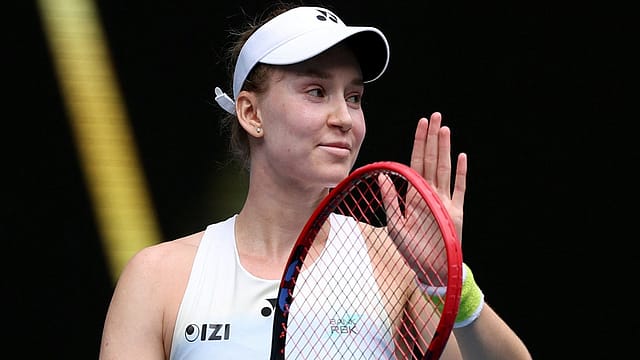
The first championship point disappeared with a double fault.
Elena Rybakina had arrived at the edge of her first US Open title and served herself another moment of uncertainty. Across the net stood Aryna Sabalenka, the two-time defending champion, a woman whose chances of survival were best treated seriously until the last ball.
Rybakina served again.
Ace.
There was the championship, compressed into two points: an opening for doubt, followed by a ball nobody could touch.
Her 6-4, 5-7, 6-2 victory at Arthur Ashe Stadium on September 12 gave the Kazakh her third Grand Slam title. It also completed a remarkable double. Both hard-court majors of 2026 had ended with Rybakina beating Sabalenka in the final. Melbourne in January. New York in September. The same opponent waiting at the most consequential doorstep.

Zeroing In on ECI
09 Oct 2026 - Vol 05 | Issue 41
Constitutional legitimacy versus political opportunism
On Monday, September 14, Rybakina will become world No. 1 for the first time, the first player representing Kazakhstan to lead the singles rankings. She had secured that distinction by reaching the semifinals. The final supplied a striking sporting endorsement: the incoming No. 1 beating the woman she was replacing, on the court Sabalenka had made her own.
And yet, to understand how Rybakina reached this moment, it helps to leave the trophy presentation and return to a much smaller space.
A hotel room. A gym. Another appointment about an ankle.
Little more than three weeks earlier, an injury had forced her out of Cincinnati. In New York, an MRI and consultations with doctors left her participation uncertain. She spent a week moving between her hotel and rehabilitation work, according to her account after the final.
Before she could consider taking Sabalenka’s championship, she needed to discover whether her body would let her compete for it.
That uncertainty belongs in Rybakina’s story. From the other side of the television screen, her tennis can look almost inconveniently uncomplicated: the serve, the clean contact, the restrained expression. The career behind it has required considerably more negotiation.
Born in Moscow, Rybakina began playing tennis at six. Her first WTA title arrived in Bucharest in 2019. Early in 2020, she reached four finals in her first five events, including a title in Hobart, before the pandemic stopped the tour. Her progress was becoming visible just as professional tennis itself became unavailable.
An earlier decision had made that professional life more sustainable. In 2018, she switched to representing Kazakhstan, whose federation offered financial support. After winning Wimbledon four years later, she credited the federation and its president, Bulat Utemuratov, with helping her continue her career.
For a developing player, funding buys the opportunity to keep finding out: another tournament, another training block, another season in which potential might become something tangible.
At Wimbledon in 2022, it became a Grand Slam title.
Rybakina recovered from losing the opening set against Ons Jabeur to win the final 3-6, 6-2, 6-2. The comeback established something that would become familiar in her biggest matches: a difficult passage could be contained before it swallowed the entire contest.
Then came the harder assignment of reproducing that level across seasons. Injury and illness disrupted her in 2024. At the 2025 Australian Open, a back problem troubled her before a fourth-round defeat to Madison Keys. The question of how consistently she could compete accompanied the question of how well she could play.
By late 2025, the results were gathering force. She won Ningbo, then completed an unbeaten run through the WTA Finals in Riyadh. In 2026 came the Australian Open, Stuttgart and runner-up finishes at Indian Wells and Toronto. The ranking challenge grew through accumulated weeks of work.
Sabalenka kept appearing at the sharpest turns.
Their history contains an essential complication for anyone tempted to declare Rybakina her inevitable conqueror. Sabalenka won their first Grand Slam final, at the 2023 Australian Open, recovering from a set down. Rybakina had experienced the other side of this contest: playing well enough to reach a major final and watching Sabalenka finish stronger.
By the time they met in Melbourne again this January, Rybakina had beaten her in the Riyadh final. Even then, the Australian Open title threatened to escape. Sabalenka led 3-0 in the deciding set.
Rybakina recovered. She won 81 per cent of her first-serve points in that set and eventually closed the championship with an ace. The tournament’s analysis recorded another revealing advantage: she won 79 rallies lasting four shots or fewer, against Sabalenka’s 72.
Those numbers help explain the matchup. Against a player who wants to seize control early, Rybakina can contest the first few exchanges on equal terms. Her serve can prevent the rally from becoming a negotiation at all. When the ball comes back, she has the pace to make the next shot uncomfortable.
For Sabalenka, that changes the value of power. A forceful strike may return with enough speed and depth to demand another forceful strike, this time from a less comfortable position. The margin between taking charge and attempting too much becomes smaller.
Sabalenka found a way through at Indian Wells in March. Facing championship point in the deciding tiebreak, she produced a backhand winner and went on to take the title. That victory ended a run of four consecutive tour-level final defeats against Rybakina. She beat her again in the Miami semifinals.
This is what gives the rivalry substance. Each player has evidence that her game can prevail. Each has also left the court with a specific problem to solve before the next meeting.
New York asked Rybakina several questions before allowing her another shot at Sabalenka. She beat Naomi Osaka in the fourth round, then recovered from a set down against both Zheng Qinwen and Coco Gauff. The ankle held up. So did her ability to restart a match that had begun moving away from her.
Her composure is easy to notice and harder to interpret. Earlier in the fortnight, she acknowledged the stress surrounding her fitness. A restrained face tells the spectator relatively little about what a player feels. The useful evidence is what she does after the setback. Against Zheng and Gauff, she constructed a way back.
Against Sabalenka, she had to do it again after losing the second set.
The final also challenged the idea that Rybakina requires an immaculate serving performance to win. She landed fewer than half her first serves, yet created 12 break-point opportunities and converted three. Her returning kept asking questions even when her primary weapon was inconsistent.
She finished with 12 aces, 36 winners and 24 unforced errors. Sabalenka generated only three break points, all late in the second set. Those figures locate the difference more precisely than a comparison of facial expressions: Rybakina sustained pressure across more of the match.
The serve still mattered enormously. So did the work that allowed her to compete when it was missing. That combination makes an opponent difficult to dislodge: interrupt one route to winning points and another remains available.
For Sabalenka, the loss carried the weight of a third successive US Open title that would now remain beyond reach. Afterwards, she acknowledged the difficulty of managing that ambition during the match. A champion can understand pressure intimately and still struggle with it on a particular afternoon.
The updated rivalry numbers capture her predicament. Sabalenka still leads their overall meetings 10-8. Rybakina leads their finals 5-2.
The distinction is substantial. Across their careers, Sabalenka has won more often. When the meeting ends with a trophy presentation, Rybakina has increasingly been the one asked to stay for photographs.
Monday brings Rybakina a different assignment. Rankings reward a rolling body of results; maintaining the lead requires replenishing it. Fitness, recovery and the capacity to win difficult matches will continue to matter after the celebration.
Her recent record offers grounds for confidence. Before the closing rounds in New York, the WTA counted 16 victories over top-10 opponents in the preceding 52 weeks. The challenge to Sabalenka had grown within a broader challenge to the elite.
Now those opponents have fresh evidence to study. Sabalenka has two major finals from this season to revisit, alongside the Indian Wells match that proves a reply remains possible.
At Arthur Ashe Stadium, Rybakina supplied the latest lesson in the smallest possible sequence. A double fault gave the championship another point to run. An ace brought it home.
With inputs from ANI & agencies