Soma Sutra: Milind Soman opens up about his Pinkathon initiative
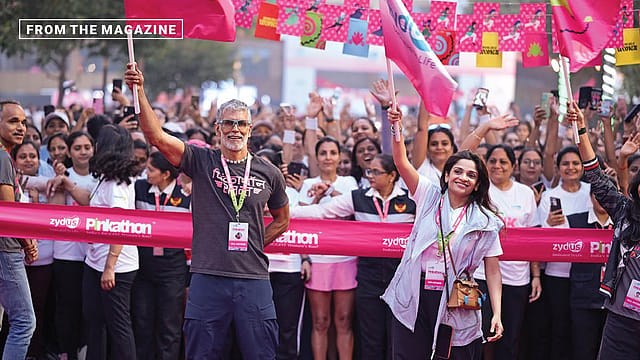
Milind Soman has worn many hats through his life. A swimmer who was Indian national champion in the men’s 100m breaststroke for several years, a supermodel who became almost every straight Indian woman’s crush when he appeared in the music video Made in India, and later a successful actor in television shows and films. Yet, over the last two decades, it is as a fitness icon that Soman is best known. He runs marathons and Ironman competitions, swims in oceans, and runs and cycles vast distances across terrains, as if all of these were unremarkable excursions in the neighbourhood park. And he does all of this at the age of 60.
Unlike other Indian supermodels who came of age in the 1990s, almost all of whom have since vanished from the public eye, Soman continues to remain sharply visible. It may appear that his reinvention from pin-up model to fitness icon is unlike any other, but there was never really any reinvention. Fitness, for Soman, was always an essential part of his life. “It is like eating or breathing or working,” Soman says over the phone. “You don’t have to remind yourself to eat or breathe or work. Exercising and working out is like that to me.”

Zeroing In on ECI
09 Oct 2026 - Vol 05 | Issue 41
Constitutional legitimacy versus political opportunism
Soman is on the road, travelling with his wife Ankita Konwar between Cervia and Milan in Italy, in a car. He has just completed two gruelling Ironman competitions, with just six days of rest between them, but there isn’t a hint of exhaustion in his voice. “These kinds of events are a good way to judge yourself. To judge how well your body can bounce back,” he says. “Any kind of endurance event is a test, really. It allows you to identify your strengths and weaknesses. You have to then work on the weaknesses, not really the strengths.”
The first of the Ironman competitions was in Wales, considered one of the toughest in the circuit. It involves a 3.8km open-water sea swim in Tenby that is often choppy and rough, followed by a 180km bike course over rolling hills with an elevation gain of over 8,000 feet, and then finally a 42.2km marathon through the town’s narrow and twisting streets. To make matters worse, it had just rained, and the bike course, with its sharp turns, was also slippery. Konwar would suffer a fall and hurt her knee during that course, and although she wouldn’t be able to complete the competition, she would go on to finish the next Ironman, in Italy, with an injured knee, just six days later. Even Soman, who has completed many Ironman competitions, found the going tough in Wales. “By the time I completed the cycling section, I could not feel my legs. And I didn’t know how I was going to do the marathon,” he says. “But I kept going.” He didn’t just keep going. Six days after that physically and emotionally draining event, he would go on to complete the next Ironman, in Cervia, alongside Konwar.
Why would anyone sign up for two almost back-to-back Ironman competitions, including one reputed to be the toughest in the circuit? “That’s Ankita,” Soman says with a laugh. “She picks the events. I just pack up and go.”
Konwar had completed her first Ironman in Barcelona the previous year, and having found the experience enjoyable—although not as difficult as she had feared—she had suggested they pick a tougher one for this year. “We just literally Googled ‘toughest Ironman’,” Soman says. That’s how Ironman Wales popped up, and the couple added the one in Italy for good measure.
For all their public image as a jet-setting couple, conquering one Ironman after another, their devotion to their health and fitness absolute, the two have also been putting special emphasis on encouraging women to pursue a fitter life, through their Pinkathon initiative, nowcalled Zydus Pinkathon, after the global lifesciences company came on board as title sponsor. Established first as a running event for women in Mumbai in 2012, it has since grown rapidly, with editions held across multiple cities. Since it has multiple categories, from 3km to 100km, it also witnesses wide participation, right from the novice runner to the seasoned athlete.
Soman says he started the movement when he noticed that although the running bug was catching on in India, women’s participation remained very low. “Back in 2012, women’s participation would be somewhere between 4 and 7 per cent at running events,” he says. Soman reckoned that if he could put together an event solely for women—a space that would be free from judgement, one that fostered a sense of community—then it would catch on. There were those who doubted it would take off. “After the success in Mumbai, when we took the event to other cities, people would say, ‘Oh, this isn’t Mumbai. It won’t work here.’ When we took it to smaller cities, people would say we shouldn’t hold the event on Sundays, and certainly not in the mornings. That women pray in the mornings, or have to cook for the family,” Soman says. “You should see the event now. The whole atmosphere and excitement, everyone jumping and dancing… We also see amazing athletes. We have had a 68-year-old complete the 100km category; a 76-year-old finish the 50km category.”
Like many other offline events, this too had a stutter during the pandemic, but it has since bounced back. It will be held across 15 cities this year. And one event, observed as Pinkathon Day this October 25, will take place simultaneously across 162 locations in 64 cities. Soman hopes that ZydusPinkathon will keep growing, eventually to around 52 cities, with an event taking place every Sunday. He sees no reason why this shouldn’t come to pass. To him, the initiative is a growing movement, one in which empowered women are taking control of their own lives and health.
For all of Soman’s push to pursue a healthier life, he hasn’t always led an entirely healthy lifestyle himself. When he stopped swimming competitively and became a model in his early 20s, some bad habits crept in. Although he remained physically active even during this period, in his book Made in India he discusses the abuse heaped upon his body by leading an “easy” and “louche” life. There was alcohol, drugs, cigarettes, endless cups of sweet tea and late-night parties. But by 27, he says, he had grown bored of it all and put an end to most of this, except for smoking, which stuck on till about his late 30s. Although Soman remained physically fit even during this period, it was in 2004 when the Mumbai Marathon was set to hold its first edition that Soman, then 37, decided to try out the half-marathon. His body held up better than expected. Although Soman admits he had hated running all his life, in his late 30s, he discovered a new love for it. “The half-marathon became a 25km, then a 30km, then a full marathon. After I finished the full marathon, I ran a 50km, then after that a 60km. Once that was done, I did a 100km, followed by a 100 miles. Then I ran from Ahmedabad to Mumbai, then Delhi to Mumbai,” he says. This passion has only continued to grow.

What makes Soman so popular among those who look up to him is his uncomplicated approach to fitness. He isn’t fond of gyms, so he will spend no more than 10 to 12 minutes every day doing simple routines like press-ups, pull-ups and planks. Apart from this, he will go on runs two or three times a week, and for swims about two or three times a month. He avoids packaged and refined food; otherwise there are no restrictions on his diet. “People often ask me if I eat biryani. Of course, I do. I eat pizzas, burgers, even cakes and other sweets,” Soman says, although he adds that he limits these indulgences, sometimes only choosing to consume them if they are exceptional in taste. For the last two years, Soman has also been pursuing intermittent fasting, where he consumes food only within an eight-hour window. Since adopting this form of fasting, he says, instead of feeling tired, as is often commonly believed, he has begun to feel even more energetic. “When you follow this, you begin to realise that the hunger pangs you feel are really your body reacting not to the need for food but to the time when you eat it. I want my body to respond to the need for food, not to the time of eating,” he says.
Since Soman defies the notion that one’s body becomes more fragile and less capable with age, I ask him for his views on fitness and ageing. Isn’t the tangible loss of physical capability and freedom an inescapable aspect of ageing, or are we exacerbating this decline by not challenging it the moment we cross a certain age milestone? Soman says the deterioration of the body is an inescapable fact. “We start declining immediately after we reach our peak. So right after we cross 25, there is deterioration; but it is only later when we start noticing it,” he says. “What we can do is decelerate, to slow it down, by remaining physically fit.”
There is, however, no one-size-fits-all approach to fitness, he says. “It’s like fingerprints. Just like how every individual has his or her own unique fingerprint, people also have their own unique bodies,” he says. “You have to find your strengths and weaknesses. Then work on those weaknesses.”