From Siberia at -45°C to Tennis World No. 3: Meet Mirra Andreeva
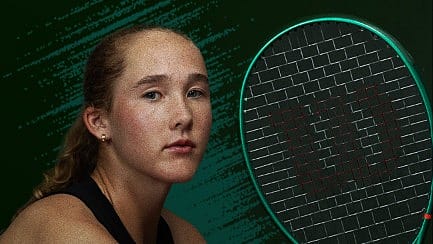
Aryna Sabalenka was leading 4-1 when Mirra Andreeva began changing the shape of the match.
She lifted the ball higher. She took pace away, then returned it without warning. She found angles that forced the world No. 2 to hit while moving and gave her no reliable rhythm to attack. Sabalenka kept swinging. The court around her seemed to keep changing.
Sixty-two minutes after the match began at Indian Wells, it was over.
Andreeva had won 6-4, 6-0. She had taken the final 11 games, captured 45 of the last 55 points and reached the semifinals on her singles debut at the WTA Finals. Sabalenka, a four-time major champion, won only 10 points after establishing her double-break advantage.

The Wealth Issue 2026
06 Nov 2026 - Vol 05 | Issue 45
Portraits of Dreamers and Doers under 35
Andreeva hit 16 winners and committed six unforced errors. Sabalenka made 23. The contrast suggested a seasoned champion managing a gifted but volatile challenger.
The seasoned player was 19.
“I feel like Aryna did not have the best day,” Andreeva told Sky Sports afterwards. “I feel like I cannot really take all the credit today. I feel like that is not very fair in some ways.”
It was gracious. It also understated what had happened.
Sabalenka’s level fell because Andreeva kept asking questions she could not answer. The Russian did not attempt to defeat one of the sport’s most destructive hitters through a louder version of the same game. She made power uncomfortable.
That is the quality separating Mirra Andreeva from the long procession of prodigies introduced as the future of women’s tennis. She has already arrived with a Grand Slam title, six WTA singles trophies, an Olympic silver medal and a world No. 3 ranking. Her age attracts attention. Her mind wins matches.
The match that sent two Siberian girls towards tennis
Andreeva’s journey began before she was born.
In January 2005, her mother Raisa watched Marat Safin play Roger Federer in an Australian Open semifinal. Safin saved match point and eventually defeated Federer 9-7 in the fifth set after more than four hours of dramatic tennis.
The match captivated Raisa. She decided tennis could offer her daughters a future.
Mirra was born on April 29, 2007, in Krasnoyarsk, a Siberian city where she remembers winter temperatures falling to minus 45 degrees Celsius and summer days rising to 35. Her older sister Erika had already been introduced to tennis. Mirra began playing at six and followed the path being created ahead of her.
The family later moved the girls to Sochi, where the climate and facilities allowed more serious training. In 2022, they left Russia for the Elite Tennis Center in Cannes.
Their agent had suggested two possible academies. One was Rafael Nadal’s academy in Mallorca. The other was Cannes, where Daniil Medvedev had also trained. The sisters tried Cannes first, liked it and never made the second inspection trip.
Mirra was 15. She had already begun accumulating victories on the lower circuit, winning four ITF titles in 2022 with a 39-9 record. Within two years, she would defeat the world No. 2 at Roland Garros and reach her first major semifinal.

A teenager arrives before tennis is ready
Andreeva’s public breakthrough came at the 2023 Madrid Open. Ranked outside the top 150 and playing as a wildcard shortly before her 16th birthday, she beat Leylah Fernandez, Beatriz Haddad Maia and Magda Linette to reach the fourth round.
Her results attracted attention. Her interviews made people stay.
She spoke with the unfiltered candour of a teenager who had not yet learned the cautious grammar of professional sport. She admitted that she found Andy Murray “beautiful”. When the former world No. 1 later praised one of her comebacks online, Andreeva said she wanted to print the post, frame it and carry it wherever she went.
She qualified for the 2023 French Open and Wimbledon, reached the third round in Paris and the fourth round in London, and finished the year ranked No. 46 after beginning it just inside the top 300. The WTA named her its Newcomer of the Year.
She also showed how much growing remained.
During her French Open defeat by Coco Gauff, Andreeva struck a ball into the crowd in frustration and later called it a “stupid move”. At Wimbledon, she received two code violations during a three-set loss to Madison Keys. The second produced a point penalty at match point. She argued that she had slipped rather than thrown her racket and walked past the umpire without shaking her hand. Wimbledon fined her $8,000.
The talent was visible. Emotional control was not yet dependable.
Andreeva said she held a long conversation with herself after losing to Gauff. She thought about the decisions required when trailing badly, the mental responses available to her and the difference between feeling frustration and surrendering to it.
The work did not eliminate her temper. It began teaching her how to use it.
The Conchita Martínez effect
Andreeva began working with Conchita Martínez in 2024 after her agent suggested the former Wimbledon champion and world No. 2.
The partnership quickly acquired the public warmth of a cool aunt travelling with an irrepressible niece. Andreeva teases Martínez during interviews, persuades crowds to sing “Happy Birthday” to her and watches old matches that her coach would prefer forgotten.
Beneath the humour sits a serious arrangement.
Martínez identified Andreeva’s backhand as naturally reliable but wanted more intensity in her footwork, greater authority from the forehand and a willingness to move forward. She also wanted the teenager to understand that affection did not remove hierarchy. They could joke away from practice. On the court, Andreeva had to listen.
“We can be hard on each other,” Andreeva told the WTA. “I know that she’s my coach, that I have to be respectful, that I have to listen to what she says.”
Martínez has been equally clear that anger itself is not the enemy. A player can become upset. The danger begins when negativity overwhelms judgement. Andreeva has also worked with a sports psychologist to find safer releases for the emotion that once travelled through her racket.
The progression under Martínez has been extraordinary.
Andreeva won her first WTA title at Iași in 2024 and reached the French Open semifinals after upsetting Sabalenka in the quarterfinals. She and Diana Shnaider won women’s doubles silver at the Paris Olympics.
In 2025, she won consecutive WTA 1000 titles in Dubai and Indian Wells. At 17 years and 299 days, she became the youngest champion since the WTA 1000 category was introduced in 2009. The Indian Wells title required another victory over Sabalenka, this time in the final.
By then, the teenager who had entered 2023 outside the top 300 had reached the top 10.
Paris turns a prodigy into a champion
Andreeva began 2026 by winning in Adelaide. She added the Linz title and entered the European clay season with growing evidence that her favourite surface also provided the clearest expression of her game.
Clay rewards patience, construction and disguise. It gives Andreeva time to read an opponent and enough court to stretch a rally beyond its obvious conclusion.
At Roland Garros, she defeated Sorana Cîrstea in the quarterfinals and Marta Kostyuk in the semifinals, conceding only seven games across the two matches. Polish qualifier Maja Chwalińska awaited in the final.
Andreeva won 6-3, 6-2 in 82 minutes. At 19 years and 39 days, she became the youngest women’s champion at Roland Garros since Monica Seles won the third of her consecutive titles in 1992.
The comparison carried historical weight. Seles, another player born in the former Yugoslavia and developed as a teenage phenomenon, won eight major titles before turning 20. Women’s tennis no longer regularly produces champions that young. Physical demands have increased, careers last longer and established players possess teams built to detect every weakness.
Andreeva did not inherit a depleted field. She climbed through a tour containing Sabalenka, Iga Świątek, Coco Gauff and Elena Rybakina.
Her ranking reached No. 3 after a runner-up finish in Beijing. At 19 years and 166 days, she became the third-youngest player this century to enter the top three, behind only Maria Sharapova and Kim Clijsters.
The Siberian comparison with Sharapova is inevitable. Both left Russia young, developed abroad and entered the highest level before adulthood had properly arrived. Andreeva’s tennis, however, is built from a different blueprint. Sharapova imposed linear aggression and competitive ferocity. Andreeva prefers variation, geometry and disruption.
How does Andreeva defeat bigger hitters?
Andreeva stands 5ft 9in and possesses easy power, particularly from her two-handed backhand. She is not physically overmatched. Her distinction lies in refusing to reduce tennis to a hitting contest.
She changes the height of the ball to move opponents outside their preferred strike zone. She uses angles to pull them beyond the singles lines, then attacks the space created behind them. Her drop shot works because she has first persuaded the opponent to retreat. Her lob works because she recognises forward movement early. Her defence contains purpose rather than merely extending points.
Martínez has added more slice, sharper forehand aggression and greater comfort at the net. The expanding variety allows Andreeva to alter a match while it is unfolding.
That ability was decisive against Sabalenka at the WTA Finals. The Belarusian wants the ball delivered with a pace and height she can redirect violently. Andreeva denied her that certainty. The high balls initially slowed Sabalenka down. The sudden accelerations then caught her poorly positioned. As frustration accumulated, Andreeva’s accuracy made escape harder.
Sabalenka led their official rivalry 4-2 before the match. Andreeva has now beaten her three times, including a Grand Slam quarterfinal, a WTA 1000 final and the season-ending championships.
Those victories establish something more significant than one favourable matchup. Andreeva has learned how to defeat the standard by which women’s tennis currently measures power.
The world No. 3 who still sounds 19
Away from competition, Andreeva has made a minor art form of reminding audiences how young she is.
She has spoken about watching Netflix, shopping, reading and enduring online school. Mathematics and English were manageable. Chemistry was not welcome. She once said she had to “suffer for two more years” before completing school.
She is shy around Murray despite discussing him freely in press conferences. Martínez says she sings and jokes away from the court. Andreeva collects gifts from supporters and carries them in her luggage. She has also waited for her mother to agree to buy her a dog.
The humour has protected her public personality from becoming another manufactured prodigy narrative. She can acknowledge ambition without pretending to possess every answer. She can discuss emotional failures without turning them into rehearsed inspiration.
Her response after defeating Sabalenka belonged to that same pattern. She credited her opponent’s poor day and concentrated on the task she had set herself: commit to every point and control only what she could control.
That modesty is endearing. It may also function as protection from the pressure gathering around her.
A Russian champion without the Russian flag
Andreeva’s career has unfolded inside the political consequences of Russia’s invasion of Ukraine.
At the 2024 Paris Olympics, she and Shnaider competed as Individual Neutral Athletes. Their silver medal was the first won by Russian competitors at those Games, but there was no Russian flag, national uniform or anthem.
Matches involving Ukrainian players carry an additional tension. Ukrainian athletes generally do not shake hands with Russian or Belarusian opponents, a position intended as a protest against the invasion. Spectators do not always understand the convention.
Andreeva was booed after losing to Elina Svitolina at the 2026 Australian Open when the players did not shake hands. During her French Open run, Marta Kostyuk declined the traditional pre-match photograph with her before their semifinal.
Andreeva has not made politics the centre of her public identity. The circumstances still travel with her. She became a Grand Slam champion listed as Russian on the tour while international sport continued debating what Russian representation should mean during war.
The issue belongs in her story, though it should not be permitted to consume a 19-year-old’s entire identity.
How far can she go?
Andreeva’s career arc has been unusually steep. Her year-end ranking moved from No. 405 in 2022 to No. 46 in 2023, No. 16 in 2024 and No. 9 in 2025. She reached No. 3 in 2026 after winning 50 of her first 66 matches of the season.
The remaining challenges are visible.
Her serve can become vulnerable against elite returners. Her forehand has improved but can still break down under sustained attack. The emotional surges have not disappeared. The schedule demands careful management for a player who has already accumulated years of high-pressure tennis before turning 20.
There is also the burden created by early achievement. A teenager who wins a major is immediately asked how many more will follow. Progress stops being measured against her age and begins being measured against history.
Martínez’s most important contribution may therefore be the balance she keeps describing: demanding technical growth without allowing professional tennis to consume the young person producing it.
At Indian Wells, Andreeva became the youngest WTA Finals semifinalist since Caroline Wozniacki in 2009 and only the fifth teenager to reach the last four under the round-robin format introduced in 2003. Her opening victory over Svitolina had also ended 6-4, 6-0. She became the first woman in tournament history to win a 6-0 set in each of her first two WTA Finals matches.
Those records describe speed. Her performance against Sabalenka revealed control.
The girl from Krasnoyarsk still looks her age when she smiles at an interviewer, jokes with Martínez or discusses Andy Murray. Once a rally begins, she processes possibilities with the calm of someone who has already seen the next shot.
Women’s tennis has bigger servers, heavier hitters and more experienced champions.
At 19, Mirra Andreeva may already possess its oldest mind.