Slap Fights: How Indian Fighters Are Entering The Controversial New Sport
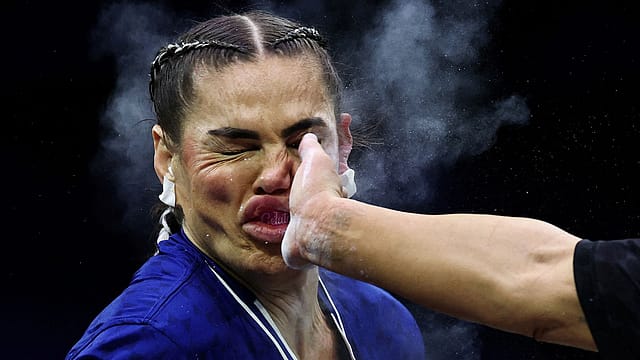
There is a kind of video, broadcasters always search for during a game of cricket. It is usually found on the face of the captain during moments of deep anguish, when a catch has been shelled or the game just taken away, and he or she will, eyes closed and from blown cheeks, expel a deep breath of disappointment. Captured on ultra motion cameras, this fleeting moment of just a second or two will stretch for what will appear a comic eternity, as the vibration from that movement of air will send ripples across the face.
It is a moment of great drama on a single face. And this kind of camera work arguably plays out even better in the new and controversial combat sport of slap fighting. A cloud of chalky powder will explode, accompanied sometimes by ear plugs flying into the air, as a powerful slap will collide in slow motion into a waiting cheek, the force of impact sending such dramatic ripples that it might look like a car were crashing into the face. Sometimes, you’ll even see the lights go out in the eyes, as the recipient keels over.
When Pardeep Hooda, who competes in mixed martial arts (MMA) fights across the country, was shown clips of this sport last year, he recalls saying, “What’s the big deal? It is just a slap.”
To Hooda, who hails from a village close to Rothak in Haryana and runs an MMA academy in Dehradun, there is no combat sport that is tougher and more dangerous than MMA. “I was telling people who told me about the sport, ‘This is just a slap. I’m from Haryana. I fight MMAs for a living. I can surely take a few slaps’.”


Survival Instinct
22 May 2026 - Vol 04 | Issue 72
India navigates global economic turmoil with austerity and smart diplomacy
A few days from that conversation, Hooda was standing opposite a British bare knuckles fighter (the kind of boxing where protective gloves or padding are not worn on the hands) in a packed venue in Dubai, his hands held tightly under the table, with his cheek on offer.
The event took place at the Slap Fighting Championship, a growing slap fighting promotion in Dubai, last year. The match went on for four rounds, with neither fighter landing strong enough strikes to knock the opponent out, and Hooda eventually lost to his rival on points.
But by the end of the match, Hooda’s opinion on this combat sport had transformed. “It is really not about just giving each other slaps,” he says. “There is a technique involved, accuracy, and I realised you even need to train for it differently.”
Slap fighting as an organised competition is a new phenomenon. Said to have emerged as an unsanctioned sport in Russia sometime in the 2010s, where strongmen took on one another in brutal, open-palmed, face-slapping matches, these fights began to go viral online during the pandemic, catching the interest of combat sport entrepreneurs in the US. Since then, some of these entrepreneurs – in particular Dana White, the head of the popular MMA promotion UFC (Ultimate Fighting Championship), who appears to think slap fighting could be the next big thing in combat sport – have been trying to nudge this brutal phenomenon into some form of respectability, introducing rules and regulations, putting in place protocols, and giving it, in the eyes of its critics, the veneer of a sporting event. His slap fighting promotion, Power Slap, which White has managed to get the Nevada Athletic Commission to officially sanction, has been held since 2023. It is aired on TV, and also on social media, where it has become a viral phenomenon, and clips of its fights routinely rack up millions of views.
Slap fights however tend to be brutal. Unlike other combat sports such as boxing or MMA fights, which may also have its critics but where fighters can at least defend themselves, or dodge blows or slip away, and which certainly involves a high level of skill, slap fights have no discernible skill except for the ability to bear punishment. It’s been heavily criticised by the medical fraternity, which has warned about brain damage and chronic traumatic encephalopathy, the neurodegenerative disease that occurs after repeated head trauma, and there has been at least one reported death (of a Polish fighter who suffered a hemorrhage after competing in such a fight in 2021).
Training for slap fights in fact turns out to be an amusing subject. While most fighters use training routines similar to other forms of combat training like those that involve building strength in various parts of the body and building agility, slap fighters put particular stress on building strength in their hands, so they can generate more power, and in their necks and shoulders, so they can withstand blows.
Gurpreet Singh, a 31 year old farmer in Mohali who has been wrestling at akhadas since childhood, laughs as he points out his training regimen to build the strength in his cheek. “We are farmers,” he says, “we find all sorts of ways to find solutions.” Gurpreet who has so far contested in two slap fights (at the Slap Fighting Championship in Dubai, and Power Slap in Riyadh) spends at least a couple of hours daily chewing large amounts of gum. “It can get really tiring and painful, but it really strengthens your cheeks. It can be the difference between winning and getting knocked out,” he says, while pointing out how he would also incorporate chewing vast amounts of sugarcane during this period.
For all the training and effort one puts in, however, Gurpreet believes, the element of luck plays a big role in the match’s outcome. From winning the toss and getting first strike, to just not being able to generate the right power or landing slaps at the accurate spot, any of those elements can lead to a win or loss on any given day.
Gurpreet had won his match in Dubai, but at the Power Slap fight in Riyadh, his opponent’s first slap had sent him hurtling down to the floor, where he appeared to remain in a frozen stage, arms extended, for a prolonged period. “I was taken to a hospital, where an MRI was done on my skull, because officials were worried about the hit I had taken,” he says. No harm was however found and he was discharged. But for many days thereafter, he wore a big bruise across his face.
For Manjot Rattu, a much worse bruise awaited. For several weeks following her first slap fight at the Power Slap event in Abu Dhabi last year, half of Rattu’s face lay swollen, including her right eye, which she could not even open. Rattu, who lives close to Jalandhar in Punjab, is a professional boxer. She had been intrigued by Power Slap, when she began following it online, and once had even shown its clips to her parents, who were shocked at the brutality of the sport. “I really wanted to participate in it, and I had begun asking around if there were opportunities for women in it,” she says.
Rattu’s initiation however was a tough one. Fighting against an experienced fighter, she took three punishing slaps, the last one sending her to the floor as she spat out blood.
“I had done a bit of training but I wasn’t actually prepared,” she says. “I had even worn my boxing mouth-guard, instead of the one slap fighters use, resulting in a nasty cut inside my mouth.” Having left for Abu Dhabi without informing her family members that she was going to participate in a slap fight, her parents, she says, were aghast upon seeing her return with a swollen face. Despite the loss, Rattu says, she found the atmosphere electric, and wants to contest again.
On that same night where Rattu’s first match had ended in defeat, Hooda stepped on to the stage in Abu Dhabi for just his second slap fight in his career. In front of him was a more experienced American slap fighter named Anthony DeFrank. But Hooda felt good about himself. After his first match a few months earlier had ended in a loss, Hooda had this time spent a lot more time practicing and training towards this match, even landing up in Abu Dhabi several days before to train more effectively.
It was perhaps the nerves that got to him, or some kind of communication error, but, at his first shot, instead of letting his hand loose across his opponent’s face upon the count of three, for some inexplicable reason, he continued to measure and take aim. By slap fighting’s convention, this was a huge miss, and Hooda lost that strike. When asked what led to that miss today, Hooda remains a bit confused. “I was personally a little depressed that time. Also, there was a language gap,” he says. “In the previous slap fight I had participated in, the way they counted was also a bit different. So I think all that led to that confusion where I missed it.”
Despite that blunder, Hooda quickly put it behind him, and delivered two deafening strikes over the next two rounds. The match eventually ended in a draw. But given the miss at the start, the draw felt, he says, ever bit like a win.