Six Appeal
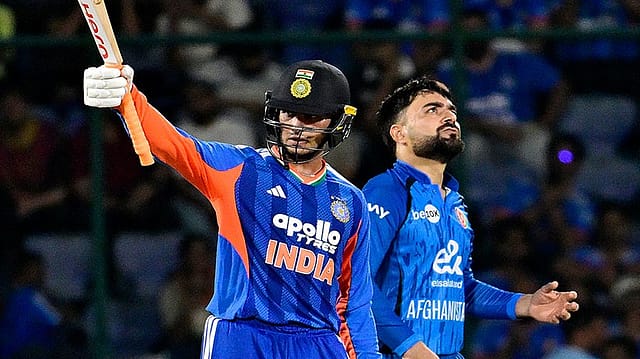
To begin the breakneck knock that has already come to define a nascent career full of breakneck knocks, which is the hundred against Afghanistan in New Delhi, Abhishek Sharma smacked a boundary off the second ball that he faced for a one-bounce four over the cover region. The first six came an eye-blink away, in the game’s second over, when the lefty pulled Azmatullah Omarzai over the square leg fence. When the ball clattered somewhere in the depths of the stands named after Gautam Gambhir, the man himself, India’s current coach, helped himself to a chuckle. Even the otherwise stoic Gambhir knew there was more to come. Many more.
Hitting early sixes is the bare minimum requisite for a T20 batter in this day and age. But at the Arun Jaitley Stadium, Abhishek managed to do so with such clinical ferocity in an era where the big hits have mostly lost their novelty that even the casual score-checker turned on the television and took immediate notice. Hopefully in time for his third six, which was the best of all, simply lofted over bowler Fazalhaq Farooqi’s head to take him to 26, off nine balls. It was so good that even Abhishek held his pose.

Losing Memory
16 Oct 2026 - Vol 05 | Issue 42
The making of a medical and social emergency
By just the fourth over, Abhishek was on 42. To put that into perspective, his opening partner, the extremely destructive Sanju Samson, was batting on three. In the same over, Abhishek reached his 50, you guessed it, with a six, a half-century that propelled India to a score of 100 by the end of the powerplay overs: 36 balls, 100 runs, let that sink in. Less than three overs later, Abhishek had his individual century, and arriving in 8.3 overs, it was the fastest to be achieved during an innings in any men’s T20 game, domestic or international, anywhere in the world. Scored in just 30 balls, it was also the fastest T20 international hundred scored by a batter from any of cricket’s full-member nations. The team score, if you must know, was 132 at this point (Afghanistan, in reply, wouldn’t even surpass Abhishek’s innings of 108, bowled out for 94).
In celebration, the 26-year-old from Amritsar sat cross-legged pitch-side, closed his eyes and held his yoga pose to a standing ovation from the disbelieving spectators in New Delhi, amongst those shaking their heads by the essay’s sheer incredulity being his father Raj Kumar and coach Gambhir. Before the end of the 10th over of the first innings, well before the 40-over game had even taken shape, Abhishek was out—not only after having shaped the gameplay in its first quarter, but the future of India’s T20 batting.
For a man who made his India debut in the T20 format just two years ago, the southpaw has risen through the ranks with such swiftness that he is already the second-best T20I batter in the world, according to the current official rankings. This hundred against Afghanistan in the final game of the series in late September was his third for his country, just two less than the world record held by a fellow Sharma, Rohit. But in all of T20s, including the Indian Premier League, this was Abhishek’s 10th three-figure score, two more than Rohit, or on par with the 37-year-old Virat Kohli.
Not a bad way to not only catch up, but even get ahead, for a boy who not too long ago felt that he had been left behind. It must be known that Abhishek was in the same Under-19 World Cup-winning batch as Shubman Gill, who he grew up playing cricket in Punjab, as well as Prithvi Shaw. Both Shaw and Gill were fast-tracked into the Indian team even as Abhishek watched from the sidelines. Shaw even went on to coronate his Test debut in 2018 with a century, while Gill carved his way into a hardened ODI side for the 2023 World Cup at home.
“At that time, I was struggling a bit,” he said on the podcast <Breakfast with Champions>. “I used to tell myself that, yeah, I’m a little delayed, I’ve fallen behind all those who were with me in the [Under-19] group.”
For a while, that feeling would persist. Until his childhood idol, Yuvraj Singh, decided to take him under his wing. It was an unlikely moment of reassurance for a young cricketer who had begun to wonder if his career was moving in the wrong direction. Yuvraj knew the feeling of expectation, of being told you were destined for something bigger, only to fail for a while and yet find a way to turn that expectation into a career. At a lunch at Yuvraj’s home, with Gill also present, the former India all-rounder offered Abhishek a different way of looking at his own journey. He wasn’t preparing him merely to make the state team, or find a place in the IPL. He was preparing him to be a household name, and to win matches in India’s blue—a pipe dream, if at all, at that point.
For Abhishek, the words mattered because of who was saying them. Here was the man he had grown up idolising, now looking at him not as a youngster who had fallen behind his peers, but as someone being prepared for an India career. “If he’s saying this, it means he has so much belief and trust in me,” Abhishek said. “After the camp, I felt that my goal is something else. I am being prepared for something bigger—to perform and lead innings for India. And that’s exactly what I will do, and I will achieve it.”
Yuvraj’s intervention was about more than belief, though. There was work to go with it: time spent on Abhishek’s batting, on the shape of his strokeplay, on understanding where his natural aggression could take him and, crucially, where it needed to be controlled. The idea was not to take the violence out of his batting but to give it direction. If Abhishek already had the appetite to hit the ball into the stands, Yuvraj’s job was to convince him that this was not a flaw to be tempered but a weapon to be sharpened. The boy thus began to shed his also-ran attitude.
The years that followed would vindicate Yuvraj’s faith, and then some. At Sunrisers Hyderabad, Abhishek began to look less like a gifted youngster trying to force his way into the game and more like a batter capable of dictating its terms. In 2024, opening alongside Travis Head, he became the face of a Sunrisers side that reimagined what a T20 powerplay could look like. The pair’s approach was to attack from the outset, turning the first six overs into a period of sustained assault rather than cautious accumulation.
Abhishek finished that season with 484 runs at a strike rate of 204.21, including three half-centuries (this led to his first India call-up on the tour of Zimbabwe). He followed it with 439 runs in 2025, striking at over 193. The numbers were remarkable, but so was the manner of the batting: the clean swing, the absence of hesitation, the sense that even a good ball could disappear. In short—Yuvraj 2.0.
The performances kept coming, and with them came a transformation in his public profile. Abhishek was no longer merely one of India’s most exciting young batters. His image was becoming incredibly marketable, a cricketer whose appeal extended well beyond the boundary. The advertising billboards across the country ranged from him endorsing a purple toothpaste one day, a two-wheeler another. He remains, clearly, the kind of pretty face that brands are willing to pay for.
But the face that sells, among other things, shaving foam and facewash, is also becoming the face of Indian cricket. And beyond the endorsements, the billboards and the boyish good looks, Abhishek is the face of India’s T20 future—a batter who embodies the format’s relentless appetite for speed, audacity and sixes. The boy who once thought he had fallen behind is now well and truly setting the pace.