'Sir' Ravindra Jadeja: From Cricket’s Punchline to One of Test History’s Greatest All-Rounders
For years, cricket struggled to decide what Ravindra Jadeja really was.
Was he a bowler who could bat? A lower-order batter who could bowl? A fielder too extraordinary to leave out? Or merely “Sir Jadeja”, the subject of an internet joke that spiralled into a nickname?
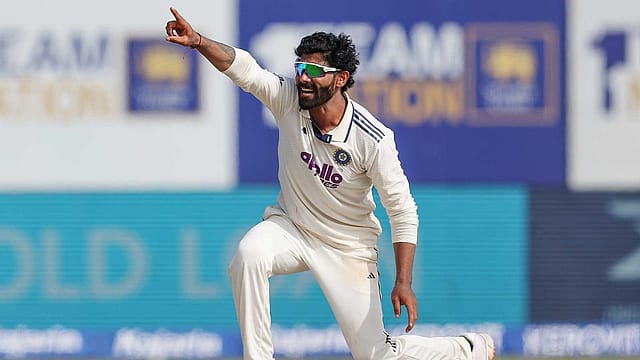
At Galle on Monday, Jadeja supplied another answer. Keshara Nuwantha charged at a delivery that drifted, dipped and spun away. The Sri Lankan batter swung. The ball refused to obey his plan. It climbed off a mistimed shot and Shubman Gill completed the catch.
Jadeja had his 350th Test wicket. No elaborate celebration followed. No great eruption. Jadeja had simply added another victim to a career built on making difficult things look brutally routine.
The wicket made the 37-year-old only the fifth Indian bowler to reach 350 in Tests, behind Anil Kumble (619), Ravichandran Ashwin (537), Kapil Dev (434) and Harbhajan Singh (417). Among left-arm spinners, only Sri Lanka’s Rangana Herath (433) and New Zealand’s Daniel Vettori (362) remain ahead of him.

Rise of the Pivotal Power
18 Sep 2026 - Vol 05 | Issue 38
The BRICS declaration is a strategic victory for Modi
But the larger number revealed the true scale of Jadeja’s career. With more than 4,000 Test runs already against his name, he became only the fourth cricketer in history to combine that tally with 350 wickets. The other three are Kapil Dev, Ian Botham and Vettori. Jadeja is only the second Indian after Kapil to enter the club.
He arrived there in his 90th Test. Kapil played 131. The landmark did more than enlarge Jadeja’s statistical footprint. It captured the long, unlikely journey of a cricketer who had spent much of his early career being underestimated, misread and reduced to a caricature.
The boy who almost walked away
Jadeja was born in Navagam-Khed in Gujarat’s Jamnagar district on December 6, 1988. His father, Anirudhsinh, worked intermittently as a security guard and had no fixed income. Cricket did not arrive in Jadeja’s life wrapped in privilege or certainty.
His mother, Lata, died in an accident in 2005. The loss nearly drove the teenager away from cricket, according to an ESPNcricinfo profile. His family persuaded him to continue.
He did more than continue. He forced his way up. Jadeja represented India at the Under-19 World Cup in 2006 and then served as vice-captain when Virat Kohli’s team won the tournament in 2008. A year later, he made his senior international debut.
Yet his ascent was never smooth. His batting appeared unreliable. His bowling was frequently branded defensive. Even after he had begun winning matches, debates over his place followed him.
Then came the triple hundreds. In 2012, Jadeja became the first Indian to score three triple-centuries in first-class cricket. His third, an unbeaten 320 for Saurashtra against Railways, placed him on a list that included Don Bradman, Brian Lara, WG Grace and Wally Hammond, according to the BCCI.
Still, many refused to take the batter seriously.
The nickname “Sir” began as mischief. It became ridicule. Jadeja’s domestic triple-centuries, his swagger and the unwavering faith MS Dhoni placed in him fed an online joke: whenever the impossible happened, “Sir Jadeja” must somehow have caused it.
Jadeja did not argue with the joke. He outlasted it.
The weapon Dhoni trusted
Jadeja’s Test debut came against England in Nagpur in December 2012. Within months, he had turned into one of Dhoni’s sharpest weapons.
During India’s 4-0 demolition of Australia in 2013, Jadeja collected 24 wickets. He dismissed Michael Clarke five times in six innings, repeatedly strangling one of the world’s best players with pace, precision and turn.
That same year, he delivered on a global stage.
In the rain-shortened Champions Trophy final against England at Edgbaston, India staggered to 129/7. Jadeja struck an unbeaten 33, then took 2/24 as India defended the total by five runs. The ICC recorded how his composure with the bat helped revive India before his bowling tightened the trap. He finished as the tournament’s leading wicket-taker and won Player of the Match in the final.
The punchline had begun punching back.
Jadeja’s great strength was not mystery. Batters knew what he would bowl. The ball would arrive quickly, attack the stumps and offer them almost no time to adjust. One delivery would skid. Another would grip. The release barely changed.
He did not need the pitch to perform acrobatics. A fraction of deviation was often enough. At the other end, Ashwin probed, plotted and experimented. Jadeja compressed the game. Together, they became one of Test cricket’s most punishing spin partnerships and powered India’s long reign at home.
A batter rebuilt under pressure
For a substantial part of his career, Jadeja’s bowling guaranteed his place. His batting supplied the bonus.
Then the bonus became a weapon.
His maiden Test hundred arrived against the West Indies in Rajkot in 2018. In 2022, against Sri Lanka in Mohali, he produced the most complete performance of his career: an unbeaten 175 followed by match figures of 9/87. The innings surpassed Kapil Dev’s then Indian record for the highest Test score by a batter at No. 7 or lower.
Months later, Jadeja scored his first overseas Test century against England at Edgbaston.
These were not empty lower-order runs assembled after the contest had ended. Increasingly, Jadeja walked into wreckage. He absorbed pressure, batted with the tail and dragged India towards totals that had appeared out of reach.
The evolution altered his place in the side. He was no longer selected despite his batting. India could trust him because of it.
In September 2024, Jadeja became the fastest Indian to complete the double of 3,000 Test runs and 300 wickets. Only Ian Botham reached that combination in fewer matches, according to ESPNcricinfo.
The man once mocked for scoring triple-centuries in domestic cricket had turned himself into a Test batter opponents could no longer dismiss as an accessory.
Three cricketers in one body
Numbers can measure Jadeja the bowler and Jadeja the batter. They struggle with Jadeja the fielder.
He prowls the inner ring as if every single belongs to him. Batters hesitate before leaving their crease. Captains station him where the ball is most likely to find trouble. A hard chance becomes catchable. A comfortable second run suddenly becomes a race against his left arm.
His fielding does not merely save runs. It alters decisions. That is the essence of Jadeja’s value: he allows one player to occupy three spaces in a team. He can break a partnership, repair an innings and manufacture a wicket without touching the ball twice.
For years, that range also made him easy to underrate. Specialists owned cleaner identities. Jadeja existed between categories.
The longer his career ran, the clearer it became that refusing to fit into one category was precisely his genius.
The sword, the scars and the second wind
Jadeja’s career has not moved in a straight line.
There were lean stretches, selection battles and injuries. A serious knee problem ruled him out of the 2022 T20 World Cup and required surgery. After five months away, he returned against Australia in Nagpur in February 2023 and immediately claimed a five-wicket haul.
He also carried the scar of India’s 2019 World Cup semifinal defeat. With the top order shattered against New Zealand, Jadeja counterattacked with 77 from 59 balls and briefly threatened to steal an impossible victory. India lost, but the innings hardened his reputation as a man capable of charging into a collapsing game.
Five years later, Jadeja was part of the Indian side that won the 2024 T20 World Cup. He retired from T20 internationals after the triumph, ending that chapter with 74 matches, 515 runs and 54 wickets, as Reuters reported.
In 2025, he added another global title. Jadeja struck the winning runs as India beat New Zealand in the Champions Trophy final, according to the ICC.
It was a fitting image: Jadeja finishing a tournament India had also won 12 years earlier with him at its heart.
No longer a joke
In Galle, Jadeja had already removed Sri Lanka captain Dhananjaya de Silva before Nuwantha handed him wicket No. 350. India had posted 462, powered by Devdutt Padikkal’s 167, and Jadeja’s strikes pressed the hosts further into trouble.
One more Test. Two more wickets. Another record.
That has been the rhythm of Jadeja’s career. He rarely announces the next landmark. He simply hunts it down.
The “Sir” that once carried a smirk now lands differently. The joke has lost its joke.
Jadeja is among only five Indians with 350 Test wickets. Only two left-arm spinners have taken more. Only three cricketers in the game’s history have matched his combination of 4,000 runs and 350 wickets. According to the ICC’s current rankings, he remains the world’s leading Test all-rounder.
The boy from Jamnagar who nearly abandoned cricket now stands beside Kapil, Botham and Vettori. Ravindra Jadeja spent years refusing to be confined to one role. History has finally found the right one for him: All-time great.
(With inputs from ANI)