Sanju Samson: From Ephemeral Exuberance to Enduring Brilliance
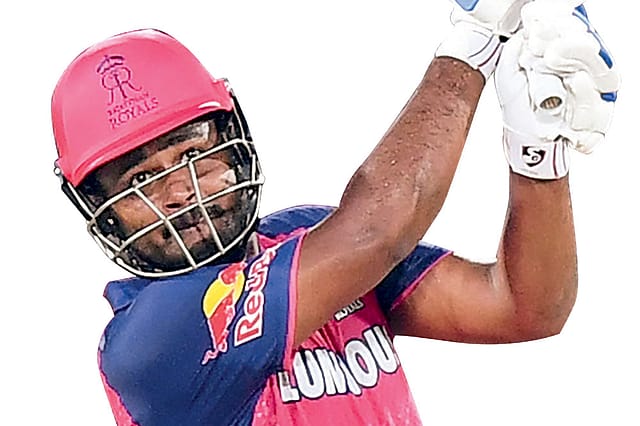
In 2014, dispirited and disappointed at the way Sanju Samson was getting out cheaply after playing a few shots of genius, like a flash in the pan, I wrote in my blog ‘Why Sanju Must Be Spoken To’.
His repeated rejection at the hands of selectors and team management came later but in the initial days it was more to do with his own temperament or awful shot-selection. Talent demands responsibility and discipline, and precocious talent demands double its measure. And, Sanju is a precocious talent.
I wrote:
“Heaving Steyn or Hilfenhaus back over the bowler’s head for a six is exciting stuff, and not many have the spleen and talent to do it against the world’s best, but you cannot build your career on ephemeral exuberance. You cannot be a Pat Cash—an aberration among Wimbledon winners—if you are serious about playing the game at the top level for long.

The Modi Years
02 Oct 2026 - Vol 05 | Issue 40
A Nation Rebuilt
Sanju should be spoken to about the way the world behaves, especially in celebrity circles. He may be too young to understand, even though he has a mature head on those young shoulders, that not many stand by failures. The moment you cannot deliver or keep yourself within the aura and halo of fame and success, you are dumped.
There is a lithe man in the commentators’ box who can tell Sanju about burning out and the demons that haunt your life once you slip off from the pedestal or public adoration. Laxman Sivaramakrishnan was a genius of a leggie but where is he now? His calling or talent was not to be a commentator but to torment batsmen with his wizardry of leg-spin. Sanju can go on to YouTube and watch how Siva once foxed a batsman of Javed Miandad calibre with his mastery (Benson and Hedges Mini World Cup final, 1985). But Siva is now a sad memory.
Heroes are born not in foam beds but in gory battlefields. Sanju must be wise enough to remember that Samson was heroic but he also had given away his powers through a weakness. Virat Kohli was right when he said it was not the case of bowlers taking Sanju’s wicket but he himself giving it. For the time being Sanju is sailing but it is time he is spoken to about the surprises on the road to fame.
Sanju must be spoken to about the vagaries of modern-day cricket which is so commercialised and run as a business that you cannot afford to be a prodigal son because there is no one out there with a father’s heart.’
I wrote it because I was convinced of his talent—that rare ability for stroke-play, a confluence of kinetic science of timing and the poetic, unrestrained wildness of beauty. I wrote it because I knew precocious talent is a dangerous gift. I wrote it because I cared for him as a player, and as a fellow city-zen. His failures hurt us deep as does the squandering of genius by an artist.
In three days, with three brilliant, match-winning knocks in the World Cup knockout stage, Sanju became the toast of the country. Everyone is singing hosanna to him but the process of patiently waiting for over a decade is not easy. Not many could endure such spells of merit-defying rejections, and potentially destructive self-doubts. It could break you, and push you to the abysmal depths and murky darkness of depression. It could suck the creative life from you, and render you a failure. That’s where Sanju deserves the pat. He did not stop his preparation. On the other hand, he had only put in more grind, and worked harder.
Whenever the selectors and the team management woke up from their selective amnesia and gave him a short rope, Sanju grabbed it and performed but only to be dumped and pushed back to warm the benches. Sanju in the dugout looked thoughtful, if not sad. There was a mist of apprehension about him. No one doubted his talent but his consistency. The pundits in the commentators’ box hollered that ‘Sanju lacked consistency’. When his ‘back-and-forward’ footwork didn’t work against certain bowlers or he repeatedly holed out at deep midwicket, the experts stopped just short of making fun of the consistency of Sanju’s inconsistency. To be fair to coach Gautam Gambhir and skipper Suryakumar Yadav, they gave Sanju five matches on the trot in the T20 series against New Zealand just before the World Cup. But Sanju came a cropper in all of them. When shadows fell over his place in the playing XI in the World Cup, Ishan Kishan roared back into form and, rightfully, stormed his way into the team and began performing well. The door was shut on Sanju. But then the shocking defeat against the South Africans, and the Indian management went back to the drawing board. Even though Gambhir now says that it was not the case of the team’s top-three left-handers falling cheaply to off-spinners, the threat was there, and the Indian team management was forced to nudge Sanju in for the crucial knockout game, a virtual quarterfinal, against a surging West Indies.
Crises not only bring forth character but create heroes. When he walked back to the dugout after almost single-handedly shredding the Caribbean attack to pieces with some high-class stroke play, skipper Surya was waiting, extending a bow. The entire team hugged him for if not for the knock India would have been packing their bags. Then came the English, and the experts wanted to see if Sanju could survive the searing pace and bounce of Jofra Archer. Sanju came out to open the innings, and became a concoction of caution and sublime strokes. He met Archer’s pace and bounce with courage and precision, repeatedly depositing him in the sea of ecstatic crowd. Sanju’s knock helped the Indians win the match by the skin of their teeth, despite a brilliant hundred by the young and hugely talented Jacob Bethel. Sanju was toasted, again! The experts admired the transformed Sanju—how he cut out the frills and excesses without losing the shots of pure class. Something happened to Sanju’s brain. Something began to suddenly come alive and take charge. Then, the World Cup final against the Kiwis. All eyes were on Sanju again. What I liked the most was the way he played an accurate Mitchell Santner, who in the T20 Series had broken through Sanju’s defence when Sanju’s ‘backward’ footwork left a chink in the defence. This time Sanju didn’t go back deep into the crease giving Santner any chance to sneak through. Matt Henry tried to trap him with a deep midwicket fielder and short balls but Sanju played them on the ground. That’s transformation. Sanju had finally attained maturity.
In all the three innings, he could have nudged and pushed for singles for another T20 hundred but Sanju, being the quintessential Sanju, has always played for the team. He has always tried to give the team a flying start, running the risk of perishing in the attempt.
Sanju has a mature head on his shoulders, and it shows in the way he speaks. He has repeatedly said that it is the failures that shaped his character. The ebbs and flows, the surprises that await you around the corner, the unexpected twists in the tale—Sanju is now a polished pebble, smoothened by the many flows of life, which has taught him about the vagaries of life, and how to keep hanging in, chiselling in, and when the opportunity comes like a sweeping wind, catch it, and ride it.
Under Sanju’s captaincy, Rajasthan Royals has done well. Leading from the front as a batter as well as a safe wicketkeeper, Sanju has inspired a bunch of talented players but in the coming IPL later this month, he has moved to Chennai Super King. As former Indian player Ajinkya Rahane says, Sanju is of Dhoni’s mould in composure and temperament. True, Sanju hardly loses cool on the ground, and off it he is such a lovable and humble person.
I can say we know each other. Not so personal but as a father of an aspiring girl cricketer—Keziah Sabin—from the same city of his, Thiruvananthapuram.
Sanju doesn’t have chips on his shoulder. He is so down-t0-earth that he puts you completely at ease.
A few years ago veteran cricket writer, seasoned talent scout and cricket administrator Makarand Waingankar sent Keziah for a week to Zubin Bharucha at the Rajasthan Royals Academy at Talegaon in Nagpur. When Keziah and I arrived at Talegaon, Sanju was not there but later in the evening he came with a few of his Kerala Ranji teammates. They were coming from a Ranji match. He brought them for trials at RR. Surprised to see us at the Academy, he called out in his now signatory ‘Chetta!’ He was so happy that Keziah was there that he told her to get as much out of Mr Bharucha as possible. In the next few days, we watched in awe how hard Sanju practised from morning till evening, belting bowlers from one end of the ground to the other, and beyond. During a break, he took Keziah aside and gave her some tips. One day during breakfast at the canteen, Sanju was talking to us when some of his team-mates and RR management came in. We stood up to leave as it would be inappropriate as they would be discussing team stuff. Sanju looked up and asked why we were leaving. When we said it might not be appropriate that we remain there, he said we were ‘his people’, and asked us to sit. He didn’t have to do it but he made sure we were n0t feeling odd.
Just before the Covid outbreak, I was part of the organisation that sent a girls’ cricket team on a tour to the UAE. We were in need of sponsors. I knew Sanju was in Australia with the Indian team. I texted him. After some time, he called and gave the name of a person to contact. Sanju took care of the team’s playing jersey without any hesitation.
Thinking of all the rejections and indifferences meted out over the years to this talented cricketer from the coastal village of Vizhinjam in Thiruvananthapuram, what Shakespeare says in King Lear, rings true, (Sanju) is more sinned against than sinning.
Sanju’s redemption is poetic justice as it is rightly said, ‘The rejected stone will become the cornerstone.’
Sanju Samson became the cornerstone on which India’s World Cup victory was built last week, and the entire country now believes that the coming few years belong to the ‘silent killer’ from Kerala lest the selectors fall into the spells of their incomprehensible hallucinations.