Roshibina Devi makes Asian Games history as Satnam Singh-Salman Khan win rowing bronze for India
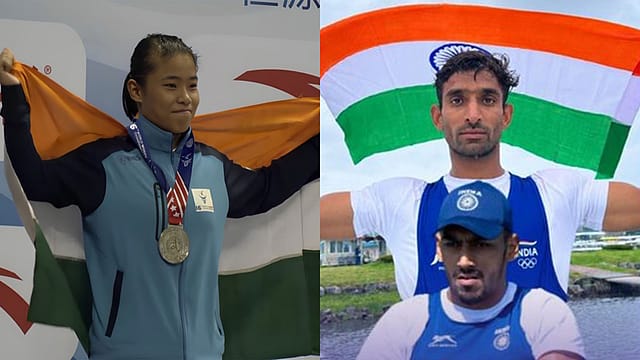
Some medals are about the podium while others are about the journey it took to get there. On a busy day for India at the Aichi-Nagoya Asian Games, two very different stories unfolded. One featured a wushu star from Manipur who has quietly become one of India's most consistent Asian Games performers. The other involved two rowers who created history in an event where India had never won a medal before.
Together, they offered a reminder that sporting milestones do not always arrive with the loudest headlines.
Roshibina Devi creates Asian Games history with third successive medal
For Naorem Roshibina Devi, the latest medal carried extra significance. The Manipuri wushu athlete became the first Indian woman to win medals at three successive Asian Games after securing silver in the women's sanda 60kg event at Aichi-Nagoya. Roshibina went down to China's Zhang Xiaoyu in the final, but the result still placed her in a category of her own in Indian sporting history.

Losing Memory
16 Oct 2026 - Vol 05 | Issue 42
The making of a medical and social emergency
Her Asian Games journey began with a bronze at Jakarta 2018. She followed it with a silver at Hangzhou 2023 and has now added another silver in Japan. Three Games. Three medals. Few Indian athletes can claim that kind of consistency on the continental stage.
What makes the achievement even more remarkable is what happened before these Games. Roshibina's place in the Indian squad reportedly became the subject of a selection controversy in the build-up to Aichi-Nagoya. The uncertainty sparked debate within Indian wushu circles before she was eventually backed by the federation and retained in the team. Days later, she responded in the most emphatic way possible — with another Asian Games medal.
In a country where attention often gravitates towards cricket and Olympic sports, Roshibina has quietly built one of the most impressive medal records in Indian combat sports.
Satnam Singh and Salman Khan row into the history books
A few hours later, another Indian achievement arrived from the rowing course. Satnam Singh and Salman Khan won bronze in the men's double sculls, becoming the first Indian pair ever to win an Asian Games medal in the event. The duo clocked 6:13.25 to finish behind crews from China and Uzbekistan.
The race was tighter than the final standings suggest. The Indians were in second place at multiple stages and remained firmly in medal contention throughout before settling for bronze in the closing stretch. Even so, the result marked a breakthrough for Indian rowing.
For Satnam, it was a second successive Asian Games medal after helping India's quadruple sculls team win bronze in Hangzhou. For Salman, it was a first Asian Games podium finish. And Salman's journey to that podium might be one of the most compelling stories of these Games.
The former Uber driver who became an Asian Games medallist
Before he was standing on an Asian Games podium, Salman Khan was driving an Uber cab in Delhi. The rower from Uttar Pradesh's Amethi district took on the job after his father's death, helping support his family while putting aside his own sporting ambitions. His life changed after joining the Indian Army, where he was introduced to rowing and gradually worked his way into India's elite setup. Today, he is an Asian Games medallist.
His partner Satnam took a different route. A former national-level handball player from Punjab, he switched to rowing after being spotted by Olympian Swarn Singh Virk and quickly emerged as one of India's leading rowers.
Why these medals matter beyond the medal tally
India arrived in Aichi-Nagoya hoping to build on the record 107 medals won in Hangzhou and remain among Asia's leading sporting nations. Reuters reported before the Games that matching or surpassing that benchmark was one of India's major objectives. But medal tallies only tell part of the story.
Roshibina's achievement is about longevity and consistency. Satnam and Salman's bronze is about breaking new ground in a discipline where India had never reached the podium before.
One athlete strengthened a legacy she has been building for nearly a decade. Two rowers created one from scratch.
And sometimes, those are the medals that people remember longest.
(With inputs from agencies)