Red Card, Broken Heart & the Golden Cup: Lionel Messi Bids Goodbye After a 21-Year Love Story with Argentina
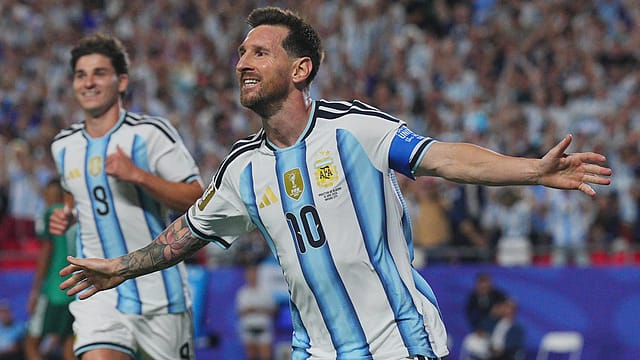
There were no defenders left to beat. No goalkeeper to deceive. No impossible angle waiting for that left foot.
Lionel Messi had spent 21 years escaping tackles, expectations, comparisons, collapses and the suffocating shadow of Diego Maradona. On Monday, August 31, the 39-year-old finally encountered something he could not dribble past: the end.
“It hurts my soul, but I understand that the time has come,” Messi wrote while announcing his retirement from international football.
He leaves Argentina after 207 appearances and 125 goals, both national records. He won the 2021 and 2024 Copa América titles, the 2022 Finalissima and the 2022 FIFA World Cup. He played in three World Cup finals and finished his last tournament with eight goals and four assists, dragging the defending champions to within one match of retaining the trophy.

Zeroing In on ECI
09 Oct 2026 - Vol 05 | Issue 41
Constitutional legitimacy versus political opportunism
Spain defeated Argentina 1-0 after extra time in the 2026 World Cup final on July 19. Ferran Torres scored in the 106th minute. Spain lifted the trophy. Messi walked away in tears.
Six weeks later, he made the walk permanent.
According to BBC Sport, Messi said he had given everything he possessed to Argentina and was leaving with peace and pride. The decision had begun forming after the World Cup final. The recent death of his father and lifelong guide, Jorge Messi, deepened his conviction that another chapter of his life had ended.
A father was gone. Now the shirt was being folded away.
Messi acknowledged the gifted young players waiting for their opportunity and said he would continue supporting Argentina as a fan. It sounded serene. Retirement letters usually do. They hide the violence involved in separating a man from the identity he has carried for most of his life.
For Messi, the separation is even harder. Argentina was never merely the country he represented. It was the country whose love he spent half his career trying to win.
Forty-Seven Seconds
The relationship began with a dismissal.
On August 17, 2005, an 18-year-old Messi came on against Hungary in Budapest for his senior Argentina debut. He was wearing No. 18. Vilmos Vanczák grabbed his shirt. Messi swung an arm while attempting to escape.
The referee showed him a red card. He had been on the pitch for less than a minute. Messi sat in the dressing room and cried.
That absurd debut now appears almost prophetic. Playing for Argentina would never be easy. Every touch would be examined. Every failure would be treated as evidence. Every achievement at Barcelona would enlarge the question following him home: why could the genius who conquered Europe not do the same for his country?
Barcelona adored him without conditions. Argentina attached clauses.
He had grown up in Rosario, left for Spain at 13 and developed inside Barcelona’s footballing culture. He spoke softly, avoided grand declarations and did not perform patriotism for the cameras. To some Argentinians, he appeared foreign. Maradona had been volcanic, theatrical and unmistakably theirs. Messi was quiet, precise and seemingly Catalan.
The comparison was brutally unfair and impossible to escape.
Maradona had delivered the 1986 World Cup through charisma, fury and football bordering on sorcery. Messi was expected to reproduce the trophy, the personality and the mythology.
Being the world’s finest footballer was insufficient. Argentina wanted him to become another man.
The First Goodbye
Messi kept reaching finals. Argentina kept losing them. Germany defeated Argentina in the 2014 World Cup final at the Maracanã. Chile beat them on penalties in the 2015 Copa América final. One year later, Chile did it again in the Copa América Centenario.
Messi missed his penalty in the 2016 shootout. “The national team is over for me,” he said afterwards. “I’ve done all I can. It hurts not to be a champion.” He was 29. This was his first international retirement, born from exhaustion and humiliation. Argentina had lost three major finals in three years. Messi had become the face of every defeat, as if the other ten players had been extras in a national tragedy staged entirely for him.
Supporters marched in Buenos Aires asking him to return. Then-president Mauricio Macri called him. Maradona urged him to reconsider. Children held signs reading, “No te vayas, Lio.” Do not go, Leo.
Messi returned. That decision may matter as much as any goal he scored. He came back to the same pressure, the same scepticism and the same possibility of further heartbreak. Argentina struggled at the 2018 World Cup and lost to France in the round of 16. Another Copa América failure followed in 2019.
The accusation hardened: Messi could win everything except Argentina. Then came the night the argument died.
Tears at the Maracanã
On July 10, 2021, Argentina defeated Brazil 1-0 in the Copa América final at the Maracanã. Ángel Di María scored. Messi collapsed at the final whistle.
His teammates ran towards him. For years, Argentina had demanded that Messi carry the national team. That night, the national team carried Messi.
It was Argentina’s first major senior title in 28 years and Messi’s first with the country. The medal did more than fill a gap in his résumé. It broke the emotional siege around him. The footballer who had spent years being tried by his own people was finally acquitted.
Qatar completed the transformation. Argentina began the 2022 World Cup with a defeat to Saudi Arabia. Messi could have recognised the familiar machinery of disaster. Instead, he scored against Mexico, unlocked Australia, tormented Croatia and struck twice in perhaps the greatest World Cup final ever played.
Argentina defeated France on penalties on December 18, 2022. Messi kissed the World Cup before lifting it. The image travelled everywhere because the trophy appeared to complete a perfect sporting career. In Argentina, it completed something more intimate. Messi had finally become impossible to question.
The boy who was said to feel more Spanish than Argentinian stood in a bisht in Lusail, holding the one object Argentina had spent nearly two decades demanding from him. He had not become Maradona. Argentina had learned to love Messi.
The Last Run
He could have left then. Qatar offered the immaculate ending: World Cup champion, Golden Ball winner, captain, redeemer. Messi stayed. Argentina won another Copa América in 2024. Then, at 39, he returned for a sixth World Cup in 2026. His body no longer possessed the acceleration of Barcelona’s incandescent years, but his mind kept discovering corridors invisible to everyone else.
He scored eight goals and supplied four assists as Argentina reached another final. ESPN recorded that he received the Silver Ball as the tournament’s second-best player. By then, Messi had scored 21 World Cup goals and played more matches on football’s largest stage than anyone before him.
Spain denied him the fairytale. Torres’ extra-time goal ended Argentina’s defence of the title. There would be no second consecutive World Cup and no photograph capable of surpassing Lusail.
Perhaps that was appropriate. Great careers rarely end at the precise moment storytellers would choose. Bodies age in public. Younger opponents arrive. The final whistle refuses to consult the script.
Messi’s international career began with a red card and ended with a defeat. Yet everything between those two disappointments transformed Argentina’s football history. He became its most-capped player. Its highest goalscorer. Its World Cup-winning captain. Its rejected son. Its returning son. Its golden son.
The Shirt Finally Loved Him Back
Statistics can record the 207 appearances and 125 goals. They can count two Copa América titles, one World Cup, six World Cup tournaments and three World Cup finals. They cannot adequately measure the distance Messi travelled inside Argentina’s imagination.
He went from being considered too European to becoming the face painted on walls from Rosario to Buenos Aires. From being blamed for failing to resemble Maradona to standing beside him in the country’s footballing heaven. From retiring in despair in 2016 to leaving with the peace of a man who no longer owes anyone an explanation.
That may be his finest victory.
Messi did not merely win trophies for Argentina. He survived Argentina’s need for him to win them.
The national shirt once felt heavier on him than any defender. In Qatar, it finally embraced him. By 2026, he was no longer carrying an accusation across the pitch. He was carrying the gratitude of a generation that had watched him lose, return, lose again and eventually reach the summit.
His club career continues with Inter Miami. Only international football has ended. There may still be goals, trophies and evenings when the left foot bends reality once more.
But the boy in blue and white is gone. Twenty-one years after Argentina gave Lionel Messi a red card, a burden and an impossible inheritance, he gives the shirt back with a World Cup star above its crest. There is nothing more to prove. There is only gracias. And goodbye.