Luck, Pluck & DEV 37: How Devdutt Padikkal Rebuilt His Body, Batting and Career
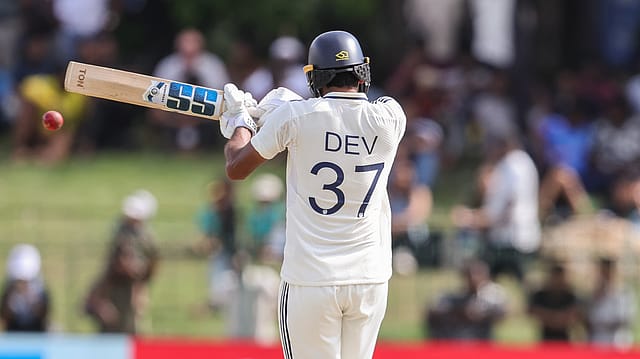
Sri Lanka caught Devdutt Padikkal twice before he had scored two runs. Both times, they dropped him.
The first life came on 0. The second arrived on 1. If batting were an examination, Padikkal had been handed the question paper, failed the opening question twice and still been allowed to continue.
Well, what do you do with two lives? Padikkal used them to score 100.
By the time he raised his bat in Colombo, Sri Lanka had spent two sessions discovering the price of two mistakes. The shirt on his back said DEV. The number beneath it was 37. The scoreboard offered another number: 117.

Zeroing In on ECI
09 Oct 2026 - Vol 05 | Issue 41
Constitutional legitimacy versus political opportunism
Luck had opened the door. Pluck kept him inside.
A week earlier in Galle, Padikkal had scored 167 in the first innings and 44 in the second. He won the Player of the Match award. India won by 165 runs.
Now came another century in the next Test. India had summoned him to Sri Lanka as an injury replacement for Sai Sudharsan. Two Tests later, the replacement was beginning to look rather difficult to replace.
Yashasvi Jaiswal had made 45. KL Rahul fell for 18. Shubman Gill reached 50 but could not carry on. Rishabh Pant retired hurt. Padikkal remained. The innings did not sparkle throughout. It could hardly afford to after those two early reprieves. Padikkal had to silence the panic, forget the catches and begin for a third time.
That may be the most revealing part of his hundred. Most people will remember the drives. Padikkal will probably remember the reset. Because the story of Devdutt Padikkal is increasingly becoming the story of a man learning how to begin again.
The Left-Hander India Thought it Knew
Indian cricket first met Padikkal as an IPL prodigy.
He was 20 when he walked out for Royal Challengers Bengaluru in 2020 and began batting as though the tournament had been waiting for him. Three fifties arrived in his first four matches. He finished his debut season with 473 runs and collected the Emerging Player award.
The following year, he struck an unbeaten IPL hundred. It was easy to reach a verdict. Tall left-hander. Lovely through the off side. Natural opener. White-ball star. That description was not wrong. It was merely impatient.
Padikkal’s most extraordinary numbers have come in the one format India has never selected him to play internationally. By early 2026, he had scored 13 centuries in 38 List A innings and was averaging above 83. No batter with at least 2,000 List A runs had a higher average. He had also become the first Indian to score four consecutive hundreds in the format.
In the 2019-20 Vijay Hazare Trophy, his first full season, Padikkal topped the tournament with 609 runs. In 2023-24, he averaged 155 across five matches. During the 2025-26 competition, he struck four centuries in five games.
You might think a man with those numbers would have played an ODI by now. He has not.
Padikkal became famous through T20 cricket. He produced his most absurd numbers in 50-over cricket. Yet the format he kept calling his “ultimate goal” was Test cricket.
Confused? Padikkal was not. He had the patience to construct a first-class double century, the control to dominate List A cricket and the timing to flourish in the IPL. What he lacked was a settled place and, for a painful period, a body that would allow all those abilities to coexist.
When His Body Began Disappearing
Padikkal’s career had appeared to be travelling in one clean direction.
He made his India debut in Sri Lanka in 2021. He had conquered domestic cricket and survived the IPL’s brightest spotlight. A longer international run felt inevitable.
Then his body began shrinking. During the 2022 IPL, Padikkal initially assumed his upset stomach was a case of food poisoning. The discomfort persisted. He fell sick repeatedly, struggled to retain energy and eventually lost around 10 kilograms. Medical tests revealed an acute intestinal condition. His formative coach Irfan Sait later said Padikkal struggled to remain fit and healthy from 2021 until early 2023.
The illness affected his weight, mood and cricket. Ten kilograms is a number on a weighing scale. For a 6-foot-3 batter, it can alter everything. Power disappears. Recovery slows. Concentration becomes harder to sustain. A long innings turns into a battle against the bowler, the conditions and your own fading energy.
Padikkal had built his batting around balance and timing. Now he could not trust the body holding that technique together. He later called those years “very tough”. The illness also forced him to look at cricket differently. Padikkal said he returned determined to enjoy the game more. That can sound like the sort of pleasant wisdom athletes offer after a setback. Padikkal turned it into work. He rebuilt his diet. He rebuilt his fitness. Then he began rebuilding the batter.
The runs returned during the 2023-24 domestic season. Padikkal scored 465 runs in five Vijay Hazare Trophy matches. He followed that with 556 runs from four Ranji Trophy appearances and averaged 92.66. His scores included 193 against Punjab, 105 for India A against England Lions and 151 against Tamil Nadu in Chennai.
Chief selector Ajit Agarkar watched the 151. India called. On Test debut against England in Dharamsala in March 2024, Padikkal scored 65. It was a fine beginning.
Indian cricket, however, is crowded with fine beginnings. A player needs runs, timing, vacancies, patience and occasionally an injured first-choice batter. Padikkal had entered the queue. He had not escaped it.
The Opener Who Lost His Opening Slot
Padikkal’s earliest success had come at the top of the order.
The field was up. The ball was hard. Bowlers supplied pace. Padikkal could lean into his drives, thread the gaps and build an innings before spin began controlling the middle overs.
Then he moved to Rajasthan Royals. Jos Buttler and Yashasvi Jaiswal occupied the opening slots. Padikkal had to move down. Suddenly, the natural opener could arrive after the powerplay. The field had spread. The ball had softened. Spinners could attack immediately. The easy rhythm of beginning against pace had vanished.
His returns dipped. This period can be read as a decline. It now looks more like an uncomfortable education. Padikkal had to learn that being a top-order batter could no longer mean opening or nothing. He batted at three and four. He worked on accessing the leg side. He began using his feet more freely against spin. He strengthened his back-foot game and searched for ways to accelerate without first spending 20 deliveries settling in.
The education took time.
In IPL 2024, Padikkal managed 38 runs at a strike rate of 71.70. Those numbers can break a T20 career. Two years later, he scored 464 runs at a strike rate of 168.72. Remarkably, he did so without facing 30 balls in any innings. The same batter who once needed time to gather momentum had learnt to manufacture it.
Well, what changed? Almost everything, apart from the timing that had made people notice him in the first place.
Two Padikkals, One Bat
Padikkal does not carry precisely the same setup from one format to another.
In white-ball cricket, he frees his arms and prepares to play a larger range of shots. The position gives him the space to attack almost every delivery and reach areas of the field that his earlier technique did not always access.
The red ball demands another DEV. His hands come closer to his body. His setup tightens. He stays lower in his stance and allows the ball to travel further before committing himself.
The switch is mental too. A delivery that must be attacked in a T20 could be left alone in a Test. A quiet over can be harmless in Colombo and costly in the IPL. The hands may remember one format even after the mind has moved to another. Padikkal has tried to preserve Test cricket as the base to which he can always return. “I have tried to model my game in such a way that I don’t go too far away from my basics,” he said after the Galle Test. “I try to make sure that I am in a place that I am always equipped to switch to red ball because that is my first priority.”
Some batters take one technique everywhere and change the tempo. Padikkal changes his setup without abandoning the principles underneath it: balance, stillness, timing and close contact with the body. He has not found one technique capable of surviving every format. He has built two techniques that recognise each other.
Preparing for Sri Lanka Before Reaching Sri Lanka
Those hundreds in Galle and Colombo did not emerge from a few polite net sessions before the series.
Padikkal went to the Karnataka Institute of Cricket and worked with coach Mohammed Naseeruddin. After completing his morning gym routine, he batted for between two and two-and-a-half hours using red Kookaburra balls. The pitches were prepared to imitate Sri Lankan conditions. Then came the left-arm spinners. Tall ones. Short ones. Different release points. Different trajectories. Prasidh Krishna also bowled to him. The idea was to prepare for Prabath Jayasuriya and the long stretches of spin Padikkal would face if selected. He worked on staying lower, playing from the back foot and stepping out whenever the length allowed it.
In Galle, that preparation escaped the nets and entered the scorecard. Padikkal rocked back when Jayasuriya shortened his length. Then he charged down the pitch and drove the spinner over long-on for six. A batter who can score from the front and back of the crease leaves a spinner unsure of where “good length” lives. India batting coach Sitanshu Kotak specifically praised Padikkal’s back-foot game and shot selection.
Gill noticed something else. Padikkal had reached his century and carried it to 167. That extension changed India’s position in the Test. Gill said the difference between a hundred and a big hundred helped move India from a competitive situation into a comfortable one. Padikkal then scored 44 in the second innings while taking on the spinners.
The Indian captain called it “a treat to watch”.
Then came Colombo. The second hundred was scruffier at the beginning. Two catches went down. Padikkal could have walked back for 0. He could have departed for 1. He did neither. He gathered himself, found his balance and denied Sri Lanka a third escape route. Luck had given him two fresh starts. His technique ensured he did not need another.
Where Does He Fit Among the World’s Left-Handers? Padikkal is emerging during a rich period for left-handed Test batting. Yashasvi Jaiswal attacks the new ball before bowlers can settle. England’s Ben Duckett bends conventional opening rules. Rachin Ravindra carries white-ball fluency into the longer format. Pakistan’s Saud Shakeel absorbs pressure. Kamindu Mendis has built his reputation through adaptability and conversion.
Padikkal has not yet accumulated their international body of work. A couple of Sri Lankan Tests cannot settle that comparison. His distinction lies in the breadth of his apprenticeship. He was raised as an opener, pushed into the middle order, rebuilt as a T20 aggressor and has now fashioned a tighter technique for Test cricket. That makes him unusually elastic. He can construct a long innings, shift gears and use his reach to dominate spin. His white-ball reinvention also gives him an acceleration gear that many conventional No. 3 batters lack.
The decisive examination will come outside Asia. Galle and Colombo have tested his footwork, patience and command of spin. England, Australia and South Africa will attack his tall frame, crowd his off stump and ask harder questions of his back-foot game. That is where the global comparisons will become real. For now, DEV 37 has entered the conversation.
Why DEV 37 May Be Different
India already has several left-handers. Jaiswal attacks harder. Pant can destroy an entire plan in an over. Sudharsan had been groomed for No. 3 before injury opened the door for Padikkal.
So, what does DEV 37 bring? Reach without an obvious stretch. Height that helps him climb on top of the bounce. A List A record that proves he can construct an innings without becoming stuck. An IPL reinvention that shows he can accelerate almost immediately. A first-class game capable of occupying the crease for hours.
Above all, Padikkal now possesses escape routes. He can rock back against spin. He can step out. He can tighten his hands for the red ball. He can release them in T20 cricket. He can open. He can enter at No. 3. He can lose 10 kilograms, lose his form, lose his preferred batting position and rebuild each part. He can also be dropped twice and still find the concentration to make a hundred.
Captaincy has added another layer. After taking charge of Karnataka during the 2025-26 Ranji season, Padikkal scored 428 runs in four matches at an average of 85.60. The sequence included an unbeaten 120 from 85 balls in a must-win chase against Punjab. Karnataka needed 250 in 40 overs to qualify for the knockouts. Padikkal took them home in 28. Naseeruddin believes captaincy gave him the freedom to make his own decisions. Responsibility lightened him instead of weighing him down. It has also prepared him for the uncertainty of playing for India.
Padikkal does not expect promises. He has described modern cricket as a result-driven business where a player cannot assume he will receive an extended run. Whenever the opportunity arrives, the runs must follow.
In Sri Lanka, they have. Padikkal entered the series as cover for an injured batter. He scored 167 and 44 in Galle. In Colombo, Sri Lanka dropped him on 0 and 1. He finished the day on 117. Sri Lanka will remember the catches. India may remember what followed. The shirt said DEV. The number said 37. The scorecard recorded another hundred. But the innings was really about two lives and what one stubborn left-hander did with both.