Kumkum Mohod Leads India’s Archery Gold Rush as Aichi-Nagoya Campaign Matches Record Medal Haul
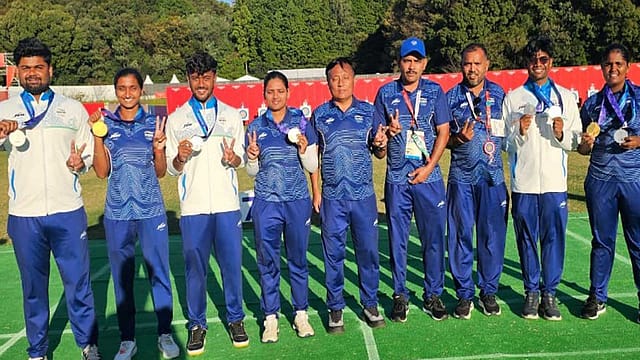
India’s archery campaign at the 2026 Asian Games in Aichi-Nagoya, Japan, ended with five gold medals, nine podium finishes and a string of historic milestones, with teenager Kumkum Mohod emerging as the standout name of the competition.
Indian archers won nine medals from 10 events: five gold, two silver and two bronze, matching the country’s record archery medal tally from Hangzhou 2023, according to Olympics.com.
More significantly, the five gold medals made archery India’s most successful discipline at the Games in terms of gold medals.
At the centre of the campaign was 17-year-old Kumkum, who became the first Indian to win an individual recurve gold at the Asian Games. Her victory also secured India a women's individual recurve quota place for the LA 2028 Olympic Games, subject to selection by the Indian Olympic body.

Look Who's Talking Regime Change
23 Oct 2026 - Vol 05 | Issue 43
Who is Kumkum Mohod and what did she achieve at the Asian Games?
The teenager from Amravati produced one of the most dramatic finishes of India's Asian Games campaign.
Kumkum faced Republic of Korea's Oh Yejin in the women's individual recurve final. After the contest ended 5-5, the gold medal had to be decided by a shoot-off.
Oh shot an eight.
Kumkum answered with a 10.
That single arrow made her the first Indian to win an individual recurve gold at the Asian Games.
Before her breakthrough, India's only individual recurve medal at the Games had been Tarundeep Rai's silver at Guangzhou 2010.
Kumkum's gold was also her third medal in Aichi-Nagoya. She had earlier helped India win gold in the women's recurve team event before pairing with Dhiraj Bommadevara for silver in the mixed recurve team event.
How did Kumkum Mohod win the individual recurve gold?
Her route to the final was just as impressive.
Kumkum defeated South Korea's reigning world champion and Olympic medallist Kang Chaeyoung 6-3 in the quarter-finals before beating China's Zhu Jingyi 6-2 in the semi-finals.
The final against Oh was far tighter.
Oh won the opening set 29-27, while the second ended 29-29. Kumkum responded with a perfect 30 in the third set but entered the final set trailing 5-3 after losing the fourth.
With the gold at stake, she shot another perfect 30 to force the shoot-off.
She then produced the decisive 10.
The victory not only delivered India's first individual women's recurve gold at the Asian Games but also helped secure the country's women's recurve quota place for LA 2028. The finalists in the men's and women's individual recurve events at Aichi-Nagoya earned one Olympic quota place for their respective countries, subject to selection by their National Olympic Committee.
How did India perform in men's recurve?
India also finished on the men's individual recurve podium, although neither of its archers secured one of the two available men's individual Olympic quota places.
World No. 1 Dhiraj Bommadevara, who topped the qualification round, lost 7-3 to South Korea's Lee Wooseok in the semi-finals.
Neeraj Chauhan also fell in the semi-finals, losing 7-1 to Japan's Junya Nakanishi.
The two Indians then met in the bronze-medal match.
Neeraj prevailed in a tense finish. After Dhiraj opened the final rotation with an eight, Neeraj responded with a 10 and carried a one-point advantage into the final arrow. Both archers then shot 10s, giving Neeraj the bronze.
The result meant India won medals in all five recurve events at Aichi-Nagoya, collecting two golds, two silvers and one bronze.
What did India win in compound archery?
India's success was not limited to recurve.
The compound archers added three team gold medals and an individual bronze, with Chikitha Taniparthi becoming another major figure in the campaign.
Chikitha won two gold medals.
She was part of India's women's compound team alongside Jyothi Vennam and Prithika Pradeep, which defeated China 238-234 in the final. The Indian trio also matched the world record during their gold-medal performance.
Chikitha then teamed up with Sahil Jadhav in the mixed compound team event. The pair defeated South Korea in the final to win another gold and secure India a historic LA 2028 Olympic quota place in the compound mixed team event.
India also won a medal in the men's individual compound event.
The women's individual compound event was the only archery competition at Aichi-Nagoya in which India failed to finish on the podium.
What makes India’s Asian Games archery campaign significant?
The numbers tell only part of the story.
India's five archery gold medals were the most won by any individual sport or discipline at the Aichi-Nagoya Asian Games. The overall nine-medal haul also matched the country's record from Hangzhou 2023.
But the campaign also showed the breadth of India's archery programme.
India collected medals across both recurve and compound formats, won medals in every recurve event and produced major breakthroughs from its younger athletes.
Kumkum's individual recurve gold and Olympic quota stood out as the defining achievement. Chikitha's two compound golds added another layer to a campaign that was not dependent on one format or one generation of archers.
For Indian archery, Aichi-Nagoya was therefore more than another strong Asian Games medal tally. It offered a glimpse of a potentially deeper and more competitive LA 2028 Olympic cycle, with established stars and young medal winners now carrying India's hopes across multiple events.