Kane’s Golden Wait Ends
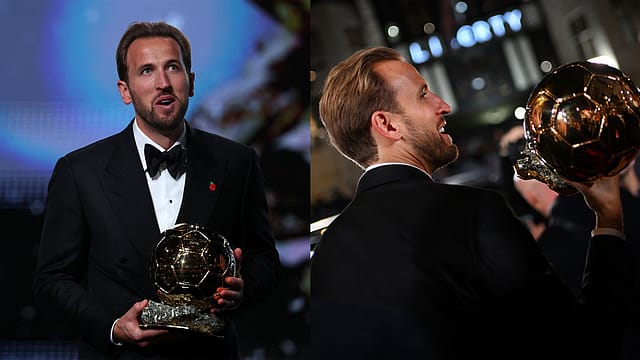
It is incredible to think that until just two years ago, when he was very much an all-time great striker and also very much at Bayern Munich – the German club that wins silverware pretty much for fun – Harry Kane hadn’t won a single trophy in his long and illustrious pro-career. Not one. Not in club football, be it in England or Germany, not with England, who he was long captaining from as early as the 2018 FIFA World Cup. Heck, not even one from his junior days to show for his brimming greatness.
Yet, just two short years later, in seemingly the blink of an eye, Kane ended up cradling against his bosom the most coveted individual trophy in all of football – the Ballon D’or. Which is genuinely a marvel of a feat to pull off in a World Cup year, given that in such a season one has to either win the World Cup or the UEFA Champions League, or both, as all Ballon D’or winners have tracing back to Zinedine Zidane in 1998. Kane won neither, his teams England and Munich falling at the semi-finals stage in both tournaments.

Look Who's Talking Regime Change
23 Oct 2026 - Vol 05 | Issue 43
But with 61 goals in 51 appearances for Munich – a single-season record for the club – as well as six goals for England at the World Cup, which shattered Gary Lineker’s all-time record for the country at the quadrennial, the 33-year-old forward had done just about enough to breast the tape ahead of France’s Kylian Mbappe and Spain’s Lamine Yamal.
Yamal, World Cup winner this year with Spain at just 18, looked visibly disappointed in the front row when Ronaldo, the original one, R9, announced on stage (Academy Award-style with all the nominees in little inset boxes) that the next-big-thing still had to wait a while to wrap his hands around the golden ball. But the cheer at the London Palladium Theatre in the capital of England screamed out just who the favourite was. Their very own legend, Kane.
The victory ended England’s 25-year wait for a men’s Ballon d’Or winner, the last being Michael Owen in 2001. Kane became only the fifth Englishman to win the award, joining a distinguished list that includes Sir Stanley Matthews, Sir Bobby Charlton and Kevin Keegan. The ceremony was also a homecoming of sorts: held outside of France or Switzerland for the first time, it marked the 70th anniversary of the award, which Matthews won at its inaugural edition in 1956.
Kane’s triumph was built on a season of extraordinary numbers. He scored 73 goals for club and country, helping Bayern to the Bundesliga and German Cup double while also winning the European Golden Boot. Bayern had paid €100 million for him in 2023, a sizeable investment in a striker already into his thirties and still without a major team trophy. Three years later, the fee looks rather less like a gamble.
There was, however, more to the evening than the numbers. Kane’s acceptance speech was a tour through the people who had accompanied him on a career that was anything but a straight line to the top. He began by thanking his Bayern teammates, singling out the competitive edge of training against defender Dayot Upamecano, before praising manager Vincent Kompany, who was absent from the ceremony while recovering in hospital.
Kane also reserved a special acknowledgement for Tottenham Hotspur, the club he joined as an 11-year-old and where he spent 19 years before leaving for Germany. It was a generous gesture towards the club with which he had become synonymous, even if the trophies had eluded him there. “I wouldn’t be where I am today without Tottenham,” he said, recalling the coaches and the many ups and downs that had shaped his career.
The speech became more personal as he moved from football to family. His parents, who had driven him to training and followed him around England and Germany, were there to witness the moment. So was his elder brother Charlie, with whom he remembered kicking a ball around the garden as children. Kane thanked the coaches who had helped him along the way, from his early development at Tottenham to the managers who had shaped his senior career, including Mauricio Pochettino, José Mourinho and Gareth Southgate.
Then came his wife, Kate, whom he called his best friend and biggest supporter. This was a trophy, he said, that they celebrated together, not one that belonged to him alone. His four children, watching at home well past bedtime, were the reason he did what he did. He wanted to set an example, both as a father and as a professional, of what hard work and belief in oneself could achieve.
It was a fitting end to a night that had finally caught up with a career whose most striking feature has been its persistence. Kane’s journey included loan spells at Leyton Orient and Millwall, and years spent trying to establish himself before becoming one of the most reliable goalscorers of his generation. His lack of silverware had become a running joke, an unfortunate footnote to a body of work that deserved better.
Now, with the Ballon d’Or in his hands, that footnote can be deleted. For a player who spent so long being defined by what he had not won, the sweetest part of the story is that he never stopped believing he would. Then on Monday night, that stoic belief gloriously glinted in his hands.