India vs New Zealand CARNAGE | Abhishek Sharma. Vaibhav Sooryavanshi. Six Overs. 118 Runs
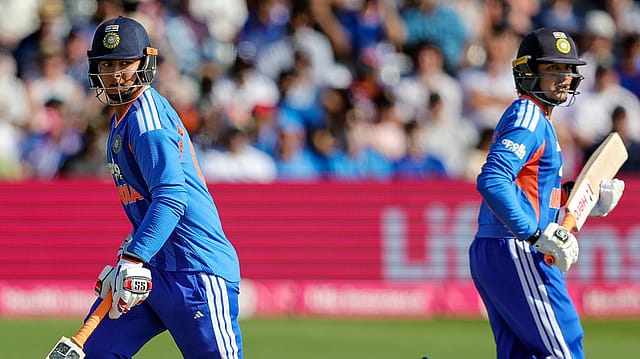
India brought up their hundred in five overs. This is not a drill. Or a video game.
Two left-handers were doing this to New Zealand in Wellington. Abhishek Sharma and Vaibhav Sooryavanshi reached 118 without loss by the end of the powerplay, the highest recorded powerplay total in men’s T20Is, according to the ESPNcricinfo live statistic supplied by Sampath.
The previous benchmark was Romania’s 116/0 against Serbia in Sofia in 2021, when the chase ended after 5.4 overs. Australia had made 113/1 against Scotland in Edinburgh in 2024. India had gone past both.
Their hundred in 30 legal deliveries was also the second-fastest recorded team hundred in men’s T20Is where ball-by-ball data is available. Only Eswatini’s 29-ball hundred against Mozambique earlier this year was quicker.

Look Who's Talking Regime Change
23 Oct 2026 - Vol 05 | Issue 43
But the record book can wait a moment. Jacob Duffy has a new ball, Sooryavanshi is taking guard, and New Zealand have 198 to defend.
Here comes the first delivery.
First over: Duffy discovers the problem
0.1 | FOUR. Sooryavanshi clears his front leg and sends the ball over mid-on. There goes the customary inspection of the pitch.
0.2 | NO-BALL. Duffy bangs it in short. Sooryavanshi swings and misses. The bowler has overstepped, which rather spoils the satisfaction of beating the bat.
0.2 | TWO. The free hit goes high off a slice and drops short of the deep-point boundary. Two runs. New Zealand have already had to watch a ball disappear vertically as well as horizontally.
0.3 | SIX. Short again. Sooryavanshi makes room and carves it over deep point. Duffy has delivered three legal balls. Thirteen runs have gone.
0.4 | ONE. An inswinging yorker finds the inside edge and runs behind square. A useful delivery, although getting Sooryavanshi off strike introduces Duffy to another problem.
0.5 | SIX. Abhishek advances and slashes the short ball over deep point. The two left-handers appear to have agreed on a destination.
0.6 | FIVE WIDES. Duffy’s bouncer sails over the advancing Abhishek and beyond the wicketkeeper. New Zealand are now helping with the arithmetic.
0.6 | ONE. Abhishek punches to deep point. The over is finally complete.
India 24/0. Duffy has bowled eight deliveries and conceded nearly an eighth of the target.
Second over: Milne tries a different length
1.1 | DOT. Movement away from Abhishek beats the outside edge. Adam Milne begins with a delivery worth putting in the team meeting.
1.2 | SIX. Fuller outside off. Abhishek throws his hands at it and clears deep point. The meeting may need a second slide.
1.3 | SIX. Milne shortens his length. Abhishek stays leg-side of the ball and hits over cover. The adjustment has cost another six.
1.4 | FOUR. More width. Abhishek reaches it and pounds the ball over cover. New Zealand have tried changing the length while leaving his arms wonderfully free.
1.5 | ONE. A low full toss is squeezed towards deep backward point. Abhishek has taken 17 from five deliveries. Sooryavanshi can resume.
1.6 | DOT. A climbing short ball beats Sooryavanshi’s swing. Milne has begun and ended with dots, a respectable-looking frame around some expensive contents.
India 41/0. Seventeen off the over. Duffy’s opening spell suddenly has competition.
Third over: Perhaps spin?
Michael Bracewell comes on. Offspin against two left-handers offers a perfectly sound cricketing argument. He still has to land the ball.
2.1 | FOUR. Short, wide and hit over cover by Abhishek. The argument suffers an early setback.
2.2 | SIX. Bracewell gives it more flight. Abhishek comes down the pitch and lifts him over extra cover. Pace has gone. The ball keeps travelling.
2.3 | FOUR. Another short delivery. Abhishek cuts over point. India have passed fifty, and Bracewell has conceded 14 from three balls.
2.4 | ONE. Abhishek takes the single. Sooryavanshi has faced only six legal deliveries so far. There are quieter ways to participate in a demolition.
2.5 | SIX. Bracewell drops short on the stumps. Sooryavanshi hits over long-on, extending the area New Zealand need to worry about.
2.6 | DOT. Sooryavanshi jabs to cover and berates himself.
He has 23. India have 62. Apparently, something could still be improved.
India 62/0. Three bowlers tried. Opening overs of 24, 17 and 21.
Fourth bowler, same emergency
Kyle Jamieson gets the fourth over. Abhishek welcomes him with four, misses a short ball, then hits successive sixes. The second brings up his fifty from 15 balls. He follows it with another four.
India are 84 without loss after four overs.
Milne returns. Twenty come off the fifth, taking India to 104/0. The hundred has arrived within five overs, and New Zealand have yet to dismiss anybody.
The hitting has a clear method beneath the noise. Both batters keep creating room for their arms. New Zealand repeatedly provide width, allowing them to attack over point and cover during the field restrictions. Short balls sit up; fuller balls become invitations to swing through the line.
The bowlers do beat the bat. They find dots. Their difficulty is making one good delivery lead to another.
Duffy’s sixth over illustrates the problem: four, four, dot, dot, four, six. Two consecutive scoreless balls, followed by ten runs. Sooryavanshi finishes the powerplay with another six, and India have 118 without loss.
Of those runs, 104 have come in boundaries: eleven fours and ten sixes. Abhishek has 67 from 20 balls.
India need 81 from 84.
Bracewell’s next over costs 15, beginning with two more Abhishek sixes. The required rate has become so modest that taking a single now feels like an act of administrative responsibility.
Then, at 7.1 overs, Fisher bowls to Sooryavanshi. The batter makes room, swings and catches the ball low on the bat. Daryl Mitchell runs in from long-on and tumbles to his right to hold the catch.
Sooryavanshi leaves for 45. The opening partnership ends at 133. New Zealand have their first wicket. India need 66 from 77 balls. They began the chase needing almost ten an over. By the time New Zealand separated the two lefties, India could afford to score at barely five.