India U15 Football Camp: How AIFF Scouted 12,000 Players for FIFA U-15 World Cup 2026
Twelve thousand boys entered the frame.
Sixty scouts criss-crossed India for two seasons. They watched school tournaments, youth leagues, national championships, district competitions and open trials. They also tracked Indian footballers growing up in overseas academies.
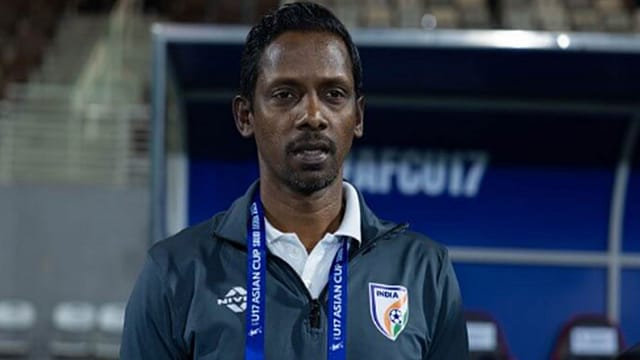
Now comes the squeeze. A trial camp has begun in Bengaluru under coach Bibiano Fernandes. At the end of it, only 14 players will survive the final cut and represent India at the inaugural FIFA U-15 World Cup & Festival in Azerbaijan. Here is how one of Indian football’s widest talent hunts will produce its youngest national team.
What is happening at the India U15 camp?
India’s U15 men’s national camp began at the Centre for Sports Excellence in Bengaluru on August 16, with players born in 2011 and 2012 being assessed in batches. The camp is still in its trial phase. New players will continue to arrive, while those who do not make the cut will return to their clubs and academies. Bibiano Fernandes will head the programme, assisted by Surinder Singh. The camp will include matches against older teams from clubs and academies, giving the coaches a chance to test how the boys handle stronger, quicker and more physically developed opponents. The All India Football Federation also plans to arrange international friendlies against other U15 national teams before selecting the final squad.

Losing Memory
16 Oct 2026 - Vol 05 | Issue 42
The making of a medical and social emergency
How big was the search for these players?
The numbers reveal the scale. According to the AIFF’s official account of the scouting programme, more than 12,000 boys were assessed during the 2024-25 and 2025-26 seasons. A network of 60 scouts, including former India internationals, national-level footballers and AIFF-licensed coaches, monitored players across more than 20 competitions and development platforms. The search covered the AIFF Elite, Junior and Sub-Junior Youth Leagues; junior and sub-junior national championships; School Games Federation of India competitions; Reliance Foundation youth leagues; the Subroto Cup; Sports Authority of India camps; and numerous state, district and private tournaments. State associations were also asked to conduct open trials, allowing boys outside the established national competition structure to enter the selection pathway.
How did 12,000 players become a national trial pool?
The strongest prospects were brought together for central trials at AIFF-FIFA Talent Academies. Bhubaneswar hosted 160 players, while another 205 were assessed in Hyderabad. That brought 365 boys from different states, competitions and football systems into a common evaluation pool. The central trials allowed the coaches to compare players against the best prospects from across the country instead of judging them only within their local competitions. AIFF has also moved towards a district-focused scouting model. Local coaches and former players are being trained and used to identify talent closer to its source, particularly in areas that national scouts may otherwise miss. The federation is simultaneously monitoring Indian citizens training at clubs and academies overseas.
Was this entire programme built for the FIFA tournament?
No. The scouting operation began nearly two years before FIFA announced the new U15 competition. AIFF Deputy Secretary General M Satyanarayan said the original aim was to identify players born in 2011 and 2012 for the federation’s talent academies. FIFA’s announcement gave that existing pool an immediate international target. The boys were already being tracked. The World Cup provided them with a destination.
Is this a conventional FIFA World Cup?
Not quite. Despite its official name, the FIFA U-15 World Cup & Festival has been designed as a development-first event rather than a smaller replica of the senior World Cup. FIFA says the matches will be shorter, played on smaller pitches and contested by teams comprising between seven and nine players a side. All 211 FIFA member associations are eligible to participate, making the tournament a vast global gathering of emerging footballers rather than an event restricted to teams that survive continental qualifying rounds. The boys’ competition will debut in 2026, followed by a girls’ edition in 2027. From 2028, member associations will be invited to send both boys’ and girls’ teams to separate tournaments.
When and where will the tournament be played?
The inaugural tournament will be held in Azerbaijan from October 22 to 31. FIFA confirmed Azerbaijan as host on June 24, citing its ability to accommodate thousands of young players and support staff at a centralised venue. The country will also co-host the FIFA U-20 World Cup in 2027.
Why has AIFF brought back Bibiano Fernandes?
Few Indian coaches know the youth international pathway as intimately as Fernandes. He first took charge of India’s U15 team in 2017 and has since coached national sides across age groups. Under his leadership, India qualified for the AFC U17 Asian Cup in 2018, 2020, 2023 and 2026. The 2020 tournament was subsequently cancelled because of the Covid-19 pandemic. His standout continental campaign came in 2018, when India reached the AFC U16 Championship quarterfinals and lost 1-0 to South Korea, narrowly missing qualification for the FIFA U17 World Cup. Fernandes has also guided India to five SAFF age-group titles: the U15 championships in 2017 and 2019, the U17 championships in 2022 and 2025, and the U19 title in 2025. His appointment was approved by the AIFF Executive Committee on August 6 before he formally signed his contract and took charge of the camp.
Who is assistant coach Surinder Singh?
Surinder Singh brings experience from club football and the international youth circuit. An AFC Pro Licence holder, he has coached Delhi FC and Minerva Punjab FC. He was also part of the Philippines U17 women’s staff that helped the team qualify for the 2026 AFC U17 Women’s Asian Cup. His familiarity with academy football and young players makes him a natural fit for a camp where evaluation and development matter as much as immediate results.
Why could this project matter beyond one tournament?
India’s final 14 may spend only ten days in Azerbaijan, but the larger prize is the player pool left behind. Thousands have now entered a structured identification system. Hundreds have been compared at national trials. Their progress can be tracked towards the U17 and U20 teams even if they miss this squad. That is the real value of the search. Fourteen boys will board the flight to Azerbaijan. Indian football’s job is to ensure the other 11,986 do not simply disappear.
(With inputs from ANI)