India-Sri Lanka 1st Test: The Most Important Runs in Devdutt Padikkal's 167 Came After 100
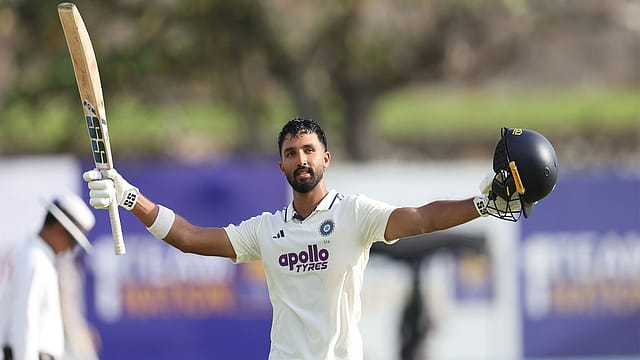
Devdutt Padikkal had already done the difficult bit.
He had his hundred. The helmet had come off, the applause had arrived and a milestone that had eluded him through the stop-start beginning to his Test career was finally his. He could have nicked one for 135 on Sunday and Galle would still have been remembered as the Test in which Padikkal announced himself.
Except Sunday morning never really arrived. Rain swallowed the entire first session. Padikkal, unbeaten on 133 overnight, had to wait again. There is something almost appropriate about that. Padikkal reportedly waited 632 days between Test appearances. Speaking about that period after reaching his maiden hundred, he admitted that being outside the Indian team had been difficult. “It's never easy,” he said of the long road back. Then, having waited almost two years for another Test, he was made to wait a few more hours before he could resume the innings that might change the course of his career.

Rise of the Pivotal Power
18 Sep 2026 - Vol 05 | Issue 38
The BRICS declaration is a strategic victory for Modi
When play finally began, Sri Lanka found some life. Rishabh Pant charged Keshara Nuwantha and miscued to mid-off for 39. KL Rahul, who had retired hurt with cramps on Day 1, returned on 77 but managed only five more before Nuwantha removed him for 82.
Suddenly, the serene Indian innings had acquired some friction. Padikkal stayed. And that is why the most interesting part of his 167 wasn't necessarily the first 100 runs. It was what happened after them. A hundred gets remembered. A big hundred tells you something else The temptation with a maiden Test century is to treat three figures as the finish line.
Padikkal didn't. He had resumed on 133 and, with wickets beginning to fall at the other end, kept stretching the innings. Dhruv Jurel joined him and the pair added 38. Padikkal went past 150 for the first time in Test cricket before Prabath Jayasuriya finally ended the innings.
167 from 230 balls. Fifteen fours. One six.
Padikkal's innings helped India reach 364/5 by tea on a rain-hit second day after the tourists had resumed from 288/2. By stumps, India had moved to 460/9.
But there was a statistic buried inside Padikkal's innings that told a more interesting story than India's total. Only two Indian No. 3 batters before him had scored 150 or more in a Test innings against Sri Lanka. Rahul Dravid: 177. Cheteshwar Pujara: 153. Devdutt Padikkal: 167. Those are dangerous names to put around a 26-year-old after three Tests. Padikkal hasn't suddenly become Dravid or Pujara because of one innings in Galle, and comparisons of that kind would be absurdly premature.
What matters is what those two men represented. They understood the value of occupation. In Test cricket, getting in is only the beginning of the transaction. Once the bowlers have spent overs trying to remove you, once the ball has softened and the fielding side has been forced into its second and third plans, leaving cheaply can feel like giving something back. Padikkal didn't give much back in Galle.
The feet told another story
There was another encouraging element to the innings: how Padikkal handled Sri Lanka's spinners.
His decisive footwork and willingness to stay positive rather than allow the slow bowlers to dictate terms were striking. That matters in Galle. This is a ground where spin doesn't merely take wickets. It can occupy a batter's mind long before it gets him out. Padikkal's response was movement. He went forward. He went back. He used his reach. When the ball was there to attack, he attacked it. There was intent without recklessness.
The significance becomes clearer when placed against his Test beginnings. Padikkal made 65 on debut against England in Dharamsala in March 2024, then disappeared from India's Test XI. Opportunities at this level do not queue politely. When another finally arrived in Sri Lanka, it came because Sai Sudharsan was unavailable through injury.
On Day 1, Padikkal turned that opportunity into his maiden Test hundred. On Day 2, he turned the hundred into a big one. That distinction is worth making. The 67 after 100 There is a strange psychological reset that accompanies a maiden hundred. For hours, the milestone sits somewhere in the distance. Ninety arrives. Then 95. Every dot ball acquires weight. Every risky stroke threatens to become the shot people remember. Then the hundred comes. Relief can loosen concentration as easily as it loosens shoulders. The personal mission has been completed. The scoreboard suddenly looks different. A batter who has spent an innings pursuing something can find himself wondering what exactly he is pursuing next.
Padikkal found another 67 runs. They came across two days, an overnight interruption and a rain delay. They came while India lost Pant and Rahul. They took him beyond 150 and into statistical company occupied by two of India's defining No. 3s. And they changed the meaning of his innings. At 100, Padikkal had a breakthrough. At 167, he had demonstrated appetite. That appetite becomes more revealing when placed against the route that brought him back to Test cricket. After the promise of his debut, Padikkal spent a long stretch outside the side, trying to force his way back through domestic cricket and India A performances. The wait could have produced urgency when another chance finally appeared. Instead, Galle produced patience.
There is a lovely contradiction there.
A batter who had every reason to hurry to establish himself played an innings built around refusing to hurry. He batted for 230 balls. He shared a 150-run partnership with Rahul after Yashasvi Jaiswal's early departure. He negotiated the interruptions of Day 1. He went to bed with his maiden century secured. He waited through the rain on Day 2 and then returned to keep accumulating.
Sri Lanka eventually got him. They had to earn it. There will inevitably be a temptation now to make Padikkal's innings answer questions it cannot possibly answer after three Tests. It shouldn't. One hundred and sixty-seven runs do not settle a Test career. They don't guarantee the No. 3 position, particularly when Sai Sudharsan remains part of India's plans. They don't tell us how Padikkal will respond when conditions change, when elite fast bowlers attack him outside off stump or when a second innings demands something completely different.
Galle is evidence, not a verdict. But it is persuasive evidence. Padikkal was given another chance and made his first Test century. Then he refused to stop at the century. He batted for 230 balls, went past 150 and made Sri Lanka work for his wicket. Somewhere between 100 and 167, the innings changed. The hundred proved Devdutt Padikkal could get there. The next 67 told India what he wanted to do once he arrived.
(With inputs from ANI)