Gold, Grit and Ghar Ka Khana: India Retain Asian Games Hockey Title, Book LA 2028 Berth
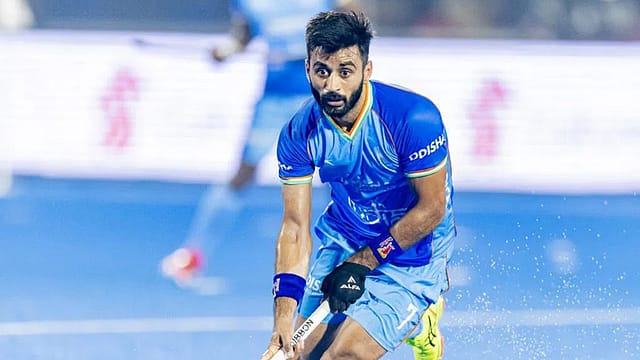
Los Angeles could wait for a moment. Hardik Singh wanted his mother’s rajma chawal and kheer. Manpreet Singh was thinking of aloo parathas, aloo sabzi and the Maggi his wife makes. Dilpreet Singh’s next target was simply to get home for a meal cooked by his mother.
India’s hockey players had earned their indulgences.
A commanding 5-1 victory over Malaysia in Aichi-Nagoya on Saturday gave the men’s team its second successive Asian Games gold and qualification for the Los Angeles 2028 Olympics. For the first time, India had successfully defended the men’s hockey title at the continental event.
Captain Harmanpreet Singh scored twice, becoming the first Indian captain to lead the men to two Asian Games gold medals. Manpreet, India’s most-capped player, became the first Indian hockey player to win three.

Losing Memory
16 Oct 2026 - Vol 05 | Issue 42
The making of a medical and social emergency
The victory also completed an unprecedented Indian hockey double: the men’s and women’s teams won gold at the same Asian Games for the first time.
Yet, when the players spoke afterwards, the conversation travelled beyond records and medals. They talked about a bruising World Cup campaign, the people who helped them through it, teammates who had stayed behind in Bengaluru and the work that had made this triumph possible.
FROM WORLD CUP SETBACKS TO ASIAN GAMES GOLD
For head coach Craig Fulton, the objective had been clear: win consecutive titles and claim a place in Indian hockey history.
The route demanded a reset.
“It wasn’t easy, especially coming off the back of the World Cup, where we had some tough moments,” Fulton told ANI. “But we bounced back, had a great debrief and team-building session before arriving in Japan, and the proof was in the pudding. We were consistent across all seven games and played a very good final.”
Hardik’s account offered a more personal glimpse of that period. After the World Cup, family and friends had helped him manage the strain.
“They were there every day and night, talking and laughing with me to keep me stress-free,” he said.
Those were the people with whom he now wanted to celebrate a medal he described as one of the hardest to achieve.
Manpreet credited Fulton’s approach with helping the players recover their confidence. The coach, he said, addressed mistakes directly while keeping the mood constructive.
“Craig never scolds. He always points out where we made mistakes and evaluates our performance percentage—whether we played up to our standard or not,” Manpreet said.
“He remains positive and keeps everyone motivated, understanding that players have good and bad days and guiding us on how to bring our best back to the game.”
THE PAKISTAN SCARE BEFORE THE MALAYSIA FINAL
India’s passage to the final had been considerably tighter than the gold medal scoreline suggested.
A 4-3 semifinal victory over Pakistan on Thursday tested their ability to retain control under pressure. Fulton acknowledged that a strong start had given way to a difficult spell.
“In the second half, we lost our way a little bit, and Pakistan are the kind of team that can hurt you if you make mistakes. They did that,” he said.
India nevertheless found a way through. Fulton attributed that to the players’ belief that they could win even after the match became uncomfortable.
Against Malaysia, the emphasis was on applying pressure from the outset and sustaining it.
“Today, our strategy from the start was to maintain pressure and attack continuously, capitalizing on opportunities to convert penalty corners or field goals,” Manpreet said.
Dilpreet described the defensive thinking behind that approach: press Malaysia’s fullbacks early and limit their entries into India’s circle.
“Our mindset was just to let the opponents enter the circle as little as possible, put early pressure on their fullbacks, and as a team, everyone defended well,” he said.
The 5-1 result delivered the decisive finish India wanted.
HOW INDIA WORKED ON THE CLOSING SECONDS
Hardik identified another area in which the team had worked to improve: the closing moments of matches.
India had previously conceded late goals, he said. This time, the players trusted their preparation enough to believe they could score with only seconds remaining.
“We trusted our structure, we trusted our training that we do in Bengaluru, and we knew that even in the last 5 seconds, we could score a goal,” he said.
For Hardik, the change reflected deliberate work. The team had focused on those decisive passages, while its defenders and goalkeepers provided protection against opponents capable of threatening on the counterattack.
His dedication extended to the wider group training in Bengaluru, including India A players who had not made the Asian Games squad.
“Even though they did not get a chance to be part of the final team, because of them, we keep getting better and better,” he said.
The medal belonged, in his telling, to a larger group than the players who stood on the podium.
MANPREET’S THIRD GOLD, HARMANPREET’S CAPTAINCY FIRST
For Manpreet, the title added a third Asian Games gold to those he won in 2014 and at the 2022 edition. Harmanpreet’s second gold as captain established another Indian first.
The result gave India its fifth men’s hockey title at the Games, following victories in 1966, 1998, 2014 and 2022.
It also took India’s overall medal tally at that point in Aichi-Nagoya to 85: 21 gold, 27 silver and 37 bronze.
The Olympic qualification secured by both hockey teams gave the achievement added significance.
“Both our men’s and women’s teams have qualified for LA from here, so it’s been a very significant tournament for us,” Manpreet said.
NEXT STOP: HOME-COOKED FOOD
The players also spoke of accommodation and food difficulties during their stay in Japan. Hardik recalled spells of wind and rain; Dilpreet described the compromises players made to keep the team’s needs first.
Now, with gold secured, the dietary restrictions could briefly give way.
“I will go home and eat naan! But main thing is home-cooked rajma chawal and kheer made by my mom,” Hardik said.
Manpreet, who dedicated his medal to his family, especially his two daughters, had his own menu ready.
“For me at home, it will be aloo parathas or aloo sabzi made by my mother, or Maggi, which my wife makes really well.”
Dilpreet needed no elaborate list.
“Right now, the only goal is to reach home soon and eat food cooked by my mother.”
With inputs from ANI