Game, Set, Tears: When Federer and Djokovic Discovered That Even Greatness Can't Defeat Time
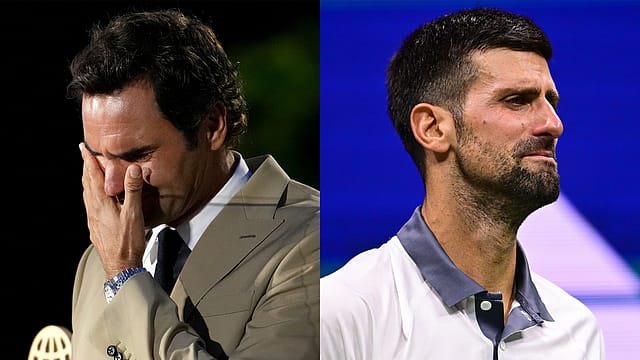
Roger Federer reached for a tissue. A day later, Novak Djokovic reached for whatever strength remained inside a failing body.
Federer was standing in Newport, Rhode Island, dressed for his induction into the International Tennis Hall of Fame. His wife Mirka had just narrated the life behind the forehand: the sacrifices, the travelling family, the husband and father concealed beneath the headband. Federer tried humour. He asked for tissues and sunglasses. Then the tears defeated him again.
Twenty-four hours later and about 280 kilometres away, Djokovic sat inside Arthur Ashe Stadium with a towel over his face.
This was no ceremony. There was no commemorative jacket, no loving introduction and no career waiting to be admired from a safe distance. There was still a match to finish. Mariano Navone was still across the net. Djokovic was still officially chasing a record-extending 25th Grand Slam title.

Zeroing In on ECI
09 Oct 2026 - Vol 05 | Issue 41
Constitutional legitimacy versus political opportunism
His body, however, appeared to have withdrawn from the chase.
The 39-year-old had vomited, cramped and struggled with his back and shoulder during a first-round contest lasting four hours and 36 minutes. As the match slipped away, Djokovic began to cry. The man who had spent two decades refusing surrender seemed to recognise an opponent that could neither be broken nor outlasted.
Time had finally held serve.
Federer’s tears came after the journey. Djokovic’s arrived while he was desperately trying to extend it. One champion had made peace with becoming history. The other was discovering that history might be preparing to move on without his permission.
Happy Tears, Painful Tears
Federer had cried several times during his Hall of Fame speech. He struggled while speaking about his childhood idol Stefan Edberg. The tears returned when he thanked his longtime coach Severin Luthi. Then came Mirka.
“Now the Mirka part,” Federer began before breaking down. “Oh gosh, this is such a mess.”
There was no defeat to mourn. Federer was being welcomed into sporting immortality as the 274th member of the Hall of Fame. He spoke about tennis as a love letter that remained unfinished even though his playing career had ended four years earlier.
“This is not a goodbye,” he said, according to ABC News.
It was an important distinction. Federer had already survived the hardest goodbye. The Hall of Fame allowed him to return to the game without asking his knees to carry him through five sets. He could finally look backwards without needing to prepare for another match.
Djokovic had no such luxury.
Against Navone, he was attempting to do what he had always done: absorb suffering, disturb probability and turn physical distress into another chapter of defiance. He had spent his career winning matches that appeared to have escaped him. This time, the escape belonged to his opponent.
Navone won 7-6, 5-7, 4-6, 6-2, 6-1, handing Djokovic his first opening-round defeat at a Grand Slam since 2006. The Serbian had gone 78 consecutive majors without losing his first match.
This was larger than an upset.
A first-round exit forces an ageing champion to confront questions that a semifinal defeat can temporarily hide. Djokovic was not eliminated by Carlos Alcaraz or Jannik Sinner, the two young men who have taken possession of the sport’s biggest stages. He was beaten by the 49th-ranked player in the world after his own body began closing down around him.
Djokovic later spoke about a recurring health problem aggravated by heat, humidity and the strain of competition. But the tears had already said what the medical details could not.
The mind was still issuing commands. The body was beginning to reject them.
Federer Had Been Here Before
Federer knew those tears.
In the 2009 Australian Open final, Rafael Nadal defeated him across five sets and prevented him from equalling Pete Sampras’s then-record of 14 Grand Slam titles. Federer approached the microphone for his runner-up speech and discovered that language had deserted him.
“Maybe I’ll try later,” he said. “God, it’s killing me.”
Then he cried.
Nadal placed an arm around him and offered comfort before accepting the trophy. The image became one of tennis’s defining pictures: the winner consoling a man who, until recently, had appeared almost incapable of losing.
The defeat carried a fear larger than the scoreboard. Nadal had now beaten Federer in major finals on clay, grass and hard court. Perhaps Federer’s time as the game’s supreme force had ended. Perhaps Sampras’s record would remain beyond him.
It did not. Federer equalled it at the French Open a few months later and broke it at Wimbledon.
A decade later, Wimbledon hurt differently.
In the 2019 final, Federer held two championship points on his own serve against Djokovic. He lost both, then lost the match in the fifth-set tiebreak. Federer later acknowledged crying after the defeat.
He was 37. Another Wimbledon final could no longer be treated as an appointment waiting in next year’s diary. Age had transformed two lost points into something far more painful: two doors that might never open again.
They did not.
Federer never played another Grand Slam final.
That is what makes the tears of ageing champions different. A young player can place defeat inside the promise of tomorrow. A veteran cannot be certain that tomorrow will contain the same court, the same opportunity or a body capable of reaching either.
When Serena Waved
Serena Williams understood that uncertainty in Melbourne in 2021.
After losing the Australian Open semifinal to Naomi Osaka, the 39-year-old stopped before leaving Rod Laver Arena. She raised a hand to her heart and gave the crowd a long wave.
It looked like goodbye.
When a reporter later asked whether it had been a farewell, Williams resisted the suggestion. If she ever said goodbye, she replied, she would not tell anyone. Moments later, while discussing her errors during the match, she broke down and left the press conference.
The defeat had ended another attempt to win her 24th Grand Slam singles title and equal Margaret Court’s record. Williams had won her 23rd in Melbourne in 2017 while pregnant. After returning to tennis, she reached four major finals and lost them all.
Every subsequent Grand Slam carried the same burden: perhaps this would be the one; perhaps this would be the last chance. Her tears in 2021 contained both possibilities.
Eighteen months later, the goodbye finally arrived in New York. Williams fought Ajla Tomljanović for more than three hours in the third round of the US Open. She saved five match points, stretching the final contest in the same manner that she had stretched the final years of her career.
Eventually, the competitor ran out of answers. The woman then took over. Williams cried while thanking her parents. She thanked her husband and family. Then she turned towards the person without whom the Serena Williams story could never have begun.
“I wouldn’t be Serena if there wasn’t Venus,” she said.
The scoreboard recorded a defeat. Arthur Ashe Stadium witnessed a life being packed away.
Bodies Deliver the Verdict
For some champions, retirement is a considered decision. For others, the body makes it on their behalf.
Juan Martín del Potro began crying before the final match of his career had even ended. The Argentine was playing Federico Delbonis at the 2022 Argentina Open after four surgeries on his right knee. During the final game, chants of “Delpo” descended from the stands. Del Potro covered his face and wept while still sitting on the changeover bench.
There were points left to play, but he already knew. The match was technically alive. His career was not.
Del Potro’s tears carried another kind of grief.
He was mourning the career his talent had promised but his body had repeatedly interrupted. He had beaten Federer to win the 2009 US Open at 20 and possessed a forehand capable of rearranging matches with a single swing. Injuries ensured that tennis received only fragments of what might have followed.
Andy Murray’s reckoning also arrived through pain.
At the 2019 Australian Open, a tearful Murray said the tournament might be his last because the agony in his hip had made ordinary life and elite competition almost unbearable. He returned after resurfacing surgery, won another title and prolonged his career for five more years.
But medical science could negotiate with time only for so long.
When Murray’s career ended in the doubles quarterfinals at the 2024 Paris Olympics, the 37-year-old was emotional as the crowd rose to salute him. He had spent the final phase of his career playing with a metal hip, turning every additional victory into a small rebellion against anatomy.
Rafael Nadal’s body delivered an equally public judgment. His final professional match came in Spain’s 2024 Davis Cup quarterfinal against Botic van de Zandschulp. Nadal lost, Spain was eliminated and the man who had made physical endurance appear superhuman stood before the crowd with tears in his eyes.
He was characteristically honest. If he had been Spain’s captain, Nadal said, he probably would not have selected himself to play singles. The player who once treated pain as another opponent to overpower understood that desire could no longer compensate for physical decline.
“I am not tired of playing tennis,” Nadal would later explain. “It is simply that my body reached a point where it did not allow me to continue.”
The sentence could serve as the reluctant retirement letter of almost every ageing athlete.
The Final Ovation
Andre Agassi reached the same destination at the 2006 US Open.
His last match was a third-round defeat to Benjamin Becker. Agassi was 36 and suffering from back pain so severe that he had required injections merely to compete. When it ended, the crowd inside Arthur Ashe Stadium stood and applauded for several minutes.
Agassi cried.
The defeat had stripped him of his profession. The ovation returned his life to him as memory.
Petra Kvitová experienced her version of that exchange at the 2025 US Open. The two-time Wimbledon champion had returned after maternity leave and already announced that the tournament would be her last. Diane Parry beat her 6-1, 6-0 in the opening round.
It was a brutal scoreline with which to close a beautiful career.
Kvitová cried during the ceremony that followed. Yet her farewell also carried the serenity of someone who had survived far more than a sporting defeat. After a knife attack severely damaged her playing hand in 2016, doctors had warned that she might never compete again. She returned, won titles and reached another Grand Slam final.
The final score could not diminish the distance she had travelled.
Perhaps that is why champions so often cry after their last defeats. Competition teaches them to measure life numerically: rankings, titles, points, sets. Then the final ovation arrives and tells them that the numbers were never the whole story.
The Last Man Still Playing
Djokovic has cried at the US Open before.
In the 2021 final, Daniil Medvedev stopped him one victory short of completing the first men’s calendar Grand Slam since Rod Laver in 1969. Djokovic began crying during the match as the New York crowd roared its support.
He later said the affection felt as powerful as winning 21 Grand Slam titles.
Those tears contained disappointment, exhaustion and something Djokovic had pursued almost as relentlessly as records: unconditional love from a crowd that had not always embraced him as warmly as Federer or Nadal.
Five years later, the tears were different.
There was no calendar Grand Slam awaiting completion. There was no final and no Medvedev standing between Djokovic and history. There was Navone, the first round and a body rebelling under the New York humidity.
Federer has entered the Hall of Fame. Nadal has returned his racquet. Murray has stopped raging against his hip. Serena has allowed life beyond tennis to begin. Djokovic remains the last active colossus of that extraordinary era.
That status carries grandeur. It also carries loneliness.
When Federer cried in Newport, he was surrounded by the people who had helped him complete the journey. When Djokovic cried in New York, he was still trapped inside the contest, trying to discover whether the journey had any road left.
His defeat does not amount to a retirement announcement. Djokovic has overturned too many verdicts for anyone else to write his final sentence. He may recover, return and launch another assault on the 25th major that continues to evade him.
But Arthur Ashe Stadium saw something it had rarely witnessed from Djokovic: a champion unable to bully his body into obedience.
Twenty-four hours earlier, Federer had said that everyone eventually leaves the court while the sport keeps evolving.
Djokovic is not ready to leave. Time does not require his consent. Across two American stages, the greatest rivalry was no longer between champions. It was between a champion and time.