Fastest Century, Most Runs, Biggest Total: Incredible Records of ICC Men’s T20 World Cup 2026
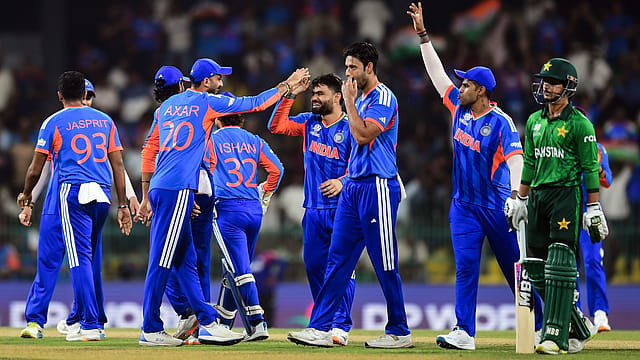
The T20 World Cup 2026, co-hosted by India and Sri Lanka, concluded on March 8 with a high-scoring final that crowned Team India champions for the third time. Beyond the trophy, the tournament entered cricket history by setting a series of ICC records across batting, bowling, and team achievements.
Here’s a more detailed insight.
How did Team India make history at the T20 World Cup 2026?
Team India achieved a rare triple milestone by becoming the first side to win three Men’s T20 World Cup titles, the first men’s team to defend the championship successfully, and the first team to win it at home.
India became the first team to hit over 100 sixes in a single tournament. Team India also became the 1st team to register two consecutive 250+ scores in the T20 WC (253 vs. England in the SF and 255 vs. NZ in the Final).
Why was the final in Ahmedabad considered historic?
The final at the Narendra Modi Stadium produced one of the most dramatic statistical feats of the T20 World Cup 2026. India scored a mammoth 92 runs in the powerplay, the joint highest in this edition.
India scored more than 100 runs in the middle overs and posted 255/5, the highest total ever recorded in a Men’s T20 World Cup final. The final underscores the tournament’s reputation as one of the most aggressive batting spectacles in recent years.
Exclusive: To the Heavens and Back
19 Jun 2026 - Vol 04 | Issue 76
Shubhanshu Shukla relives the space odyssey that put India into orbit
How did fielding performances influence the tournament’s outcome?
Fielding played a decisive role during the ICC Men's T20 World Cup 2026, often shifting momentum in high-scoring matches. New Zealand’s Glenn Phillips took 11 catches, the most by a fielder in a single edition.
His consistency highlighted how sharp fielding and athletic outfield work remained crucial in containing aggressive batting during the Men’s T20 World Cup.
Which batting records defined the tournament?
Batting dominated the Men’s T20 World Cup, with multiple scoring landmarks falling. Pakistan’s Sahibzada Farhan scored 383 runs, setting a record for the most runs in a single edition. He also became the first player to score two centuries in one tournament.
How did the Indian openers shape the narrative of the final?
Sanju Samson emerged as a central figure for Team India. His 89 at a strike rate of 193.48 in the final became the highest individual score in a T20 World Cup final. Samson also smashed 24 sixes during the tournament, the most ever by a player in a single Men’s T20 World Cup campaign.
Abhishek Sharma smashed an 18-ball half-century in the final. He now holds the record for the fastest fifty in a T20 World Cup knockout game.
Which explosive innings changed T20 World Cup records?
New Zealand’s Finn Allen delivered one of the tournament’s most explosive performances by reaching a century in 33 balls, the fastest in T20 World Cup history. The knock reflected the evolving power-hitting standards that now define modern limited-overs cricket.
What bowling performances stood out in the tournament?
Bowling milestones also emerged despite the batting-heavy conditions. Jasprit Bumrah finished with 14 wickets and produced match-winning figures of 4/15 in the final, earning Player of the Match. His performance reinforced his reputation as one of the most decisive bowlers in ICC tournaments.
Which associate players made their mark?
The T20 World Cup 2026 also highlighted the rising competitiveness of associate nations. USA’s Shadley van Schalkwyk took 13 wickets in four matches.
While Zimbabwe’s Brian Bennett ended the tournament with a record-breaking average of 146, scoring 292 runs in just 6 innings, reflecting the growing depth of global T20 cricket.
What broader trends did the T20 World Cup 2026 reveal?
Beyond individual feats, the tournament illustrated the rapid evolution of T20 cricket. Teams regularly crossed the 200-run mark. The Ind vs. Eng semi-final became a historic run-fest, producing a match aggregate of 499 runs, the highest ever in T20 World Cup history.
The scoring surge reflects improved power-hitting, tactical analytics, and increasingly fearless batting approaches.
What does this tournament mean for the future of T20 cricket?
The T20 World Cup 2026 reinforced the format’s transformation into a high-intensity spectacle where records fall rapidly. With Team India leading the way and emerging players redefining scoring limits, the latest ICC tournament records suggest the next phase of the Men’s T20 World Cup could push the format even further.
(With inputs from yMedia)