BWF World Championships: Sindhu, Ayush Exit as Satwik-Chirag, Treesa-Gayatri Reach Quarterfinals
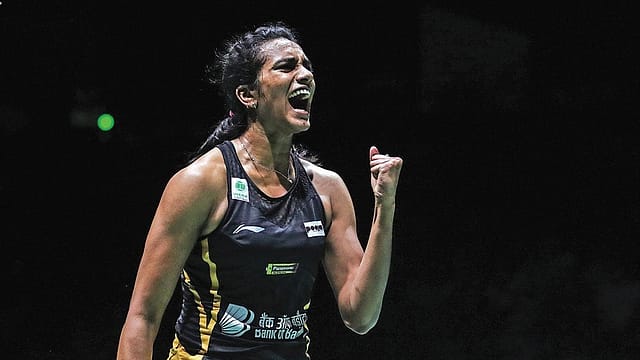
India’s singles campaign ended in pain. Its doubles pairs refused to let the country’s World Championships challenge end with it.
PV Sindhu fell agonisingly short against China’s Wang Zhi Yi after an 88-minute battle, while Ayush Shetty’s impressive run was halted by Indonesia’s Alwi Farhan. But Treesa Jolly and Gayatri Gopichand stormed into the women’s doubles quarterfinals before Satwiksairaj Rankireddy and Chirag Shetty fought their way through a tense three-game contest in New Delhi.
The contrasting results left India without a singles contender but with two pairs standing one victory away from a World Championships medal.
SINDHU’S FIGHT ENDS AT 17-ALL
Sindhu’s bid for a sixth World Championships medal ended with an 11-21, 21-15, 17-21 defeat against third seed Wang.
The five-time medallist made a sluggish start as Wang controlled the opening game. Sindhu responded with greater aggression and sharper movement in the second, winning six consecutive points from 15-15 to force a decider.

Rise of the Pivotal Power
18 Sep 2026 - Vol 05 | Issue 38
The BRICS declaration is a strategic victory for Modi
She carried that momentum into the final game, moving 8-4 ahead before stretching her advantage to 13-10.
Then Wang struck back. The Chinese player reeled off five successive points and forced Sindhu into a contest of endurance. One rally stretched to 54 shots as both players searched for an opening.
Wang required medical attention during the deciding game and appeared to struggle with cramps. Her extended breaks interrupted the match’s rhythm, although she returned to hold her nerve at the decisive moment.
Sindhu fought back to 17-17, placing the match on a four-point knife-edge. Wang claimed every one of them to seal her quarterfinal place. After the defeat, Sindhu wondered whether the breaks had formed part of Wang’s strategy, but refused to use them as an excuse. “That’s their way of tactic,” Sindhu said. “I have to be focused, and I was. But again, each point matters.”
Sindhu said it was impossible to know whether Wang was genuinely injured or attempting to disrupt her rhythm. Her own failure, she felt, was not remaining patient when the match reached its most critical stage. “I don’t know if she had an injury; maybe that was her tactic and her way of doing it,” Sindhu said. “But I should have converted that into a win because there were long rallies. It was a good match. At 17-all, every point matters, and I should have been a little more patient.”
The loss also ended Sindhu’s unbeaten run against Chinese opponents at the World Championships. She had won each of her previous eight such contests. “It does hurt a lot more because after you train and work hard for so long, losing these kinds of matches definitely hurts,” she said.
Sindhu will now turn her attention to the Asian Games after taking time to recover and study where the match escaped her. “Whatever is done is done,” she said. “Now is the time to go back and see and do whatever is required.”
AYUSH SHETTY’S RUN HALTED
Ayush Shetty’s campaign ended in a 19-21, 11-21 defeat against Indonesia’s Alwi Farhan. Shetty pushed Farhan closely in the opening game but could not find a way back after losing it narrowly. The Indonesian took control in the second and closed the contest in straight games.
His exit followed Sindhu’s defeat and officially ended India’s challenge in both men’s and women’s singles. The responsibility for extending India’s World Championships medal run, which began in 2011, shifted entirely to the doubles court. Treesa and Gayatri answered first.
The unseeded Indian pair dismantled Japanese seventh seeds Rin Iwanaga and Kie Nakanishi 21-16, 21-12 in 44 minutes. The victory made Treesa and Gayatri the first Indian women’s doubles combination in 11 years to reach the World Championships quarterfinals. Jwala Gutta and Ashwini Ponnappa were the last to advance this far, in 2015.
Treesa and Gayatri began aggressively and opened a 13-9 advantage in the first game. The Japanese pair responded with seven consecutive points, flipping the score and threatening to snatch control.
The Indians did not allow the collapse to spread. They regrouped and captured the next eight points, turning a 13-16 deficit into a 21-16 opening-game victory. The second game carried little of the same tension. Treesa and Gayatri moved their opponents around the court with sharp drops, attacked the open spaces with cross-court smashes and never allowed Iwanaga and Nakanishi to rebuild their rhythm.
A combination ranked 39th in the world had swept aside the seventh seeds and stepped within one win of a medal. The challenge now becomes considerably harder. Treesa and Gayatri will face Chinese fourth seeds Jia Yi Fan and Zhang Shi Xian in the quarterfinals.
SATWIK-CHIRAG REFUSE TO FALL
Satwik and Chirag were forced to take the longer route. The two-time World Championships bronze medallists defeated Malaysia’s Junaidi Arif and Yap Roy King 21-23, 21-19, 21-17 after repeatedly dragging themselves back from the edge.
The Indians saved two game points in the opener but could not complete the escape. They trailed 16-18 in the second game as the Malaysians moved within three points of victory. Satwik and Chirag responded under pressure, stealing the game 21-19 and forcing a decider.
The trouble returned. Arif and Yap opened a 15-12 lead in the third game, leaving the Indians with little room for another stumble. Satwik and Chirag closed the gap, levelled at 17-17 and then seized the final four points without reply. What had threatened to become a round-of-16 exit ended with the Indian pair charging into another World Championships quarterfinal.
They will face Chinese third seeds Liang Wei Keng and Wang Chang for a place in the semifinals and a guaranteed medal. India’s two remaining pairs now confront seeded Chinese opposition. The singles lights have gone out. The doubles court is carrying everything.
(With inputs from ANI)