Ashley Noffke’s Mission: Can Australia’s Overlooked Quick Rebuild Pakistan’s Broken Pace Factory?
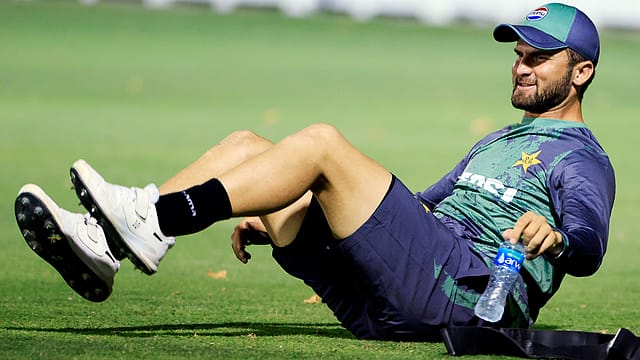
Ashley Noffke has been asked to repair the most famous factory in Pakistan. The conveyor belt is still moving. Young fast bowlers continue to emerge. Several arrive with speed, rawness and stories of discovery that belong to Pakistani cricket folklore.
But the finished product no longer frightens the world.
Wasim Akram and Waqar Younis once hunted in pairs. Shoaib Akhtar made pace a form of theatre. Imran Khan built a generation around reverse swing. Mohammad Asif could alter a delivery through geometry. Mohammad Amir appeared at 17 and seemed destined to own a decade.
Pakistan’s present attack contains famous names, occasional brilliance and unfulfilled promise. What it lacks is sustained domination.
Noffke has inherited that decline in the middle of a tour already consumed by panic.
After Pakistan lost the first two Tests against England by an innings and 103 runs and 194 runs, the Pakistan Cricket Board removed head coach Sarfaraz Ahmed and bowling coach Umar Gul. Seven players were sent home. Five uncapped cricketers were summoned. One selector reportedly attempted to resign, while another publicly blamed the captain and coaching staff over selection.

Zeroing In on ECI
09 Oct 2026 - Vol 05 | Issue 41
Constitutional legitimacy versus political opportunism
Mike Hesson and Noffke were transferred from the white-ball set-up and asked to take control before the final Test at Edgbaston.
Noffke’s first task was not teaching a bowler where to pitch the ball. It was persuading the survivors that they might still be wanted. “There’s obviously a feeling of uncertainty,” he acknowledged before the Test. That may be the most accurate description of Pakistan cricket available.
Who is Ashley Noffke?
Noffke is a 49-year-old former Australian fast-bowling all-rounder from Queensland. His international statistics can fit comfortably inside one sentence: one one-day international, two T20 internationals, four wickets and no Test cap.
His cricketing life cannot. Noffke played 118 first-class matches, took 386 wickets at an average below 30 and scored 3,766 runs, including two centuries. He represented Queensland for most of his career, played county cricket in England and later moved to Western Australia.
In 2001, he was selected for Australia’s Ashes squad following an influential performance in Queensland’s domestic final. An injury suffered while attempting a football-style run-out during a tour match sent him home before he could play a Test. He was subsequently taken to the Caribbean in 2003 but again failed to break into the Australian XI.
The problem was partly timing. Noffke belonged to an era in which Australia could choose its fast bowlers from Glenn McGrath, Jason Gillespie, Brett Lee, Michael Kasprowicz, Andy Bichel, Stuart Clark, Nathan Bracken and Mitchell Johnson. Being an excellent domestic bowler did not guarantee an international career. Sometimes it barely guaranteed a vacant chair.
Noffke kept returning to Queensland. Then, at 30, he produced one of the finest all-round seasons in Australian domestic cricket.
The Season Australia Could No Longer Ignore
During the 2007-08 season, Noffke took 51 first-class wickets and scored 741 runs for Queensland.
He became only the third Australian, after George Giffen and Greg Matthews, to complete the double of 500 runs and 50 wickets in a domestic first-class season. His performances earned him the State Player of the Year award.
Australia finally selected him. Noffke took three for 18 on his T20 international debut against New Zealand in December 2007. He later played another T20 international and a solitary ODI against India.
Then his international career ended. Three matches were all Australia found for a cricketer who had just completed a season of remarkable consistency. That disappointment may be more relevant to Pakistan than a hundred Test caps.
Noffke knows what it means to train at international standard without international security. He understands the distance between performance and selection, and the frustration of watching reputations occupy places that numbers appear to have earned.
Pakistan’s young bowlers are now confronting a harsher version of that uncertainty. Some have been called into a Test squad during a lost series. Others have disappeared despite strong domestic performances. Roles, coaches, captains and selection theories keep changing around them.
Noffke cannot promise them selection. He can understand what its absence does to a player.
The Career That Began After Australia
Noffke retired from first-class cricket in 2010 and gradually built a coaching career larger than his international playing record. He worked in Western Australia and returned to Queensland, serving across its men’s, women’s and pathway programmes. He became head coach of Brisbane Heat in the Women’s Big Bash League and Queensland Fire in Australia’s domestic women’s competition.
Success followed. Brisbane Heat won the WBBL title in his first season as head coach. Queensland Fire subsequently captured their maiden Women’s National Cricket League championship. Noffke was named WBBL coach of the year in consecutive seasons, 2019-20 and 2020-21.
He also served as an assistant coach with Australia’s women’s team, became bowling lead at UP Warriorz in the Women’s Premier League and coached London Spirit in The Hundred. Before joining Pakistan, he accepted the job of rebuilding Otago’s men’s programme in New Zealand.
Cricket Australia described him as a deeply analytical thinker who played an important role in producing Queensland’s next generation of players. His coaching did not depend on inheriting a finished international superstar. Much of it involved pathways, emerging cricketers and teams whose success had to be constructed rather than remembered. Cricket Australia and Otago Cricket record the range of that work.
This is why his three international appearances can be misleading. Pakistan has not hired the cricketer Australia barely used. It has hired the coach that disappointment helped create.
What Is the Noffke Method?
Noffke’s first public intervention after taking charge of the Test attack offered a clue. He did not enter the dressing room with a dramatic declaration about aggression, national pride or restoring Pakistan’s fast-bowling tradition.
He listened. Noffke and Hesson held one-on-one conversations, giving players an opportunity to express what they were feeling after the upheaval. “We’ve given them time to talk,” he said. “They can get things off their chest and then move forward.”
That sounds elementary until placed inside the Pakistani dressing room. Several players reportedly learnt about their removal indirectly. Selectors and coaches have contradicted one another publicly. Fitness decisions have become television controversies. Responsibility for failure has moved rapidly between players, captains, coaches and committees.
In such an environment, uncertainty is not background noise. It enters a bowler’s run-up. A young fast bowler needs clarity about workload, role and selection. He must know whether he is expected to attack or contain, swing the new ball or operate as first change, increase his pace or protect his body. Constantly changing those instructions can produce a bowler who performs every role tentatively.
Noffke’s methods have been shaped by development systems where relationships, defined responsibilities and repeated practice matter. At Otago, he spoke about listening to players and building appropriate frameworks around their ambitions. Pakistan tends to demand transformation before the framework has survived a season.
Why Has Pakistan’s Pace Factory Slowed?
Pakistan is not suffering from a complete absence of fast-bowling talent.
Shaheen Shah Afridi remains capable of deciding a match with the new ball. Naseem Shah possesses pace, movement and control. Mohammad Abbas has repeatedly demonstrated the value of relentless accuracy. Ubaid Shah is among the country’s most exciting young quicks. The latest replacements, including Razaullah and left-armer Mohammad Imran Jnr, give Noffke additional pace and variation.
The problem lies between discovery and durability.
Young Pakistani bowlers frequently move from age-group or domestic cricket into international competition before their bodies and methods are fully formed. Once selected, they can be used across Tests, ODIs, T20 internationals and franchise leagues without a coherent long-term workload plan.
Injuries interrupt development. Rehabilitation becomes contested. Bowling actions, run-ups and roles are modified by successive coaches. A few poor matches can bring exclusion; one spectacular spell can bring an immediate return.
Pakistan’s home strategy has complicated the inheritance further. To secure Test victories, the team has increasingly prepared slow surfaces designed for spin. That approach helped Noman Ali and Sajid Khan engineer a comeback series victory over England in 2024. It also reduced the role of fast bowlers at home and risked leaving them underprepared for tours where pace must take 20 wickets.
The recent numbers reveal the decline. During Pakistan’s current period of Test deterioration, its fast bowlers have collectively averaged more than 35 runs per wicket and required almost ten overs per dismissal—figures far removed from the country’s historic reputation. Pakistan still produces pace. It has become less successful at turning pace into a career.
Can Noffke Revive Shaheen Afridi?
Shaheen will be the most important test of Noffke’s influence.
At his best, Shaheen attacks the stumps at speed, swings the new ball late and can damage an innings before it has settled. Injuries, heavy workloads and fluctuations in pace have prevented that threat from appearing consistently.
Noffke had already worked with him in Pakistan’s white-ball set-up. In August 2025, he said Shaheen was moving towards his best and highlighted an improvement in his speed. The International Cricket Council recorded Noffke’s confidence that the bowler was on an upward curve.
A technical coach can help Shaheen refine his run-up, wrist position, release and lengths. A responsible management group can regulate his workload and distinguish between being medically available and being physically ready to bowl long Test spells.
Noffke controls only part of that equation.
If Pakistan continues moving Shaheen between formats, leadership roles, injuries and tactical identities, no bowling intervention will produce durable improvement. A coach can adjust the machine. He cannot stop the board from repeatedly switching it on and off.
What Can He Do With the New Fast Bowlers?
Noffke described pace as the immediate value offered by Razaullah and Mohammad Imran Jnr. He was encouraged by Razaullah and Ubaid Shah in training but cautioned that helpful practice pitches could disguise the more difficult skill: finding an attacking length when the surface offers little assistance.
That observation reveals the difference between identifying pace and coaching fast bowling.
On a responsive pitch, a bowler can beat the bat while operating fractionally short. On a flat Test surface, that same length may allow a batter to leave comfortably or defend from the back foot. Pitching fuller creates wickets but also introduces the half-volley.
The elite skill lies in occupying the narrow space between the two. Noffke can help Pakistan’s emerging bowlers understand that their speed is an asset rather than a complete method. He can work on repeatable actions, seam presentation, field plans, patience and the physical conditioning required for long spells. He can also give them something Pakistan’s selection culture rarely guarantees: permission to develop without pretending to be Wasim Akram immediately. Whether he receives time to do so is another matter.
Why Pakistan May Be His Most Difficult Assignment
Noffke has previously developed teams inside relatively stable cricket systems. Pakistan has just given him five uncapped players days before a Test against England.
Youth can refresh a struggling squad. It can also become camouflage for administrative failure. If the newcomers succeed, the purge will be presented as courage. If they fail, their inexperience will provide the next explanation. Neither outcome proves that a development pathway exists.
Noffke must also operate without certainty over his own position.
He joined Pakistan as part of Hesson’s white-ball staff. He is now performing a Test role because the previous coaches were removed during the series. The PCB has not established that this emergency arrangement constitutes a long-term red-ball appointment. Jason Gillespie, Gary Kirsten, Aaqib Javed, Azhar Mahmood and Sarfaraz Ahmed have all occupied or moved through major coaching roles during Pakistan’s recent turbulence. Gillespie later said repeated interventions had undermined coaching authority. Following the latest purge, he argued that Pakistan’s talent required structural support and consistency, not another abrupt overhaul, Reuters reported. Noffke has entered a job whose predecessors repeatedly discovered that responsibility outlasted authority.
Can Ashley Noffke Save Pakistan Cricket?
No bowling coach can save Pakistan cricket. Noffke cannot stabilise the PCB, appoint selectors, protect a Test captain, repair the domestic calendar or prevent private disagreements from becoming public accusations.
He cannot determine the pitches Pakistan prepares at home. He cannot guarantee that a promising fast bowler will receive a sustained run. He cannot control franchise workloads unless the board empowers a unified medical and performance system.
He can improve the bowling. That achievement would still matter enormously.
Noffke can help Shaheen rediscover his most dangerous length. He can prevent Naseem from becoming a collection of tantalising spells. He can build Ubaid, Razaullah and Imran Jnr before public expectation consumes them. He can reinforce why Abbas’s accuracy is a weapon rather than an absence of spectacle.
Most importantly, he can create a small pocket of clarity inside an institution producing uncertainty. Pakistan once relied on fast-bowling genius to rescue administrative dysfunction. The country expected another prodigy to emerge whenever the previous attack weakened.
Noffke represents the opposite proposition. Great bowlers should be developed deliberately. Bodies need protection. Roles require clarity. Talent needs repetition, honest conversations and time. Nothing about that proposition is romantic. Everything about Pakistan’s history suggests it is necessary.
The Repairman and the Demolition Site
Ashley Noffke reached the Australian team after producing a season selectors could no longer ignore.
Three matches later, he was gone. He rebuilt his cricketing life in quieter places: domestic dressing rooms, women’s teams, training nets and development pathways. He learnt to find careers that international selection had not yet validated.
Pakistan has now placed him among cricketers confronting the same fear. One week, a player belongs to the plan. The next, he is on a flight home. One coach announces a philosophy. Another inherits the team before the philosophy reaches the second Test.
Noffke’s response has been to invite players into a room, one at a time, and listen. It may appear too gentle for a crisis this loud. It may be exactly where repair begins. Ashley Noffke can help rebuild Pakistan’s broken pace factory. The greater question is whether the PCB wants a patient craftsman—or simply another man standing beside the wreckage when the next wall comes down.
With inputs from ANI & agencies