47 NOT OUT | How Dwayne Bravo Bowled, Danced & Sang His Way into T20 Immortality
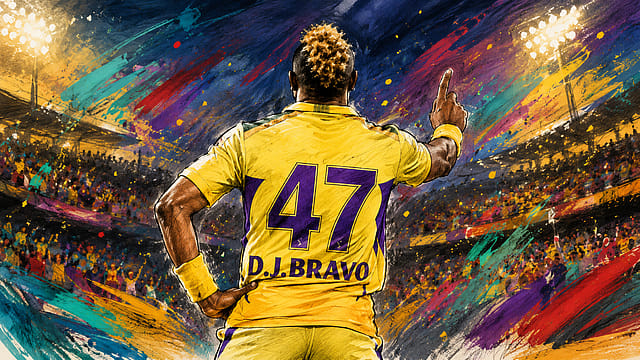
Dwayne Bravo’s mind sent him to the crease. His body had already resigned.
It was September 2024, and Trinbago Knight Riders were playing St Lucia Kings in the Caribbean Premier League. Bravo injured his groin while attempting a catch in the field. He left the ground, received treatment and waited.
The match kept moving. When TKR’s ninth wicket fell, the 40-year-old appeared at No. 11. He could barely run. Twenty-one seasons of fast bowling, violent hitting, diving, dancing, travelling and recovering had converged upon one damaged muscle.
Bravo faced two deliveries. Then he retired hurt.
There was no final slower ball. No last-over theatre. No airborne celebration with arms stretched wide. No farewell innings carrying his familiar ingredients of danger and mischief. His final appearance as a professional cricketer lasted two balls.

Zeroing In on ECI
09 Oct 2026 - Vol 05 | Issue 41
Constitutional legitimacy versus political opportunism
Two days later, Bravo announced that the season was over and so was his playing career. His mind wanted to continue, he wrote, but his body could no longer withstand “the pain, the breakdowns, and the strain”. He retired after 21 years with 631 wickets in professional T20 cricket, then the highest aggregate in the format. He had represented West Indies in 40 Tests, 164 one-day internationals and 91 T20 internationals. Reuters recorded the abrupt ending.
Two years later, the shirt retired after the body did. Trinbago Knight Riders announced that no player would wear Bravo’s No. 47 again. The decision made him the first cricketer in CPL history to have a jersey number retired. Knight Riders group CEO Venky Mysore described Bravo’s contribution as impossible to measure.
That is usually what sporting organisations say when statistics have stopped being sufficient. Bravo played 107 CPL matches and took 129 wickets. He won five league titles as a player, captaining championship sides in Trinidad and St Kitts. He added a sixth as TKR’s head coach. He helped turn the Knight Riders into the Caribbean league’s defining dynasty.
Yet No. 47 carries more than wickets and trophies.
It belongs to the child from Santa Cruz who wanted cricket before cricket could promise him anything. It belongs to the Test player West Indies lost too early, the one-day captain caught in a dispute much larger than a dressing room, and the T20 entrepreneur who recognised where the game was heading before its institutions did.
It belongs to the bowler who made a slower delivery feel like intellectual property. It belongs to DJ Bravo. It belongs to Champion.
Before the Music, There Was Santa Cruz
Dwayne John Bravo grew up in Santa Cruz, a valley community in northern Trinidad where cricket lived in streets, open spaces, club grounds and conversation.
Bravo would later write that he knew from the age of five that cricket was his destiny. It sounds like the polished certainty of an autobiography until one considers everything required to make it true.
Caribbean cricket produced imagination in abundance. It could not offer every gifted child a stable career. By the time Bravo was emerging, the magnificent West Indies empire of Clive Lloyd and Viv Richards had receded. The regional game was struggling with administration, money, facilities and identity.
A young Trinidad cricketer still had to force his way through club cricket, youth competition, territorial selection and the limited scrutiny available outside international matches. Bravo did it with the Queen’s Park Cricket Club, one of the great institutions of Trinidad cricket. He progressed through the West Indies Under-19 system and made his senior Trinidad and Tobago debut while still a teenager.
The player who emerged was far more classical than the entertainer remembered today.
Bravo possessed a high-elbowed cover drive, quick feet and the elasticity to score around the wicket. His medium-fast bowling moved through the air and away from the right-hander. He fielded with the anticipation of someone expecting every ball to involve him.
West Indies selected him for an ODI against England in Georgetown in 2004. His Test debut followed at Lord’s that July. He was 20. The ground carried old cricket’s deepest rituals. Bravo belonged to the generation that would dismantle many of them.
The Cricketer He Was Supposed to Become
The DJ Bravo retrospective can obscure Dwayne Bravo, Test all-rounder.
He played 40 Tests, scoring 2,200 runs and taking 86 wickets. He made three centuries. The numbers do not place him among the game’s statistical giants, but they reveal a complete cricketer whose international career might have taken a very different shape. He could occupy the crease, rescue an innings and attack when the field opened. With the ball, he relied on swing, seam movement and changes of pace before variation became his principal business. His hands made him dangerous in the slips, in the circle and near the boundary.
Bravo belonged to the scarce species every team covets: the player who creates balance simply by appearing on the team sheet. He also entered West Indies cricket during one of its most turbulent periods. Great individuals remained. Brian Lara could still manipulate an attack. Shivnarine Chanderpaul continued accumulating runs through sheer stubbornness. Chris Gayle was becoming a force across formats.
The collective structure around them was fragile. Contracts, selection, player representation and relations between administrators and cricketers repeatedly generated conflict. West Indies players were expected to preserve a grand inheritance while operating inside a system frequently at war with itself.
Bravo’s final Test came against Sri Lanka in December 2010, when he was only 27. A player with the technique and temperament to extend his red-ball career deep into his thirties never played another Test. His career did not end with a grand decision to abandon tradition for money. It narrowed through selection, injury, institutional disagreement and the emergence of an entirely new cricket economy.
Twenty20 cricket then offered Bravo something the old structure could not reliably provide. A market that understood exactly what he was worth.
The Tour That Broke More Than an Itinerary
The deepest rupture came in India in 2014.
Bravo was captain of the West Indies one-day side when a dispute erupted over a new payment arrangement negotiated between the West Indies Cricket Board and the West Indies Players’ Association. The players argued that the agreement had been reached without proper consultation and would reduce their earnings. Bravo became the public voice of their resistance.
On October 17, after the fourth ODI in Dharamsala, the West Indies players abandoned the tour. A fifth ODI, a T20 international and three Tests were left unplayed.
It was an extraordinary act. The Board of Control for Cricket in India threatened legal action and calculated enormous losses. Relations between the two boards deteriorated. West Indies cricket, already financially strained, faced the wrath of the most powerful organisation in the sport.
Bravo stood at the centre of the storm because captains do not get to disappear when collective anger becomes public. The walkout remains contested. Administrators accused the players of damaging West Indies cricket. The players maintained that they had been cornered by a contract they had not adequately approved. Supporters saw labour resistance. Critics saw abandonment.
The consequences for Bravo were unmistakable. He and Kieron Pollard were omitted from the West Indies squad for the 2015 ODI World Cup. Bravo never played another one-day international, although he remained active, fit enough for franchise cricket and influential enough to be wanted around the world.
His international numbers stopped. His global career accelerated.
Cricket Became a World Without Borders
T20 cricket reorganised the profession of being a cricketer. A player no longer required one national board to supply his entire career. He could represent Chennai in April, another franchise in a different country months later, return to Trinidad for the CPL and collect specialised knowledge from every dressing room.
Bravo became one of the format’s first true citizens. He appeared in the Indian Premier League, CPL, Big Bash League, Pakistan Super League, Bangladesh Premier League and other competitions around the world. Airport lounges replaced the conventional off-season. Team colours changed. The job remained. Arrive. Read the pitch. Bowl the dangerous overs. Finish the chase. Lift the room.
Bravo retired having played 582 T20 matches, taken 631 wickets and scored nearly 7,000 runs. The aggregate matters, but the mechanism behind it matters more.
He turned limitation into specialisation. Bravo was never the fastest bowler. He could not intimidate a batter by threatening the helmet at 150 kilometres an hour. On flat pitches, with short boundaries and oversized bats, conventional medium pace could become an invitation. So he made the batter supply the pace.
The Ball That Arrived Late
The Bravo slower ball did not merely travel more slowly. It betrayed expectation. His approach looked familiar. The arm appeared ready to deliver at ordinary pace. The batter’s muscles committed to the swing. Then the ball left Bravo’s hand with reduced speed, altered rotation or a slightly different trajectory.
The shot arrived before the delivery. A mistimed drive rose towards long-on. A batter attempting to clear the leg-side boundary lost shape. A yorker dipped beneath a swinging bat. A wide delivery forced the striker to reach for power and found the toe of the blade.
Bravo did not invent slower bowling. Generations of seamers had used cutters and changes of pace. He industrialised deception for the T20 death overs. His variations included the back-of-the-hand slower ball, off-cutters, wide yorkers and deliveries aimed into the surface. He adjusted according to boundary dimensions, the batter’s stance and the position from which power was most likely to come.
The method required nerve. At the death, a fractionally misplaced slower ball can become a full toss. A yorker can turn into a half-volley. Failure is public, immediate and likely to land several rows beyond the rope.
Bravo kept returning. That willingness became part of his value. Captains used him when the innings was most combustible because he possessed both the skill to survive and the personality to want the responsibility.
His wickets often produced the same celebration: a leap, a gesture, a few dance steps, sometimes an exchange with the dismissed batter. The theatre could irritate opponents. It also advertised the central truth of Bravo’s cricket. Pressure did not silence him. It switched on the music.
Chennai Found Its Caribbean Son
India supplied Bravo with his largest second home.
He began his IPL career with Mumbai Indians before joining Chennai Super Kings in 2011. The yellow shirt transformed the relationship. Chennai valued defined roles, tactical clarity and continuity. Bravo offered several cricketers in one: death bowler, lower-order hitter, boundary rider, dressing-room performer and tactical conspirator.
MS Dhoni understood how to use him. The alliance worked because Dhoni’s calm and Bravo’s exuberance were not opposites on the field. Both studied pressure. Both delayed decisions. Both believed the final phase of an innings could be controlled through nerve.
Dhoni often kept Bravo’s overs for the point at which a batter had no choice but to attack. Bravo responded with pace taken off the ball, deliveries pushed beyond the hitting arc and an appetite for confrontation. He won the IPL Purple Cap in 2013 with 32 wickets, then a tournament record for a single season, and again in 2015 with 26. In 2022, he moved past Lasith Malinga to become the IPL’s leading wicket-taker at the time.
The record has since moved on, as sporting records do.
The relationship with Chennai outlived it. Bravo helped CSK win championships as a player and returned as bowling coach. Younger bowlers gained access to the thinking that had once been concealed inside his wrist: how to read a batter, disguise pace, protect one side of the field and recover after being hit.
Chennai supporters adopted him because he offered excellence without emotional distance. He danced with teammates. He embraced the crowd. He appeared in videos, celebrations and songs. He called Dhoni his brother. The franchise did not present him as a visiting overseas professional. He became one of theirs.
When ‘Champion’ Escaped the Dressing Room
The singer had been travelling inside the cricketer for years.
In the Caribbean, music does not wait for sport to end. Calypso, soca, dancehall and cricket share rhythm, language and public space. A dressing room can become a rehearsal venue. A victory can acquire choreography before the players have left the stadium.
Bravo’s musical identity eventually became inseparable from his sporting one. DJ stood for Dwayne John, but it developed into a stage persona. He released music, performed with professional artists and built an entertainment brand around the qualities already visible on the field: confidence, repetition, humour and movement.
Then came “Champion”. The song’s lyrics celebrated prominent Caribbean figures from sport and culture. Its hook was uncomplicated, infectious and built to be repeated by a crowd. The dance required little instruction.
During the 2016 World T20 in India, it escaped containment. The West Indies men danced to it through their campaign. Supporters played it in stadiums and streets. Children copied the routine. Broadcasters used it. Social media carried it beyond cricket audiences.
When Carlos Brathwaite struck four consecutive sixes off Ben Stokes in the final at Eden Gardens, West Indies became T20 world champions for the second time. The women’s team had already won its own title that day.
“Champion” became the soundtrack to a Caribbean double. Bravo had helped win the tournament and supplied its anthem. The achievement is easy to dismiss as celebrity decoration. It was more revealing than that. Modern T20 cricket was becoming a hybrid of elite competition, television, music, fashion, commerce and personality.
Bravo understood the hybrid instinctively. Many cricketers constructed brands after becoming famous. Bravo made performance and personality feed each other. The slower ball enhanced the dance. The dance made the wicket memorable. The song carried the cricketer into spaces a scorecard could not reach.
He was building a second profession while still mastering the first.
The Meaning of No. 47
Sporting numbers acquire mythology slowly. Sometimes a number belongs to a batting position or childhood hero. Sometimes it comes from availability, superstition or accident. Eventually, repetition erases the origin.
No. 47 became Bravo’s portable flag. It appeared on shirts in different competitions, travelled across borders and followed his evolution from Dwayne Bravo to DJ Bravo to Champion. He used it in music and commercial branding. “47” became a shorthand for the entire package.
Bravo later wore No. 3 in parts of his career, explaining that the figure carried family significance through the birth dates of his mother and daughter and the year associated with his son’s birth.
Yet 47 endured in the public imagination. That is why TKR’s decision matters. Retiring shirt numbers is more common in American sport than in cricket. Cricket teams historically treated numbers as administrative markers rather than sacred property. Franchise leagues have changed that. They require their own rituals, ancestry and heroes. The CPL began only in 2013. It does not possess a century of inherited folklore. Bravo helped give it memory. He led Trinidad and Tobago Red Steel to the 2015 championship before the team became Trinbago Knight Riders. He captained TKR to titles in 2017 and 2018. He then led St Kitts and Nevis Patriots to their first championship in 2021.
In 2020, he became the first bowler to reach 500 wickets in T20 cricket. By the end of his CPL playing career, he had taken 129 wickets. That was the competition record when he retired. Active careers have subsequently moved the leaderboard, with Sunil Narine and Imran Tahir now reported ahead of him. The distinction is important because tribute should not require a frozen record book.
Bravo’s achievement survives the correction. He was the first man through 500 T20 wickets, the format’s leading wicket-taker upon retirement and the bowler who helped define what death-over expertise looked like. No. 47 represents the architecture of that career.
The International Career That Never Quite Settled
Bravo’s franchise success created a convenient argument: that he had chosen private leagues over West Indies.
The full story is less tidy. He retired from international cricket in 2018 after years outside the West Indies side, returned in 2019 and finally stepped away after the 2021 T20 World Cup. His international career had effectively contained multiple exits. He was part of three major West Indies triumphs across different eras: the 2004 Champions Trophy and the 2012 and 2016 World T20 titles. Those teams revealed what West Indies cricket could still become when its players were united and properly deployed. They also exposed the gap between the talent available to the region and the instability surrounding it.
Bravo’s generation was frequently accused of mercenary behaviour for participating in franchise leagues. Yet those same leagues valued Caribbean skills, personality and tactical intelligence more clearly than the regional system often did. Players such as Bravo, Gayle, Pollard, Sunil Narine, Andre Russell and Darren Sammy became indispensable to the development of global T20 cricket. They did not simply join the franchise revolution. They taught it how to look, sound and play. The tragedy for West Indies was that some of their greatest years were distributed among cities and owners across the world. The triumph was that the world could no longer ignore their value.
Retirement did not remove Bravo from the game. It moved him ten metres beyond the rope. He coached Chennai Super Kings’ bowlers. He worked with Afghanistan. After his professional retirement, Kolkata Knight Riders announced him as a mentor across the Knight Riders network.
The final migration brought him home. Bravo became Trinbago Knight Riders’ head coach and added another CPL championship in his first season in charge. Five titles as a player became six across playing and coaching.
The transformation makes perfect sense. Death bowling is applied forecasting. A bowler must imagine the batter’s intention, the likely shot, the value of a single, the boundary dimensions and the emotional condition of the contest before beginning the run-up. Bravo spent two decades solving those equations under extreme pressure. Coaching allows him to hand over the answers. It also permits him to offer younger Caribbean players something more fundamental: a model of how to build a career when the old pathway no longer guarantees security.
The lesson is not simply to travel wherever a contract appears. Bravo’s longevity depended upon reinvention. The new-ball all-rounder became a death specialist. The lower-order batter learned to finish. The cricketer became an entertainer. The entertainer became a businessman. The senior player became a teacher.
His career kept changing shape because the game did.
47 Not Out
There will always be arguments about Dwayne Bravo.
Was his Test career underdeveloped? Certainly. Did franchise cricket receive years that might have belonged to West Indies? Yes. Were administrators, selectors and player disputes partly responsible? Undeniably. Did the performance sometimes overwhelm the cricket? Only if one failed to notice how difficult the cricket was.
Bravo’s greatness did not rest upon conventional statistical symmetry. His Test average did not place him among legendary batters. His medium pace never terrified through speed. He was not the cleanest power-hitter of his generation.
He became immortal through usefulness. Give him the final overs. Send him in with 45 required from 24. Place him on the boundary. Ask him to lift a wounded dressing room. Put a microphone in his hand after the trophy has been won. Then, when the body refuses, place him beside the field and let him teach somebody else. This is the fuller meaning of TKR retiring No. 47.
The franchise is honouring a player who took 129 CPL wickets and helped win six championships. It is also recognising a man who expanded the possibilities of a Caribbean cricket career. Bravo began when international selection was still supposed to be the summit and everything else a supplement. He finished after T20 leagues had become a parallel world, capable of creating their own legends, loyalties, fortunes and forms of immortality.
His journey contains the entire transformation. Lord’s and Dharamsala. Port of Spain and Chennai. A red ball swinging away from a Test batter. A white ball refusing to arrive when expected. A labour dispute that interrupted one career. A song that crossed every border the cricketer did. A torn groin. Two final deliveries. A shirt raised beyond reach.
No Trinbago Knight Riders player will wear 47 again. Its owner has moved into the dugout, where the next over is already being planned.