18 Years, No. 18 & King Kohli: How Virat Turned 12 on Debut into 28,000 Runs
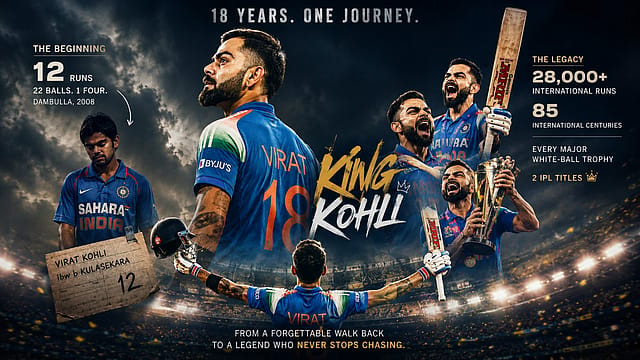
The ball nipped back. The 19-year-old debutant pushed forward. It beat the bat, struck the pad and ended the beginning.
Twelve runs. Twenty-two balls. One four. Nuwan Kulasekara had trapped the debutant in front of the stumps. The young man turned and walked back. India were 23 for two in Dambulla and heading towards 146 all out. Sri Lanka would chase the total with eight wickets and 91 balls to spare.
There was no century, no snarling celebration, no chase to rescue, and no glimpse of the theatre that would eventually follow him around the world.
The scorecard records his international arrival in one cold line: Virat Kohli, lbw Kulasekara, 12.
Eighteen years later, that line feels almost mischievous.
The boy who began with 12 now sits beyond 28,000 international runs. He has struck 85 hundreds, 54 of them in ODIs, and stands second only to Sachin Tendulkar’s impossible-looking mountain of 100 international centuries.
Rise of the Pivotal Power
18 Sep 2026 - Vol 05 | Issue 38
The BRICS declaration is a strategic victory for Modi
The No. 18 shirt has won the Under-19 World Cup, the ODI World Cup, the Champions Trophy, the T20 World Cup and, after an 18-season ache, two IPL titles. Kohli is the only cricketer to have collected every major white-ball crown available to him.
But those are the famous numbers. The deeper story hides elsewhere.
It lives in 20,960 runs crammed into a single decade. In seven double centuries scored faster than Don Bradman reached his first seven. In an unbeaten T20 World Cup equation that reads eight innings, eight Indian victories. In 995 runs gathered across 10 consecutive ODI innings.
These records do more than measure Kohli. They expose him.
THE BOY WHO DID NOT ARRIVE QUIETLY
Kohli had already given Indian cricket a trailer.
Earlier in 2008, he captained India to the Under-19 World Cup in Malaysia. The ICC’s history of the tournament recalls that his team went unbeaten and defeated South Africa in a rain-shortened final.
The teenager from West Delhi was talented, ambitious and impossible to ignore. He was also some distance from the chiselled athlete who would later turn fitness into an entry condition for the Indian dressing room.
What followed was not a smooth coronation. Kohli moved in and out of the side before making himself indispensable. His maiden ODI hundred arrived against Sri Lanka in Kolkata in December 2009. The hundreds then began multiplying. So did the targets.
Kohli did not invent the run chase. He made it feel personal. A target gave him a villain. The asking rate supplied the clock. A packed stadium created the noise. Kohli entered, calculated the equation and began stealing the match one gap at a time.
Then came Hobart in 2012.
India needed to chase 321 inside 40 overs against Sri Lanka to remain alive in the tri-series. Kohli smashed an unbeaten 133 from 86 balls. Lasith Malinga disappeared for 24 runs in an over. India reached the target in 36.4 overs.
A few weeks later, Pakistan made 329 in the Asia Cup. Kohli replied with 183, still his highest ODI score.
The chase master had acquired his crown. His record when India have pursued 350 or more explains why the label stuck. Across four such ODI chases, Kohli has scored 411 runs at an average of 205.50. He has crossed fifty every time and converted three of those innings into centuries. India won three of the four chases. When the target swelled, Kohli seemed to shrink the ground.
THE DECADE HE SWALLOWED WHOLE
Great players dominate seasons. Kohli consumed the 2010s.
Between 2010 and 2019, he scored 20,960 international runs in 386 matches, averaging 57.58. Those ten years produced 69 centuries and 98 fifties. No other cricketer has scored 20,000 international runs inside a single decade.
Ricky Ponting’s 18,962 runs in the 2000s fell short. Tendulkar’s 14,197 in the 1990s fell further behind.
Kohli’s most concentrated burst came across 10 consecutive ODI innings. He amassed 995 runs at 142.14, with five centuries and three fifties. During that rampage, he became the fastest batter to 10,000 ODI runs, reaching the milestone in 205 innings.
And he did not merely score hundreds. He chained them together.
Kohli has produced back-to-back ODI centuries on 12 occasions. AB de Villiers, next on the list, managed the feat seven times. When Kohli went big, he frequently kept going. He has five ODI scores above 150 as a non-opener, ahead of Viv Richards’ three and de Villiers’ two. Across those five innings, he scored 820 runs and was dismissed only once.
The absurdity of the statistic is pure Kohli: an average of 820.
2018: WHEN THE WORLD RAN OUT OF AWARDS
There are great years. Then there is Kohli’s 2018.
He scored 2,735 international runs at 68.37, struck 11 centuries and added nine fifties. He made Test hundreds in South Africa, England, Australia and India. In the six-match ODI series in South Africa, he plundered 558 runs.
The ICC’s account of that season records a batter who piled up more runs than anyone else and broke Tendulkar’s record for the fastest journey to 10,000 ODI runs.
Then Kohli swept the ICC awards. Sir Garfield Sobers Trophy for Cricketer of the Year. Test Player of the Year. ODI Player of the Year. Nobody had claimed all three in the same edition before him. His career collection has since grown to 10 ICC awards, the most won by any cricketer.
The rankings surrendered too. Kohli became the only player to breach 900 rating points in Tests, ODIs and T20Is.
Behind those giant peaks sits another number that captures his relentless consistency. Among international cricket’s 20 highest run-scorers, Kohli is the only one with a combined career batting average above 50.
Volume usually drags averages down. Kohli kept dragging his upwards.
THE CAPTAIN WHO WANTED MORE THAN HUNDREDS
Captaincy revealed another version of him.
The chest pushed out further. The celebrations became louder. Fast bowlers suddenly found a captain who wanted five wickets overseas rather than safety at home. Fitness stopped being a private virtue and became a cultural demand.
Kohli led India in 68 Tests and won 40, making him the country’s most successful Test captain. According to the ICC’s record of his Test career, only Graeme Smith, Ricky Ponting and Steve Waugh finished with more victories as captains.
His batting expanded with the responsibility.
Kohli scored seven Test double centuries, all as captain. No Test skipper has made more. He completed those seven in 1,176 days, beating Bradman, who took 1,484 days to reach the same mark.
The doubles travelled too. West Indies. England. New Zealand. South Africa. Sri Lanka. Bangladesh. Six different opponents, a range matched only by Kumar Sangakkara and Younis Khan.
His ordinary centuries travelled even farther. Kohli became only the fourth Indian after Tendulkar, Rahul Dravid and Mohammad Azharuddin to score Test hundreds in South Africa, England, New Zealand and Australia.
There were hundreds at home. Hundreds abroad. Hundreds under lights. Hundreds while chasing.
And 59 of his international centuries came in victories, more than any other batter has produced. In ODIs alone, 44 of his 54 hundreds ended with India winning. Kohli did not merely collect centuries. He weaponised them.
THEN THE HUNDREDS STOPPED
For years, Kohli had made scoring centuries look like habit. Then the habit vanished.
November 2019 became August 2022. One series passed. Then another. Outside edges found hands. Starts died. Every innings became a referendum. Every dismissal triggered another round of diagnosis.
His intensity, once presented as the secret, was repackaged as the problem. His technique was dissected. His place was questioned. The man who had trained a generation to expect a hundred began carrying the burden of not scoring one.
The drought lasted 1,020 days.
Before the 2022 Asia Cup, Kohli stepped away from cricket for a month and did not pick up a bat. The ICC later reported that he had spoken about the mental strain of the period.
He returned against Afghanistan and struck 122 from 61 balls. International century No. 71 arrived in the format in which nobody expected it. It was his first T20I hundred. The celebration changed. The fury drained from his face. Relief took its place.
Kohli would later say the angry celebrations belonged to an earlier version of him. The ICC’s study of his evolution described a player who had emerged from the drought with a softer smile but the same appetite. The hundred did not erase the fall. It proved he could climb again.
THE BIG STAGE KEPT FINDING HIM
Kohli’s genius has always sharpened when tournaments tighten.
Across the ODI World Cup, T20 World Cup and Champions Trophy, he has scored 3,834 runs in 87 innings at 61.83, the highest aggregate in ICC white-ball tournaments. He has six hundreds, 33 fifties and a record 15 Player of the Match awards in those events. He also owns 22 Player of the Series awards in international cricket, two more than Tendulkar.
The T20 World Cup offers the cleanest version of the Kohli bargain. He is its highest run-scorer with 1,292 runs and 15 fifties. Eight times he finished unbeaten. India won all eight matches. Across those innings, he scored 464 runs and crossed fifty six times.
If Kohli stayed, India survived.
His last T20I supplied the perfect ending. In the 2024 World Cup final against South Africa, with India wobbling, he scored 76. The innings lacked his usual fluency. It carried something heavier: responsibility. India won, and Kohli retired from T20 internationals with the trophy in his hands.
In May 2025, he walked away from Test cricket too. He finished with 9,230 runs, 30 centuries and seven double hundreds. The ICC noted that he had played 123 Tests and led India more often than any previous captain.
Even after winning the IPL weeks later, Kohli described Test cricket as sitting “five levels” above the rest.
The format had taken pieces out of him. He loved it anyway.
BENGALURU FINALLY STOPPED HURTING
For 17 IPL seasons, Kohli stayed.
He scored the runs. Wore the failures. Watched other teams lift the trophy. Returned wearing the same colours. Royal Challengers Bengaluru finally won in 2025. Then they did it again in 2026. This time Kohli struck the winning six. Reuters reported that he finished unbeaten on 75, ended the season with 675 runs and stretched his overall IPL tally to a record 9,336.
There is another record hiding inside that longevity. Kohli has now crossed 500 runs in nine IPL seasons, more than any other batter. Four consecutive seasons from 2023 to 2026 brought him at least 600 runs. The younger Kohli tried to overpower T20 cricket. The older one kept rebuilding his method to stay ahead of it.
Eighteen years after Dambulla, international cricket has narrowed for Kohli.
T20Is are gone. Tests are gone. Only ODIs remain. That makes every innings feel more finite. It also makes the number 100 impossible to ignore. Kohli has 85 international centuries. Tendulkar has 100. The gap is 15, and every one of them must now come in a format that offers fewer matches and fewer second chances.
Perhaps he gets there. Perhaps he does not. The pursuit is no longer the most interesting part.
The story lies in the distance already covered: from a makeshift opener scoring 12 in a losing cause to the most prolific ODI centurion in history; from the chubby Under-19 captain to the fitness evangelist; from the angry young batter to the older man who survived 1,020 days of silence; from three lost IPL finals to the winning six of a second consecutive title.
Eighteen years have left Kohli with more than 28,000 international runs, 85 hundreds and every major white-ball trophy. They have also left him with something statistics cannot quite hold.
When India chase, people still look for him. When a tournament tightens, they still expect him. When he reaches the nineties, the country still begins counting one run at a time.
On August 18, 2008, Virat Kohli walked back for 12 and the match continued. Eighteen years later, whenever he walks out, the match seems to begin.
(With inputs from ANI)