Sonia Gandhi’s Memoir Reopens Operation Blue Star Row
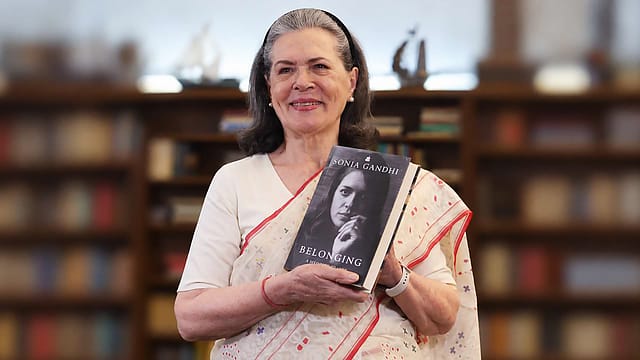
Sonia Gandhi’s account of Indira Gandhi watching footage of the Golden Temple after Operation Blue Star drew criticism from the Aam Aadmi Party and the Bharatiya Janata Party on Tuesday, November 10, as her memoir went on sale. The Congress leader writes that she saw tears on her mother-in-law’s face and took them as a sign of pain and regret at how the siege had ended and how many lives had been lost.
Published in India by HarperCollins, Belonging: A Journey of Love traces Sonia Gandhi’s life from her childhood in post-war Italy and her relationship with Rajiv Gandhi at Cambridge to the years she spent building a life in India. It recounts how the assassinations of Indira and Rajiv Gandhi shaped her relationship with the country. Her recollection of the aftermath of the June 1984 army operation has drawn the sharpest political reaction.

The Wealth Issue 2026
06 Nov 2026 - Vol 05 | Issue 45
Portraits of Dreamers and Doers under 35
AAP Questions Sonia Gandhi’s Reading of Indira’s Tears
Delhi AAP president Saurabh Bharadwaj told ANI that Sonia Gandhi was trying, in her own way, to help people move past the wounds of 1984. He said an expression of remorse from Indira Gandhi herself at the time would have carried far greater weight. Sonia Gandhi’s interpretation, he argued, could not be independently verified and should be read in the context of today’s politics.
Bharadwaj said the use of artillery during the army operation at the Golden Temple complex and the killings of Sikhs in Delhi later that year called into question the Congress’s secular credentials.
Rajya Sabha MP Satnam Singh Sandhu asked what, in Sonia Gandhi’s telling, Indira Gandhi had regretted: the injustice suffered by Sikhs, the damage to the Golden Temple complex or her own decision to send in the army. He also questioned Sonia Gandhi’s recollection that Indira sensed her death was imminent and had spoken to her family about how they should handle it.
“Who will take responsibility for that devastation?” Sandhu asked. He said the Congress had yet to accept responsibility and called for accountability over the killings of Sikhs that followed Indira Gandhi’s assassination.
The Army Operation and the Violence That Followed
In June 1984, the Indian Army entered the Golden Temple complex in Amritsar on Indira Gandhi’s orders to remove armed militants led by Jarnail Singh Bhindranwale, the head of the Damdami Taksal. Bhindranwale and armed followers were killed in the operation. Militants had reportedly stockpiled arms inside the complex.
The operation drew widespread criticism. On October 31, 1984, two of Indira Gandhi’s Sikh bodyguards, Beant Singh and Satwant Singh, assassinated her at her New Delhi residence. Anti-Sikh violence followed, with Sikhs targeted and killed in Delhi and elsewhere.
BJP Extends Its Attack to the Manmohan Singh Years
BJP MP Bhola Singh used the release to attack Sonia Gandhi’s role in the Congress and in the United Progressive Alliance government. He alleged that Manmohan Singh was prime minister in name only and that Sonia Gandhi ran the government by “remote control”. He said there was already extensive material about her political activities and her control of the party.
Singh also accused the Congress of a “recurring pattern” of abusing power. He cited the Emergency and the anti-Sikh violence, alleging that the party had been willing to go to great lengths in its “hunger for power”.
In the memoir, Sonia Gandhi describes what she remembers seeing as Indira watched the footage. She writes of “tears of pain and regret, I think”, and of sorrow at the way the siege had ended and the lives lost.
With inputs from ANI