Siddaramaiah vs DK Shivakumar: The Truce That Isn’t
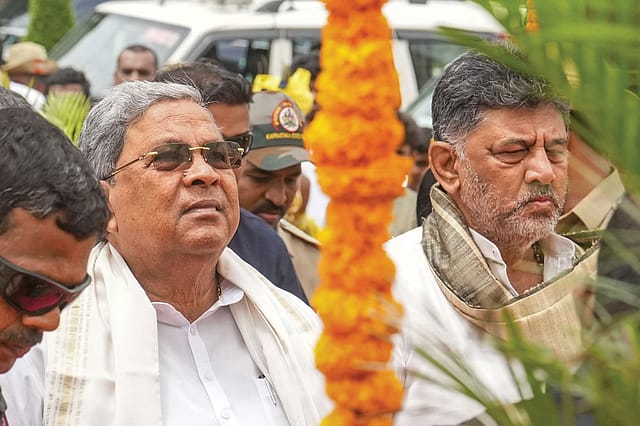
Bengaluru is passing through its coldest stretch this week, the air suddenly sharp, the city slowed by an unfamiliar chill. It is almost as if the iciness between the two chief ministerial contenders—Siddaramaiah in possession of the present and DK Shivakumar waiting on the future, with the Congress party behaving as if time itself were indefinitely negotiable—has taken on atmospheric form.
A couple of days ago, a breakfast meeting produced a truce for the cameras, and there is another scheduled for tomorrow, this time at Shivakumar’s residence. What will likely emerge is not resolution but suspension, with Siddaramaiah continuing as Chief Minister and Shivakumar retaining the party presidency and the deputy chief minister’s office, steadily widening his operational corridor, with more portfolios that answer to him, more loyalists in consequential rooms. The transition is being prepared without it being declared.
The morning after the first truce, Shivakumar drove to Mandya and stood before the Bhoo-Varaha Swamy idol. Reporters speculated that he was there to seek “divine intervention” as supporters hailed him as the next CM. Shivakumar has waited a long time for this phase of waiting. Years of organisational muscle-work, of money raised, of MLAs insulated during defections, of jail time folded into personal mythology. Crucially, he is now publicly signalling that he is prepared to wait, but he is equally careful to acknowledge what he has not been given. There is no assurance. No binding promise from the high command. In the new Congress arithmetic, even patience does not guarantee arrival. The unease beneath the truce is this: what if the chair does not pass laterally at all? What if Delhi intervenes and inserts a third name—someone without skin in this duel, someone like Mallikarjun Kharge? The possibility is real enough to discipline both camps.

Youth Issue 2026
24 Apr 2026 - Vol 04 | Issue 68
50 Portraits of Icons and Achievers
December 1 was meant to be the informal deadline that existed nowhere on paper and everywhere in conversation. The day the script would flip and the chair would change hands. Instead, we have another breakfast invite. Both sides have hardened their positions while continuing to issue facile public statements. Siddaramaiah’s camp insists there was never a mid-term power transfer agreement. Shivakumar’s camp insists the understanding was real, struck in Delhi after the 2023 mandate, and is being postponed rather than cancelled.
Shivakumar’s recent movements—temple visits in quick succession, photo ops with Vokkaliga seers, reminders disguised as patience—suggest a pivot from negotiation to time management. Siddaramaiah, by contrast, has chosen visibility over choreography: travel, mass programmes, stakeholder meetings. At the street level, the contest is kept deliberately warm.
Watching from the margins is BJP’s alliance partner Janata Dal (Secular), which, like Shivakumar, thrives on Vokkaliga support. JD(S) does not need to destabilise the Congress; it merely needs to wait for the Congress to do that work internally. Every delayed transition, every publicly denied promise, every choreographed display of unity reinforces JD(S)’s core argument: that the Congress is not a ruling party so much as a negotiation masquerading as one.
There is also the long-delayed BBMP election which, when it finally arrives, will be the first sanctioned arena for internal score-settling. It is entirely plausible that one Congress faction may ensure the party underperforms, using the city as a proxy battlefield, establishing morale, narrative, and revenge routes for the next Assembly election, which the party, in its present equilibrium, appears curiously to be taking for granted.
When the Congress won Karnataka with a decisive mandate in 2023, it promised administrative clarity. What it has produced instead is operational governance under existential suspense. Files move. Budgets pass. But always against the outline of a leadership that does not yet belong to itself. Decisions are taken with one eye on tomorrow’s seating arrangement.
The Congress high command has orchestrated the truce because it backs arithmetic. Neither leader can be displaced without electoral cost. Both can be restrained without resolution. The formula holds so long as impatience does not exceed fear. Whichever man eventually occupies the chair will insist that it was always meant to happen this way.