House Manners
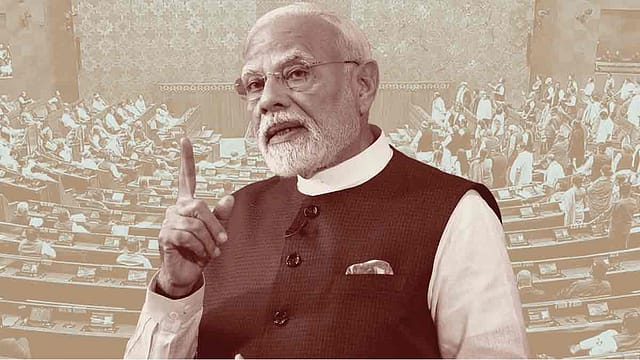
With disruptions in Parliament touching new heights—or plumbing new depths —it is worth considering when things started going wrong. The blockade of Prime Minister Narendra Modi’s seat in Lok Sabha is only the latest in a deteriorating trend that can be traced to repeated protests—chiefly by Congress MPs—for and against the creation of Telangana during the tenure of the UPA government from 2004-2014 that often held Parliament to ransom. The pro-Telangana Congress MPs brought placards and banners to Lok Sabha and Rajya Sabha, the first time this was done. Opponents like KVP Ramachandra Rao, once close to the late YSR Reddy, took to standing in Rajya Sabha with a banner in the manner of the Christ the Redeemer statue opposing division of Andhra Pradesh.
On February 13, 2014, days before Parliament approved the creation of Telangana, Congress MP Lagadapati Rajagopal used a pepper spray in the lower house, seriously discomfiting several MPs. On that day, the Lok Sabha staff had been “tipped off” that a stunt was being planned, perhaps from the press gallery. Lok Sabha officials positioned themselves to stall any such adventure as the press gallery in the old Parliament building directly overlooked the speaker’s chair. But they could do nothing to stop Rajagopal as MPs are not frisked and do not go through a scanner. The main opposition BJP disrupted Parliament too, but did not use placards and banners, and their case for a parliamentary committee on 2G licences was grounded in an adverse CAG report and judicial observations. It is perhaps time to strictly prevent the carrying of placards inside Parliament.
The MissOil Strike
03 Apr 2026 - Vol 04 | Issue 65
The War on Energy Security
Fadnavis In Spotlight

The Mumbai leg of French President Emmanuel Macron’s India visit saw him being received by Maharashtra Chief Minister Devendra Fadnavis while posters and banners welcomed the visiting leader and his wife Brigitte Macron. The French president was hosted by Prime Minister Narendra Modi for a bilateral meeting and Macron even went for a brisk run on Marine Drive. The high-profile visit puts the spotlight on Fadnavis and Maharashtra as a business destination as the French contingent included a strong business delegation and Macron invited Bollywood to France.
NCP Crash Theories
Claims of foul play in the plane crash that killed Maharashtra Deputy Chief Minister Ajit Pawar by Rohit Pawar, MLA from Karjat-Jamkhed and grandnephew of Sharad Pawar, are puzzling in the initial absence of similar misgivings on the part of the late leader’s immediate family. The MLA, who is aligned with the Sharad Pawar faction of NCP, did not offer any evidence but the official NCP faction led by Sunetra Pawar has now sought a CBI probe. However, it is evident that the official NCP remains an integral part of NDA.
Wait and Watch
The decision to depute Lok Sabha speaker Om Birla for the swearing in of the Bangladesh Nationalist Party government led by Tarique Rahman was carefully calibrated to signal India’s good wishes while waiting to see if the situation on the ground improves. The Speaker is sixth in the order of precedence after the president, vice president, the prime minister, governors, former presidents and the currently vacant deputy prime minister’s post. Birla shares his perch with the Chief Justice of India but future engagement hinges on whether BNP is genuinely keen on a reset in ties with India and takes concrete steps to secure the safety of Hindus in Bangladesh. After the election, an aide of Rahman has “advised” India to change its mindset and that may not be the way to go.
Shell Life
The defence ecosystem in India is growing and one area where quiet strides have been made is in ready-to-fill shells. Though governmentowned Munitions India Limited continues to be a primary supplier, there are several new private sector firms eyeing a large market. The demand for shells and ammunition is growing as India builds larger and varied stockpile capacities and increases the frequency of its live fire exercises. But there is also an export market as conflicts continue to flare up while older ones like the Ukraine war showing no signs of ending.
Chinese AI Puzzle
The Global Times, seen as an unofficial Chinese mouthpiece, took note of the India AI summit and acknowledged New Delhi’s bid to leverage the technology to enhance its status as a major power and consolidate its image as a “leader of the Global South”. But the Global Times report also said experts warn that India’s data governance and AI policies lack “stability”. Meanwhile, China’s ambassador Xu Feihong congratulated India and announced the arrival of a Chinese delegation. On balance, the tabloid might offer a better reading of how China views India’s efforts to become a major AI player.
Spring in the Air
As winter gives way to spring, the Delhi-NCR pollution count has improved, moving to the “moderate” category in much of February with some days showing localised “good air” readings. The possibility of rain in the second half of the month could reduce pollution further. The month provides a rare break from unrelenting pollution problems ahead of long summer months when road and construction dust along with the heat takes a toll of citizens and sends the AQI soaring.