Mayawati Says Ambedkar’s Mission of Self-Respect Remains Unfulfilled, Calls for Bahujan Political Power
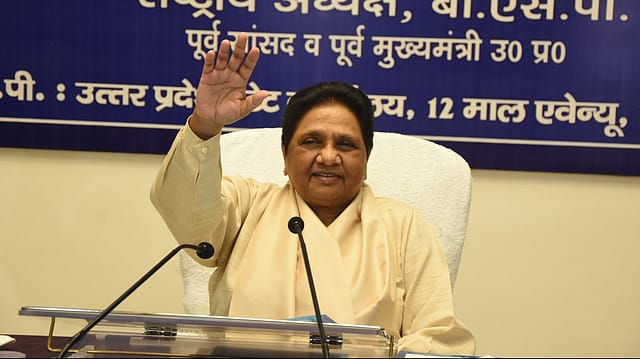
Bahujan Samaj Party (BSP) chief Mayawati on Thursday said Dr BR Ambedkar's mission of securing self-respect and dignity for marginalised communities remained unfulfilled, urging the Bahujan Samaj to reflect on why it had yet to attain political power despite the constitutional guarantees of equality and rights.
In a post on X on Constitution Day, Mayawati said Ambedkar had devoted his life to fighting the exploitation and subjugation of Dalits, Adivasis, backward classes and other marginalised sections. His objective, she said, was to enable these communities to become a 'ruling class' through the democratic electoral process.
Questioning why the goal of attaining political power in Delhi remained distant, she said the Constitution drafted by Ambedkar had not translated into the expected social and economic transformation.
"Despite the passage of so many years since the nation's independence—and even with the existence of the humanitarian, welfare-oriented, and 'Bahujan'-friendly Constitution drafted by Babasaheb Dr. Bhimrao Ambedkar—why does the ultimate goal, that is, attaining power in Delhi, remain so distant?" she wrote.

Anatomy Of A Stillborn Revolution
20 Nov 2026 - Vol 01 | Issue 01
Whatever Happened To The Cockroach Janta Party?
MAYAWATI QUESTIONS SUCCESSIVE GOVERNMENTS
The BSP chief questioned whether successive central governments had fulfilled their constitutional responsibilities, particularly on reservations and the socio-economic conditions of marginalised communities.
She raised concerns over poverty, unemployment, access to education and healthcare, and the assurance of dignity and self-respect.
"The most critical question is: have successive central governments truly and honestly fulfilled their constitutional obligations—ranging from the implementation of reservations to addressing fundamental needs such as poverty, unemployment, education, healthcare, and the assurance of self-respect? If these responsibilities have not been discharged with sincerity and integrity, why has there been no accountability for this failure?" she asked.
Mayawati also referred to Ambedkar's concluding speech in the Constituent Assembly on November 25, 1949, in which he emphasised the need to move beyond caste divisions and strengthen social and economic democracy alongside political freedom.
BSP'S FOUR TERMS IN UTTAR PRADESH
Mayawati said the BSP had followed the principle of 'Sarvajan Hitay, Sarvajan Sukhay' — welfare and happiness for all — during its four terms in power in Uttar Pradesh.
She said the party had worked towards equality, equity and fraternity, laying the foundation for what she described as social transformation and economic liberation.
"The BSP, during its four terms in power in Uttar Pradesh, exemplified the ideals of equality, equity, and fraternity by adhering to the policy and principle of 'Sarvajan Hitay, Sarvajan Sukhay' (for the welfare and happiness of all). In doing so, it laid a strong foundation and initiated a meaningful process of 'social transformation and economic liberation'," she said.
MAYAWATI SEEKS TO STRENGTHEN BSP AHEAD OF POLLS
With Assembly elections approaching in Uttar Pradesh, Uttarakhand and Punjab, Mayawati called for strengthening the BSP, describing it as the authentic Ambedkarite party capable of translating the ideals of the Constitution into reality.
She argued that this objective could not be achieved through parties she described as narrow-minded, feudal or casteist, and called on the Bahujan Samaj to support the BSP.
Mayawati also said the party sought to establish the rule of law in Uttar Pradesh and promote governance centred on public welfare, social well-being and development.
"So that an 'iron rule of law' can be established here in UP, along with a governance model rooted in the principle of 'the welfare and happiness of all'—prioritising public interest, social well-being, and development. This would enable all sections of society—currently plagued by poverty, unemployment, backwardness, and the distress of forced migration—to lead a prosperous life filled with peace and happiness," she added.
Meanwhile, the BSP's Punjab unit organised a public meeting in Phillaur in Jalandhar district to mark Constitution Day. Party national coordinator Akash Anand attended the event as the chief guest.
Punjab has the highest proportion of Scheduled Caste population among Indian states.
With inputs from ANI