Panthic Censure Blow to Mann in Poll Season
Punjab’s chief minister Bhagwant Mann has been held guilty of sacrilege by Sikh high priests in Amritsar. But like much else in the state’s Byzantine religious politics much of the action is in the nature of shadow boxing. The real deal behind these moves is to garner political advantage in elections early next year. All parties are trying their hand in this game.
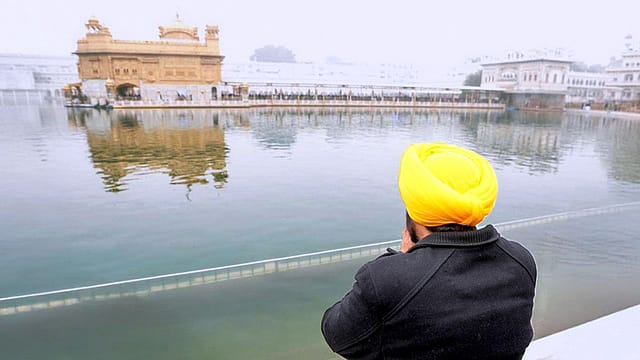
The proclamation against Mann, who was declared guru dokhi (one disloyal to the guru) and Khalsa Panth virodhi (one who is opposed to the Khalsa Panth), was made from the pulpit of the Akal Takht, the “temporal seat” of the Sikhs in the Golden Temple. At the head of the congregation that made the determination of disloyalty against Mann was Giani Kuldeep Singh Gargaj, the jathedar (leader) of the Akal Takht.

The Health and Wellness Issue
25 Sep 2026 - Vol 05 | Issue 39
The case against Mann was that he allegedly made derogatory remarks about various Sikh religious practices. A video recording of his alleged utterances was leaked and later sent for forensic examination by the high priests. On Monday, Gargaj said that, “the video has been examined by recognised laboratories and their clear conclusion is that there has been no tampering with the video and it is not AI generated…and is authentic.”
“He (Mann) sprinkled liquor on the photograph of the guru. Now many will say that we don’t place faith in a picture. That is not the issue, the issue is one of emotion. There are pictures of gurus in homes and there is attachment to them. When a responsible person sprinkles liquor on such pictures and then lies in front of the Akal Takht that I am not the person in the video…” Mann had earlier—in January this year—appeared before the Akal Takht and given his clarification.
Within no time, major political parties in the state, especially the Congress and the BJP, reacted negatively against Mann. Former chief minister Charanjit Singh Channi exclaimed on Monday, “Do you think Bhagwant Mann is a Sikh?” Punjab BJP chief Kewal Singh Dhillon said that Mann must accept moral responsibility for his actions and step down.
A POLITICAL CLASH
Mann’s denouement, if one goes by reactions of political parties and observers, occurred on religious grounds. But as with much else in Punjab, what is apparent is not real and what is real is not apparent. The real tussle is political and religion is just a foil on what is happening in the state.
The same day, on Monday, the same set of religious figures also summoned the Punjab cabinet and all Sikh MLAs in state assembly, across party lines, to appear before the Akal Takht on 29th June and explain how a law dealing with Sikh affairs could be passed by the state legislative assembly without first consulting the Sikh clergy. The Act toughens the punishments for “disrespect” towards the Guru Granth Sahib, the Sikh holy scripture.
The law in question, The Jaagat Jot Sri Guru Granth Sahib Satkar (Amendment) Bill, 2026, was passed by the Punjab assembly on 13th April and received the Governor’s assent within days. A week before the law was passed, the Sikh priests met in Amritsar and said that no law relating to Sikh religious affairs should be passed without first consulting the religious representatives of the community, in essence the Shiromani Gurudwara Parbandhak Committee (SGPC) and the cohort of various jathedars.
While moving the Bill, Mann—in the statement of objects and reasons for the Bill—said that, “In the recent past, there have been attempts to disturb peace and communal harmony in the State by committing sacrilege of Sri Guru Granth Sahib ji. The Government is determined not to allow such incidents and ensure deterrent action against all those who commit such sacrilege. Proposed “The Jaagat Jot Sri Guru Granth Sahib Satkar (Amendment) Bill, 2026” aims to achieve this objective by providing punishment of life imprisonment for such acts of sacrilege.”
On paper, the law passed in April was meant to deter persons from indulging in sacrilegious behaviour. But there is another aspect to the law: it placates--if not actively trying to secure the favour—of the religious conservatives and extremists among Punjab’s voters. This was not the first time that the Aam Admi Party (AAP) had dabbled in religious politics in Punjab. Right from its inception, it has tried to curry favour with this spectrum of voters. It worked splendidly for the party in 2017—when it made massive gains for a new party in the state--and in 2022 when it formed the government.
Now, after four years, the party is trying to undo the accumulation of resentment against it. In these four years, farmers in the state have been on the warpath, women voters remain disaffected and the state’s economy has lost its sheen. In such a situation, securing the “Sikh vote” can undercut AAP’s rivals, if it succeeds. The sacrilege law is one step in that direction.
The rub is that in Punjab, as elsewhere, political rivals are unlikely to sit and watch events overtake them. If the SGPC is a representative body of the Sikhs, it also happens to be the handmaiden for Akali interests. It would be naïve to think that AAP could move to corner the “Sikh vote” while the Shiromani Akali Dal (SAD) would sit on its haunches and let events overtake it. It is worth noting that Mann appeared before the Akali Takht in January, five months ago. The Jaagat Jot Bill was passed in mid-April and Mann was held guilty for religious infractions in June. The timeline could be innocuous, after all the video in question was to be examined forensically. But nothing in Punjab’s politics is as obvious as it seems. It is also worth noting that the AAP boss, Arvind Kejriwal, has hinted that elections in Punjab may be held in November, months before they are due in the normal course.