Mission Dharna: A video game about reaching Jantar Mantar finds its best jokes in the chaos
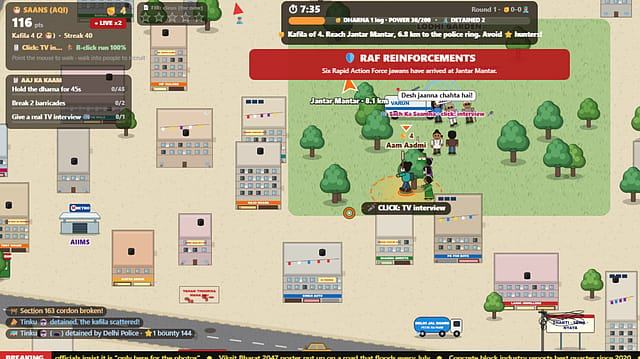
A news ticker announces that a report into a paper leak has itself been leaked. When the police chase you, you can hide in Sharma Ji ki Dukaan. And a possible ride on Zomato can make your journey faster and easier.
These are some of the jokes tucked into Jantar Mantar Chalo, a recently launched video game that turns protest into a series of comic obstacles. The game has been created by Suraj Kushwah, a 27-year-old DevOps engineer from Bareilly, Uttar Pradesh, who uses bugswriter as his Instagram handle.
The gameplay is quite simple. Players can choose to be an andolankari (protester) or a Delhi Police officer. The protesters must gather people, dodge the police, break barricades and reach Jantar Mantar to stage a dharna. The police must stop them. While this could be fun, the details of the game are what make it worth exploring.

Zeroing In on ECI
09 Oct 2026 - Vol 05 | Issue 41
Constitutional legitimacy versus political opportunism

Kushwah says he was following news reports of people trying different ways to reach Jantar Mantar when the idea came to him. He saw an opportunity for dark humour and decided to build the game—in two sleepless nights— as a satirical take on how the CEC protest unfolded, and the everyday difficulties of getting around in Delhi.
Take the gamchha (towel). In the game, picking one up helps a character avoid identification by CCTV cameras. It is a simple gag, but one that draws on a familiar image: a person covering their face to avoid being recognised. The joke lies in making this a useful item in a game, much like a power-up in arcade games.
Food plays a similar role. A plate of golgappas—one of Delhi’s most beloved street food—restores stamina, allowing the player to keep moving. A chai stall offers a brief pause and a place to hide, perfectly fitting for a city where tea stalls often become informal meeting points. The game takes ordinary things (every house features the all-familiar Sintex water tanks) that people recognise and gives them a new purpose.
“So it's as lore-accurate as it can be,” says Kushwah, who claims to have completely read the vast lore of the popular game, The Elder Scrolls. “Okay, so like the places, everything, there are very tiny jokes, which I tried to add in every element. For example, if you see the dustbin, there is litter around, as is typical in the country; and there are potholes on the road and very minor things here and there.”
Other details are more pointed. Players may encounter media organisations while building their procession. Some of them can help attract more people to your group, while others can “brainwash” members of the crowd to leave it. The distinction is built into the rules: one encounter strengthens the march, while the other weakens it. The joke does not need much explanation.
A ticker running along the bottom of the screen adds another layer of satire. One fictional update announces that tear gas shells have been found past their expiry date, prompting protesters to file a consumer complaint. Another reports that a probe report into a paper leak has itself been leaked. Both jokes work by taking familiar public controversies and pushing them into absurd territory.
In the game, the player has to deal with the protest through a set of tasks. Barricades block the route; a lathi charge can break up a crowd; internet connectivity may disappear, leaving the player without a working minimap. If detained, the protester is taken to faraway places such as Narela or the Kapashera border and must find a way back.
The humour comes from treating these problems as obstacles to be overcome. Even the city’s potholes, overflowing dustbins and wandering cows get in the way. The result is a world that feels recognisable, though exaggerated for comic effect.
The game also allows players to switch sides. As a police officer, you have to detain protesters and load them into buses. The same situation that is an obstacle for one player becomes the objective for another. It is an unusual choice, and one that gives the game a different texture from a straightforward protest-themed running game.
The project may seem ambitious, but for Kushwah, its success was expected. “I told my cousins and friends 150 per cent that this will go viral. I was like 200 per cent because I understand the internet well.”
After actually posting a video of the game on Instagram, he saw it being shared widely. He also had to deal with the practical work of keeping the game running as more people joined in, as servers ended up crashing due to the heavy traffic. At one point, Kushwah says, there were more than 1,700 people playing simultaneously.
The game’s jokes seem to be what made people to like it. Some other games have too come up, like Bhaag Neha Bhaag, a 2D Subway Surfers-like platformer that has the police chasing AISA chief Neha Bora. But the details of Jantar Mantar Chalo give players reasons to look around rather than simply rush towards the finish.
That is the appeal of Jantar Mantar Chalo. Its satire is built into the things players do and the consequences they face. It takes familiar scenes from public life and turns them into small, playable jokes. In this world, even a protest march has a stamina bar.