Kolkata on a Plate: What’s it that makes the food in the city the best?
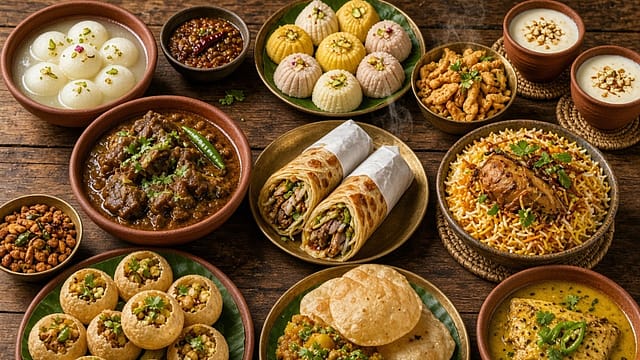
Let me begin with a confession: I am biased. But bias, like good mustard oil, is something Kolkata has taught me to wear with pride. Other cities have restaurants. Kolkata has a religion, and it is practised three times a day, with a fourth sitting for adda.
Consider what this city did. It took the Mughal’s patience, the Bengali’s greed, the Chinese immigrant’s wok, the Briton’s tea and the Armenian’s bakery, and made them all sit down together at one table without a single quarrel. Only in Kolkata does the Anglo-Indian cutlet sit beside the mustard fish and neither feels the need to apologise.
Begin with the roll. The kathi roll was born at Nizam’s, near New Market, where a parantha met a skewered kebab and the street food of the world was permanently altered. Everything since, in every mall food court, is a footnote.
Then the fish. A Bengali without hilsa is a poet without a pen. The ilish, bony, treacherous and divine, is best met steamed in mustard or wrapped in banana leaf. Bhojohori Manna has made a business of honouring the Bengali kitchen, and 6 Ballygunge Place does it with grace. For the bhetki paturi, that parcel of fish and mustard steamed in leaf, go to Oh! Calcutta, which does it with some elegance. Fish here is not a dish. It is an argument you are happy to lose.
Then the mutton. The kosha mangsho, slow-cooked until the meat surrenders and the gravy turns the colour of old mahogany, is best eaten at Golbari in Shyambazar, a place with no airs. Pair it with luchi, never with naan. Luchi is a puffed, golden indulgence that deflates the moment you look at it, much like the ego of a Delhi man at a Kolkata dinner table.
And now, the biryani. Lucknow may claim its origins, but Kolkata gave it the potato, and in doing so, gave it character. Arsalan at Park Circus, Shiraz, and Aminia all offer a version where the humble aloo sits inside the rice like a quiet philosopher. The Royal Indian Hotel on Chitpur Road is a little older and a little more ceremonial about it.
Then the Chinese. This is where the city truly shows off. Tangra, the old Chinese quarter, gave India its own Chinese cuisine: chilli chicken, hakka noodles, and the sort of sweet-sour-spicy sorcery that no Beijing chef would recognise, but every Kolkatan would defend with his life. Go to Beijing or Kim Fa, order too much, and leave humbled. And for the soul of the thing, rise early and find the Chinese breakfast at Tiretti Bazaar, where steamed dumplings and soup greet you before the city has cleared its throat.
Now, the street. The phuchka is not a golgappa, and anyone who says otherwise has not been properly raised. Tamarind water, a sharper bite, a soft potato filling, and the vendor’s hand moving with the confidence of a surgeon. Vivekananda Park has its devotees. Add a paper cone of jhalmuri, that spicy puffed rice tossed with mustard oil, onion and a stray green chilli, and you have eaten something no five-star kitchen can replicate.
And the sweets, ah, the sweets. The rosogolla belongs to this city in spirit whatever courts and committees may say. KC Das, whose family is credited with making it famous, still serves it spongy and soaked in syrup. Nobin Chandra Das’ name is spoken with reverence. For sandesh, in all its delicate shapes, I would send you to Girish Chandra Dey or Bhim Chandra Nag, where the confectioner is a sculptor and the sweet, a small piece of art. Finish with mishti doi in its earthen pot. Nobody has ever been unhappy after mishti doi.
Finally, the ritual of the places themselves.
Flurys on Park Street, with its tea and pastries, remains a memory you can eat. Peter Cat serves its chelo kebab to a loyal congregation. And the Indian Coffee House on College Street proves that a city can feed the mind and the stomach with equal indifference to profit.
What makes Kolkata’s food the finest on Earth is not merely the dishes. It is the attitude. Here, eating is not a pastime but a philosophy. The Kolkatan will fight over politics, football and poetry, but he will never fight over a good meal, because a good meal is the one thing on which the city has always agreed.
Other cities feed you. Kolkata claims you. And once you have been claimed, no other plate will ever quite satisfy.