Women Issue 2026: Business: Fortune’s Favourites
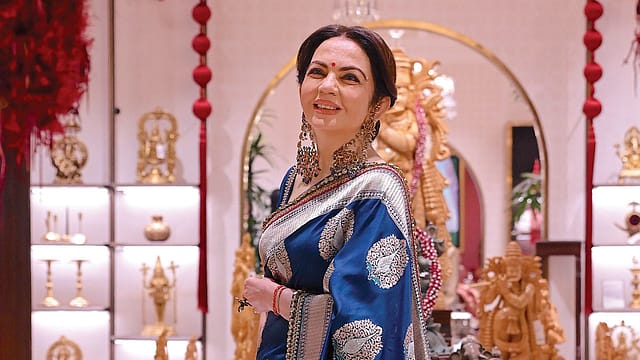
IT IS A BIT IRONIC TO WRITE ABOUT WOMEN corporate leaders because I have always been of the belief that women leaders need not have to compete with each other within the gender bucket. In fact, I have often said that it is important for organisations to look at both genders equally, just like we have done recently in cricket where we have introduced pay parity. Nevertheless, here is my list.
The Helmswoman: Nita Ambani, 62, Chairperson and Founder, Reliance Foundation
It is not at all incongruous, or for that matter strange, but Nita Ambani’s name is critical for a list where we’re discussing women corporate leaders, because Nita has exuded leadership of the finest kind in everything she has touched and continues to. Whether it is the setting up of the Dhirubhai Ambani International School, or for that matter, imagining and then executing Swadesh, to the recalibration of the Reliance Foundation. The stunning Nita Mukesh Ambani Cultural Centre in Mumbai will be her lasting contribution to the cultural landscape of India. And having seen both Nita and Mukesh at such close quarters, I can say that Nita is the wind beneath Mukesh’s wings in more ways than one. She has brought to Reliance the softness that a behemoth always needs and Reliance has benefited from this hugely. The work that she has done in Reliance Foundation, both inside India and outside, is commendable. Not to mention her role now at the International Olympic Committee, where for the first time, India set up an India House pavilion in the Paris Olympics. For me, Nita embodies the kind of zeal that is both tireless and extremely focused. Whether it is a cricket match of the Mumbai Indians, or for that matter, the Time Gala in New York, or her enormous contribution as India’s brand ambassador to the Metropolitan Museum of Art in New York, Nita Ambani has shown what it takes to be a woman, even if that woman has all the financial support. She could have easily been a stay-at-home woman but she chose a path less travelled, and to quote Robert Frost, “that made all the difference.”
Scientific Temper: Kiran Mazumdar-Shaw, 72, Executive Chairperson and Founder, Biocon

I’ve known Kiran now for over two decades, and the one thing that strikes anyone about Kiran is her utmost devotion to the cause of science and, within that, to the alleviation of disease, because that, in effect, is the purpose behind the brilliant organisation she single-handedly created called Biocon. When you see a corporate leader like Kiran Mazumdar-Shaw, you recognise that there is no glass ceiling. The glass ceiling is more often than not a false narrative and therefore needs to be re-examined within the purview of what we call leadership. Having seen her at work, and outside work, one can say that Kiran exudes the kind of confidence and the empathy that all corporate leaders need.
Paper Queen: Shobhana Bhartia, 69, Chairperson and Editorial Director, HT Media
No list of women leaders in the corporate world in India can be complete without the mention of Shobhana Bhartia. When she took on the Hindustan Times from her late father, KK Birla, no one had imagined that a girl from Kolkata, heavily sheltered, would strike out on her own in a manner that redefined the entire world of journalism. Very few will remember that it was Shobhana who steered the Hindustan Times into digital way before digital became fashionable. And the absolutely irrepressible Karan Thapar began his career working for Shobhana Bhartia, in addition to many editors that she spawned, some of whom have now taken a rude break, while others continue to flourish in various fields, both within and outside domains related to journalism. For me, Shobhana represents the kind of attention to detail I haven’t seen in most people. Add to that her courage and the fact that she comes from a family that was an avid participant in India’s freedom struggle, Shobhana marries both history and contemporariness with a passion that is very rare. Apart from the many boards she sits on, I know what delights Shobhana is her interaction with young minds, whether it is at Columbia or, for that matter, at Harvard. And to that end, Shobhana Bhartia is truly a corporate leader, one of the finest kinds.
Flying High: Kanika Tekriwal, 35, Founder and CEO, JetSetGo
Kanika Tekriwal is perhaps the youngest on this list. She battled cancer and did something that no woman has dared to do—enter the world of private charter aviation, and made a remarkable success of it at the early age of 27. For me, Kanika is not only about boundless energy but about boundless aspirations, which she meets with rigour and compassion. I have seen her at work and I’ve seen her with her colleagues. I’ve seen her speak at various fora, whether it is in India or at Davos, and the one thing that strikes me about Kanika is her ability to look beyond the pale of what is normally expected of a person, and then move beyond and create a whirlpool of excellence around her. Kanika, of late, has been reimagining the private aviation sector, both in terms of routings, as well as the kind of hospitality she wants to provide in the air. And in everything that she’s done, she exemplifies remarkable rigour and determination, not to mention her enthusiasm, which is infectious, to say the least.
Kolkata’s Hotelier: Priya Paul, 58, Chairperson, Apeejay Surrendra Park Hotels
I’ve known Priya since she was a little child running around in polka-dot skirts, creating a stir for everyone. Look at the person she has grown into. Having taken over the reins of a single property at The Park in Kolkata, she’s now made The Park Hotels into a design powerhouse and continues to blaze a trail as far as hospitality is concerned. To that end, Priya has used some of the finest minds in the world, from Terence Conran to Singapore-based designers, to reimagine hospitality and what it means and what it should do.
Reimagining Inheritance: Roshni Nadar Malhotra, 44, Chairperson, HCL Technologies
Roshni Nadar Malhotra has perhaps made the biggest impact in the world of IT and IT services in India, but has been totally low key, following in the footsteps of the very reclusive but brilliant father, Shiv Nadar. And what I’ve seen over the years is how Roshni, who first started work at the Shiv Nadar Foundation, quietly morphed into running the behemoth that HCL Technologies is today. In its operating style and in her vision, she has shown remarkable diligence, but with a vision to expand internationally in a manner that was hitherto not seen by most IT companies other than perhaps TCS. Roshni continues to shed a massively brilliant luminescent light on IT services for Brand India and everything that Indianness stands for.
Banking on the Future: Arundhati Bhattacharya, 69, president and CEO, Salesforce, South Asia
Arundhati Bhattacharya, who is now the CEO of Salesforce, was the chairperson of the State Bank of India, and one saw, at reasonably close quarters, the manner in which she transformed India’s most valuable bank. She didn’t just stop at the transformation. She created an entirely new organisation out of a sluggish one, and which is why when she became the CEO of Salesforce. No one was as delighted as I was because here was a lady who had straddled the top of the corporate world, and post-retirement, reinvented herself with a level of audacity that is only admirable. It was the same audacity that made her reinvent and reimagine how Salesforce would be. Arundhati has been a tireless supporter of the role of women in corporate India. She has every conceivable award. But what very few people know is that beneath the veneer of a very strategic mind lies an extremely compassionate heart.
Collaborate and Soar: Devyani Jaipuria, 41, Entrepreneur and Philanthropist
Devyani Jaipuria is easily the most impactful young corporate leaders amongst women in India today. Straddling an empire which she has carved out for herself across education, healthcare, and hospitality, Devyani brings a rare insight into everything she does. By nature, she is an extremely collaborative person. People like Devyani enable organisations to grow from within. And therefore, the organisation that Devyani is building today is not only supremely homogenous but is equally effective in everything that it sets out to do, both in terms of delivering shareholder value as also customer delight. Whether it is her involvement with healthcare, or for that matter, with a chain of schools that she runs, or in the intricate care that she takes to design both her homes and other spaces that she’s entrusted with, Devyani brings both flair and fortitude.
Lines of Beauty: Vandana Luthra, 66, Founder, VLCC Health Care
Vandana Luthra started VLCC more than 30 years ago, and she used her experience and her expertise to create a brand that would cater to Tier I and II cities, not to mention metropolises. What started as Vandana Luthra Curls & Curves morphed into VLCC, and it went from just being a salon to being a full-service beauty clinic and a spa. Over the years, I’ve seen Vandana and her remarkably supportive husband, Mukesh, transform not only the company but the leaders within their companies, so much so that not only have they recalibrated the employment prism for people who want to enter the beauty sector but have also been hugely inspiring way before any other Indian brand could do the same. For me, personally, VLCC epitomises not just the Indian dream but the ability to execute when one puts one’s mind to it. For that reason and more, Vandana Luthra truly belongs to the list of great corporate leaders amongst womenfolk.
Healing Power: Preetha Reddy 69, Suneeta Reddy 68, Shobana Kamineni 65 and Sangita Reddy, 63, Entrepreneurs, Apollo Hospitals Enterprises
I always refer to them affectionately as the four sisters. I don’t think anyone has contributed to Indian healthcare in a more significant and meaningful manner than the sisters Preetha, Suneeta, Shobana, and Sangita of the Apollo Hospitals Enterprises. They work seamlessly and in unison, and sometimes I wonder why they’re not clawing at each other because that is what one would normally expect from family-run businesses. But the respect which they give each other, including the space, as also the manner in which they work together to create and continue to magnify the vision of their illustrious father, Dr Prathap C Reddy, tells me that there is a place for family-run businesses which may well be run only by women. For me, they not only represent continuity but also a borderless world because they’re always willing to take risks that very few would ordinarily. Whether it is the expansion into Apollo Pharmacies, or for that matter, expanding the footprint of the Apollo Hospital group, they’ve done it both with aplomb and without sacrificing the imprint of remarkable healthcare, which is today the birthmark of Apollo Hospitals. Kudos to these four sisters and may their tribe increase.