When a Heart Gets the Right of Way: How India’s Green Corridors Turn Traffic into Lifelines
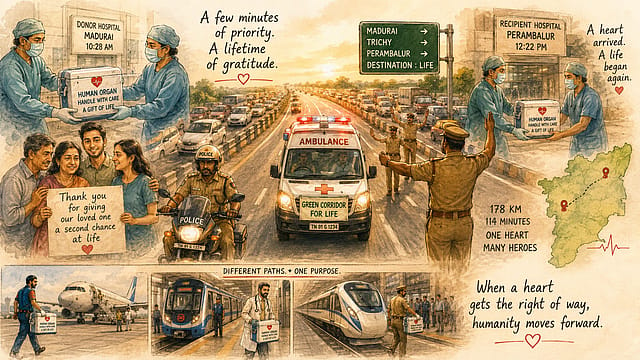
At 10.28 am on Wednesday, a heart left Madurai.
The 23-year-old to whom it had belonged would never make another journey. He had been declared brain dead at a private hospital. Yet, before his family could fully absorb the finality of that sentence, they made a decision that allowed a part of him to travel farther.
The destination was Dhanalakshmi Srinivasan Medical College Hospital at Siruvachur in Tamil Nadu’s Perambalur district. The distance was approximately 178 km. Under ordinary conditions, the road from Madurai towards Tiruchirappalli and Perambalur can demand considerably more than two hours. This was no ordinary passenger and there was almost no time to lose.

Zeroing In on ECI
09 Oct 2026 - Vol 05 | Issue 41
Constitutional legitimacy versus political opportunism
Following instructions from Central Zone Inspector General of Police V Balakrishnan, police personnel cleared the Madurai-Trichy-Perambalur route. Traffic was regulated, junctions were secured and an uninterrupted passage was created for the ambulance.
At 12.22 pm, 1 hour and 54 minutes after it had left Madurai, the heart reached the hospital. It was transplanted into its recipient, who was reported to be stable. A young man had died. Somewhere else, another heart had begun to beat. Between those two moments lay a green corridor.
The Road That Must Not Turn Red
A green corridor is not a permanently reserved lane, a specially constructed road or a piece of expensive infrastructure. It exists temporarily, sometimes for only a few minutes.
Police synchronise or manually control traffic signals, hold vehicles at intersections, clear bottlenecks and escort the ambulance carrying the organ. When the journey involves two cities, the operation may bring together multiple police jurisdictions, airports, airlines, railway officials, transplant coordinators and medical teams.
The medical reason is unforgiving. Once blood supply to an organ stops, the cold ischaemia clock begins.
A donor heart preserved through conventional cold storage generally needs to be transplanted within four to six hours, with the risk of complications increasing as the duration rises. Lungs and livers have their own preservation limits; kidneys can generally endure longer. The better the organ and the shorter its time outside the body, the better the odds confronting the recipient and the surgical team.
The journey is only one part of this window. Surgeons must retrieve the organ, prepare it for transport, carry it to the recipient hospital and complete the transplantation. A traffic jam consuming 40 minutes is not merely an inconvenience. It eats into an organ’s life.
The green corridor gives those minutes back. It also produces one of the most affecting sights on Indian roads. In cities where ambulances frequently struggle for space, hundreds of vehicles are stopped so that a small icebox can pass. Most people waiting at those junctions will never know the donor or the recipient. For a few minutes, they nevertheless become part of the transplant.
Chennai Showed India the Way
Tamil Nadu’s place in Wednesday’s story is fitting. The state helped turn organ transportation from an improvised emergency into a replicable public system.
One of its defining moments came in September 2008, after 15-year-old Hithendran was critically injured in a motorcycle accident. When he was declared brain dead, his parents agreed to donate his organs. His heart was transported across Chennai to save a young child.
The episode moved Tamil Nadu and helped build public understanding of deceased organ donation. It also demonstrated that successful transplantation required far more than surgeons. Hospitals had to identify brain death, counsellors had to speak to grieving families, authorities had to allocate the organs fairly and the city had to move them rapidly.
The green corridor acquired its recognisable modern form in Chennai in June 2014. A donor heart had to travel roughly 12 km from the Rajiv Gandhi Government General Hospital to Fortis Malar Hospital. Twenty-six police personnel were positioned along the route. The ambulance covered a journey that could have taken more than 40 minutes in around 14 minutes. A few hours later, the heart was beating inside 21-year-old commerce student HvoviMinocherhomji.
That journey became widely recognised as India’s first formally organised green corridor for organ transport. Soon, the idea began travelling faster than the organs themselves. Mumbai, Pune, Delhi, Bengaluru, Hyderabad, Kolkata, Indore, Chandigarh and several other cities adopted it. Some corridors crossed city limits. Others connected hospitals with airports. Police forces that had spent decades perfecting routes for presidents, prime ministers and chief ministers began using the same administrative muscle for a person whose name they might never learn.
In 2019, Pune completed its 100th green corridor in four years. The symbolism was exquisite. Maharashtra Chief Minister Devendra Fadnavis was at the airport, but his convoy was reportedly made to wait until a donated heart had passed. The organ received precedence over the politician. For once, India’s VIP culture had found the right VIP.
From Roads to Runways and Railway Platforms
As transplant networks expanded, the green corridor stopped being only a traffic-police operation. It became a chain whose weakest link could destroy the entire effort.
In September 2014, a donated heart travelled from Bengaluru to Chennai through coordinated corridors at both ends, airport clearances and a commercial flight. A journey that could have taken up to seven hours was completed in 2 hours and 7 minutes.
In August 2015, Maharashtra’s first successful heart transplant required an organ to travel from Pune to Mumbai. The heart was carried by road, air and another cleared road corridor before reaching the recipient.
In Kolkata in 2018, a heart retrieved in Kakinada, Andhra Pradesh, was flown to the city and then transported 26 km from the airport to Fortis Hospital in 16 minutes.
The method has since escaped the road altogether. In January 2025, Hyderabad Metro operated a dedicated service to transport a donor heart across 13 km and 13 stations without delay. In August 2026, the Metro was used again to carry a donated heart and lungs from Raidurg to Rasoolpura, covering 14 km and 13 stations in 25 minutes.
Bengaluru has used Namma Metro to transport a liver and other organs across a city notorious for its congestion. Chennai Metro has carried donor lungs. These missions do not merely produce dramatic photographs of doctors holding an icebox inside a train. They raise an important urban question: if a Metro can offer a faster and more predictable route than an ambulance, why should the organ remain trapped on the road?
Indian Railways took the experiment farther in July 2026 when a donor heart was carried from Surat to Ahmedabad aboard the Mumbai Central-Gandhinagar Capital Vande Bharat Express. The train made a special halt at Ankleshwar, where the organ had been retrieved, and carried it to Ahmedabad for transplantation at the UN Mehta Institute of Cardiology and Research Centre. The Railways described it as the first transportation of a live donor heart by train in India. A railway timetable had briefly reorganised itself around a heartbeat.
India Finally Wrote the Rulebook
For years, many green corridors depended upon urgent phone calls, personal initiative and extraordinary coordination. Their success made news precisely because they looked miraculous.
But a life-saving system cannot depend upon miracles. In 2024, the Union health ministry issued India’s first comprehensive standard operating procedures for transporting human organs through road, air, rail, Metro and waterways. The guidelines proposed a “One Trigger System”, under which a request from NOTTO, a Regional Organ and Tissue Transplant Organisation or a state authority could set the process in motion.
They asked states and cities to appoint police nodal officers, authorised airport green corridors between ambulances and aircraft, and provided for priority passage and security escorts on Metro systems. Airlines could seek priority take-off and landing from air traffic control. Airport personnel could allow ambulances closer to aircraft and assist medical teams in moving the organ box without routine delays.
The change was administrative, but its meaning was profound. Green corridors were no longer to be treated as acts of individual ingenuity. India had begun recognising organ transport as a public system.
The World Has Different Names for the Same Race
Other countries do not always use the expression “green corridor”, but they confront the same enemy.
In the United Kingdom, NHS Blood and Transplant operates trained emergency logistics teams and a specialised fleet. In the United States, transplant organisations rely on couriers, charter aircraft, commercial airlines and real-time tracking systems. Yet even sophisticated networks fail. According to the United Network for Organ Sharing, transportation problems account for about 2.5 per cent of unused organs in the US.
A delayed commercial flight, a closed cargo office or a courier taking a wrong turn can waste a gift that cannot be replaced. The United States has consequently pushed for organs to be carried inside aircraft cabins instead of being treated as ordinary cargo, and for mandatory real-time tracking of organs in transit.
Technology is also trying to lengthen the clock.
“Heart in a box” perfusion systems keep a donor heart warm and supplied with oxygen and nutrients during transportation, allowing doctors to monitor its condition instead of simply storing it on ice. In 2019, a drone carried a donor kidney about 4.5 km across Baltimore before it was successfully transplanted at the University of Maryland Medical Center. The experiment suggested a future in which organs could fly above traffic rather than asking traffic to disappear.
These developments could expand the geographical pool of donors. They remain expensive, specialised and far from universally available. For much of India, the immediate lifesaving technology is still a police wireless message, a disciplined chain of officers and a road temporarily cleared by human hands.
The Corridor Begins With a Family
It is easy to celebrate the speed and forget the sorrow that made it necessary.
Every heart photographed inside an icebox once beat inside someone who was expected to return home. A green corridor begins before the police arrive. It begins in an intensive care unit, where a transplant coordinator approaches a family experiencing the worst hours of its life and asks whether it can imagine saving strangers.
Tamil Nadu’s success rests on this larger architecture. The state began building a structured deceased-donation programme in 2008, strengthened brain-death certification, centralised organ allocation and brought government hospitals into the network. By April 13, 2026, it had recorded 100 deceased donors in 102 days. Their organs enabled 317 major transplants. More than 70 per cent of the deceased donors were road-accident victims, according to the state transplant authority.
That statistic contains the cruelty and generosity of the system. Roads take many young lives. Green corridors allow some of those roads to return life. India still has a profound shortage of donated organs. Corridors cannot compensate for poor brain-death identification, inadequate transplant facilities, uneven state systems or families never being offered the opportunity to donate. Nor should the spectacle of an ambulance racing at high speed distract from the need for safe, standardised transportation.
A green corridor can protect an organ that has been donated. It cannot create the donor, select the recipient, perform the operation or guarantee the outcome.
Yet it does something rare. For 114 minutes between Madurai and Perambalur, institutions that usually move slowly moved together. Police officers across jurisdictions, doctors at two hospitals, ambulance personnel and motorists who were asked to wait all accepted the same priority.
They did not know the recipient. They did not need to. A family had given a heart. The state made sure the road was worthy of the gift.
(With inputs from ANI & agencies)