What the India-China Statements Reveal About Modi-Xi Talks
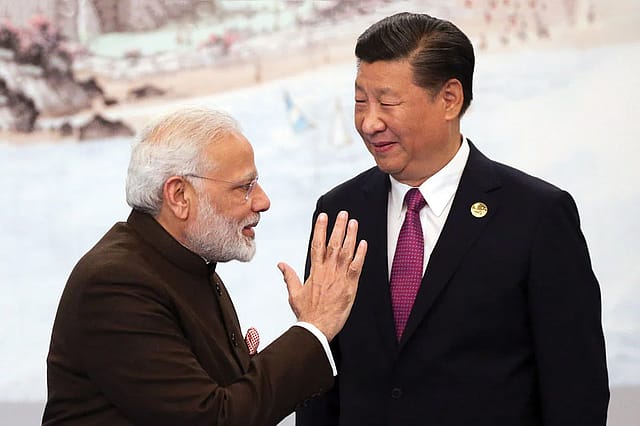
The statements from the foreign ministries of India and China about the 45-minute meeting between Prime Minister Narendra Modi and Chinese President Xi Jinping on the sidelines of the New Delhi BRICS Summit offer scope for close scrutiny.
Foreign policy experts watching both the neighbours, which together account for 35% of the world’s population, argue that the differences between the press releases published by the Indian side (Ministry of External Affairs) and the Chinese side (Ministry of Foreign Affairs) after the Xi-Modi parleys are quite interesting.
Jingyi Zhang, a UK-based China scholar and researcher at the Department of International Development at King’s College London, points out that in the Chinese version, Modi says the following — which is missing in the Indian version:
“India has an independent foreign policy, and developing relations with China is not affected by any third party. India’s policy and position on issues relating to Taiwan and Tibet remain unchanged, and it will not allow any force to engage in anti-China activities on its territory.”

Zeroing In on ECI
09 Oct 2026 - Vol 05 | Issue 41
Constitutional legitimacy versus political opportunism
Zhang’s research interests include neoliberalism, Marxism, and Indian political economy. He says, “This ‘not affected by any third party’ sentence appeared last year when Xi met Modi [on August 31 on the sidelines of the Shanghai Cooperation Organisation (SCO) summit at Tianjin, China].” This year it appears again but not in the Indian version, he adds.
As is well known, the “third party” is invariably the United States.
Further, the Indian press release notes, “On economic and trade relations, they underlined the need to address each other’s concerns, including structural trade imbalance and supply chain issues, and facilitation of meaningful and predictable market access.”
However, in the Chinese version, it’s not specific: “The two sides should also address each other’s economic and trade concerns in a balanced way and promote the sound and steady development of economic and trade relations.”
Jingyi, who has analysed Chinese and Indian texts for years now, notes that the “third party” reference comes up often in Chinese statements. For instance, he said, in the case of the China-Mexico relations, too, such expressions are common: “Relations between China and Mexico are not directed against any third party and should not be influenced by any third party.”
Where Modi talks emphatically about “mutual respect, mutual sensitivity and mutual interest”, no such mention is found in the Chinese press release this time around. “Mainly the ‘mutual sensitivity’ part is missing. I think for the Chinese side, issues related to Tibet cannot be sacrificed due to ‘sensitivity’ but a principle,” Jingyi notes.
The UK-based researcher feels that, regarding general bilateral relations between Beijing and New Delhi, “I notice the Chinese side is always claiming ‘China and India are partners rather than rivals, and development opportunities rather than threats to each other’ while it’s extremely ambiguous on the Indian side.”
Xi is back in India for the first time in seven years. Although he and Modi met at the recent SCO summit in Bishkek, Kyrgyzstan, they did not hold official talks.
China has lately been worried about India’s stance on Taiwan, which it says is an inalienable part of China. Although India-Taiwan trade ties have improved over the years, much to the anguish of China, New Delhi does not have any full-fledged diplomatic ties with Taiwan, only cultural relations. India has also said that its stance on Taiwan stands unchanged.