US and India Trade Out Rancour
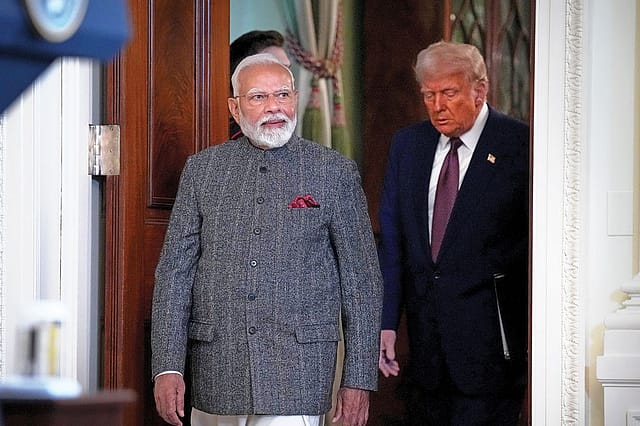
The framework agreement ends many months of bitter statements, uncertainty and an unprecedented deterioration in bilateral relations between the two countries that were assiduously built over a quarter century.
India has agreed to remove or reduce tariffs on all US goods. These include industrial products and a host of agricultural commodities that include animal feed, soyabean oil, dried distillers’ grains, tree nuts, red sorghum and other products.
The US, in turn, has reduced tariffs on Indian exports from 50% to 18%. Important Indian exports such as textiles and apparel, leather and footwear, organic chemicals and certain machinery will fall under this category. The joint statement on the subject between the two countries adds that subject to the successful conclusion of the Interim Agreement, the US will remove the reciprocal tariff on a wide range of goods identified in the 5th September, 2025 executive order issued by President Trump. Goods under this class include generic pharmaceuticals, gems and diamonds and aircraft parts.
Apart from tariffs, the framework agreement addresses other important issues. The two countries will establish rules of origin. Rules of origin in any trade agreement between two countries specify the content added in the exports from each country. This is to ensure that the two don’t turn into mere entrepots for goods produced in some third country and end up eliminating potential benefits that ought to go to them alone.
The point of negotiating a BTA is very important as trade between India and the US has been a weak point in what was otherwise a very robust relationship. Ever since Prime Minister Atal Bihari Vajpyee’s historic visit to the US in September 2000, the two countries have deliberated on a BTA. But that went nowhere. Hopefully, the framework agreement will give impetus for an early conclusion to a BTA.

Bengal Thriller 2026: The Plot Thickens
17 Apr 2026 - Vol 04 | Issue 67
Mamata Banerjee faces her toughest battle
Interestingly, the joint statement says that, “The United States and India agree to strengthen economic security alignment to enhance supply chain resilience and innovation through complementary actions to address non-market policies of third parties, as well as cooperation on inbound and outbound investment reviews and export controls.”
This section, in effect, aligns India’s trade and economic priorities closer with those of the US. This is interesting because India’s approach to trade and multilateral relations has been based on “de-risking” those parts of India’s trade and political engagement that make it dependent on one country or even a small set of countries. This is a prudent approach in a world where uncertainty and frictions are on the rise. These risks are in part due to the US itself and its drive to reduce its trade deficits with other countries, above all China.
India has promised to purchase $500 billion worth of energy products, aircraft and aircraft parts from the US, among other items over the next five years. In 2024, India’s imports from the US stood at $45 billion. There is no reason to suspect that this figure cannot grow naturally in the coming years.