UNESCO Adds 3 New Sites from Andaman & Nicobar Islands, Chhattisgarh to India’s Tentative List
Three new sites have been added to India’s Tentative List by UNESCO’s World Heritage Centre, the first formal step towards World Heritage status. Two are in the Andaman and Nicobar Islands, the Indian archipelago in the Bay of Bengal: the Karst-mud-volcano Complex of Baratang and the Andaman Subduction Volcanoes, which cover Narcondam and Barren Islands.
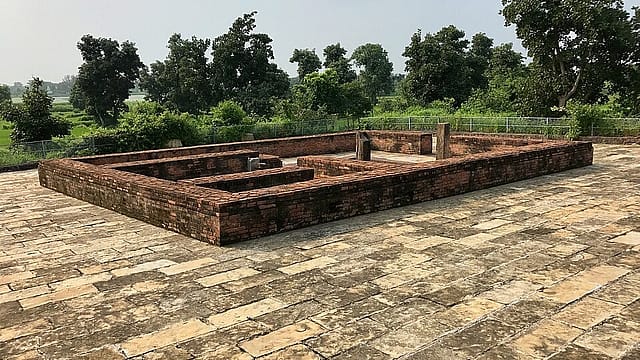
The third, the Sirpur Cultural and Archaeological Landscape, is in the Mahasamund district of Chhattisgarh in central India, on the Mahanadi River about 78 km from the state capital, Raipur.
The Tentative List is the inventory of sites a country intends to put forward for World Heritage status. The Permanent Delegation of India to UNESCO said that addition to it is a prerequisite before any property can be nominated for inscription on the World Heritage List. It thanked the Archaeological Survey of India for its “diligent work” on the documentation and research.

Losing Memory
16 Oct 2026 - Vol 05 | Issue 42
The making of a medical and social emergency
BARATANG: MUD, METHANE AND LIMESTONE CAVES
Baratang Island is a distinctive geological and ecological landscape in the Andaman and Nicobar group, known for its limestone caves, mud volcanoes and a well-preserved geological record. Its rock formations shed light on the region’s tectonic and sedimentary history, and the caves are a prime example of dissolutional karst, formed as rainwater slowly dissolves rock.
The mud volcanoes, which local people call “Jalki,” are a significant example of mud volcanism triggered by earthquakes. They do not run on magma. Instead, they push up cool slurries of mud, water and gases, mainly methane and hydrogen sulphide, as overpressured layers of shale move upward. They build low cones, bubbling pools and fields of dried craters.
The site has four clusters of small vents, each about two metres high at the centre of the mound. After 20 years of dormancy, the volcanoes erupted again in 2025, which drew new attention to the site as a destination for geotourism. The property, which also includes the largest underground cave complex in the region, with numerous limestone caves in about one square kilometre, falls within the Baratang Reserve Forest and Jarawa Tribal Reserve.
NARCONDAM AND BARREN ISLAND: RARE ISLAND VOLCANOES
The Andaman Subduction Volcanoes cover Narcondam and Barren Islands. They are the only Quaternary-period volcanoes of their kind, formed by subduction, in the inner volcanic arc of the Burma-Andaman-Java chain, and the Quaternary covers roughly the last 2.6 million years. Their long isolation has made them a draw for natural scientists, and together they tell complementary stories of volcanism, ecological succession and endemism.
The two sit in the same arc but have very different histories. Narcondam lies nearer the margin of Asia, over continental-to-transitional crust, and shows signs of recent uplift. It has no crater at the summit, only three hummocks left from earlier eruptions.
Barren Island lies over oceanic crust and has a caldera two kilometres wide, formed when a stratovolcano collapsed in the Pleistocene epoch. Their rocks differ in chemistry: Barren Island’s lavas are mainly basalts and basaltic andesites, while Narcondam’s range from dacite and andesite to rhyolite and show signs of magma mixing.
Only the landmasses of the two islands are proposed for listing. The Geological Survey of India declared Barren Island a Geoheritage site in 2025, and Narcondam has been identified as an Important Bird Area and a Key Biodiversity Area.
SIRPUR: A RIVERSIDE TRADE CENTRE OF MANY FAITHS
Sirpur is a nationally protected monument on the eastern bank of the Mahanadi River. It records centuries of archaeological and architectural complexity, trade links and a landscape shaped by several faiths.
Its natural setting is also unusual. Sirpur sits in the Proterozoic Chhattisgarh Basin, shaped by the Raipur Limestone Group, and its landscape is built of stromatolites, layered sedimentary structures that cyanobacteria fossilised over more than a billion years.
Today, around 300 houses and about 1,500 people live within the site. Tribal communities such as the Gond and the Baiga live in the buffer area, and their living heritage complements the ancient monuments. The Barnawapara Wildlife Sanctuary lies in the buffer zone.
UNESCO notes that Sirpur is comparable to World Heritage properties that show the link between commerce, religion and urban growth. But it says that the combination of a riverside trading centre, a multi-faith religious landscape and a large archaeological urban ensemble within one site is distinctive.
With inputs from ANI