Supreme Court Flags Vehicular Emissions as Major Cause of Delhi-NCR Pollution
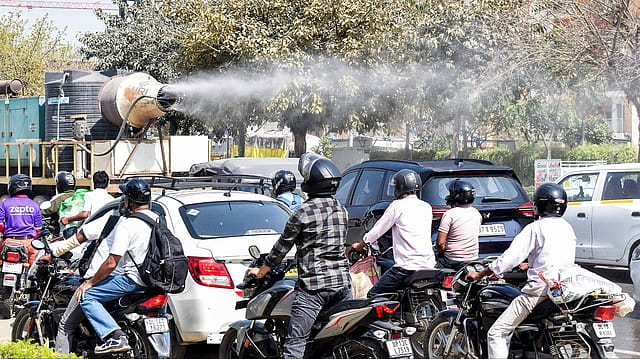
The Supreme Court on Friday identified vehicular emissions as a major contributor to air pollution in Delhi-NCR, expressing concern over the volume of traffic on roads connecting the national capital with neighbouring cities. With Delhi's Air Quality Index (AQI) hovering close to 400, the court called for immediate, medium and long-term measures rather than relying solely on restrictions and judicial orders to address the crisis.
A three-judge bench headed by Chief Justice of India (CJI) Surya Kant, also comprising Justices Joymalya Bagchi and V Mohana, made the observations while hearing a suo motu case examining the regulatory framework governing air pollution in Delhi-NCR.
“We keep talking, sometimes make statements and suggestions, but the point is that AQI is already touching 400,” the CJI observed.

The Era of Forever Wars
30 Oct 2026 - Vol 05 | Issue 44
Coping with an explosive Middle East
Pointing to the movement of vehicles between Delhi and neighbouring cities, including Ghaziabad, Greater Noida, Gurugram and Faridabad, the bench said the scale of traffic congestion needed urgent attention.
“Look at the roads in Delhi and the roads connecting Delhi with the NCR. Take a look at any road and the kind of vehicles moving on them. That is the major problem,” the CJI said.
The court's observations come amid another deterioration in the capital's air quality, with the overall AQI recorded at 389 at 8 am on Friday, placing it in the ‘very poor’ category, according to the Central Pollution Control Board (CPCB).
VEHICULAR EMISSIONS UNDER THE SCANNER
The court's focus on vehicular pollution brings attention to one of the major sources of Delhi-NCR's deteriorating air quality. The large number of private vehicles, congestion on arterial roads and movement of traffic between the capital and satellite cities have complicated efforts to control emissions.
The Commission for Air Quality Management (CAQM) has previously identified vehicular pollution as a major contributor to the region's pollution burden. Its recommendations have included the time-bound phasing out of highly polluting vehicles and stronger on-road emissions monitoring.
During Friday's hearing, Additional Solicitor General Aishwarya Bhati, appearing for the Centre and other authorities, outlined measures already introduced to address pollution. These included restrictions on the entry of certain categories of vehicles, geo-tagging of pollution under control (PUC) certificates and action against visibly polluting vehicles based on complaints received through applications and social media.
The government also referred to measures such as phasing out diesel-operated rickshaws and regulating buses entering Delhi from neighbouring cities.
STUBBLE BURNING AND FESTIVAL POLLUTION
The bench also discussed agricultural fires, which have become a recurring concern during Delhi's winter pollution season.
Bhati informed the court that stubble burning accounted for 14 per cent of Delhi's pollution on Thursday. The bench stressed the need to educate farmers about using machinery to manage crop residue rather than setting fields on fire.
The hearing also touched upon the difficulties faced by farmers in adopting alternatives to burning, particularly the cost and availability of agricultural machinery.
The CJI questioned why people could not return to traditional practices during festivals, particularly Diwali, instead of relying on celebrations that add to pollution.
“Why don't we revert to our original customs?” he asked, emphasising the need for greater public awareness and responsibility during festivities.
Justice Joymalya Bagchi observed that the commercialisation of festivals had also contributed to the problem.
The bench cautioned that imposing additional restrictions and passing more orders would not necessarily resolve the crisis.
“No restriction is going to work. The more orders we pass, the more violations will multiply,” the court observed, underlining the importance of behavioural change alongside regulatory measures.
The CJI also cautioned against placing the burden of the pollution crisis on economically weaker sections, noting that festivals are an important period of livelihood for people dependent on seasonal work.
“Poor people do not generate any pollution. They are the sufferers. It is those who can afford it and those who can contribute to it,” Surya Kant remarked.
DELHI'S AIR QUALITY REMAINS VERY POOR
Meanwhile, several monitoring stations across the national capital recorded air quality in the ‘severe’ category on Friday.
IIT Delhi and Rohini both recorded an AQI of 474, followed by Punjabi Bagh at 465, RK Puram at 443, ITO at 422, Firoz Shah Road at 420 and India Gate at 403, according to CPCB data.
Other areas also reported elevated pollution levels. Anand Vihar and Akshardham recorded an AQI of 359, while IGI Airport Terminal 3 registered 385. Aya Nagar recorded 393 and Chandni Chowk 391.
Municipal authorities deployed truck-mounted water sprinklers around India Gate as part of measures under Stage II of the Graded Response Action Plan (GRAP).
The deteriorating air quality also drew criticism from Congress MP Shashi Tharoor, who described the situation as a matter of “national disgrace”.
Tharoor criticised the government's failure to demonstrate the political will required to address the problem. He said he had personally organised roundtable discussions on air pollution in Delhi for 10 years before giving up hope that the government would implement the recommendations.
The Supreme Court was also hearing a plea seeking the closure of schools or the introduction of hybrid classes for students across age groups whenever the AQI crosses a specified threshold. The bench said it would rely on expert opinion while considering the issue.
The court said it would pass further orders and listed the matter for November 16, after reopening following the Diwali vacation.
With inputs from ANI