Shimla school audit: 81% lack clean drinking water, 43% have no safety fencing — what went wrong?
Imagine arriving at school in the morning and finding no clean drinking water.
Now imagine studying in a classroom without enough furniture, walking to school because there is no motorable road, or spending the day in a campus without a boundary wall.
For thousands of children in Shimla district, these are not hypothetical problems.
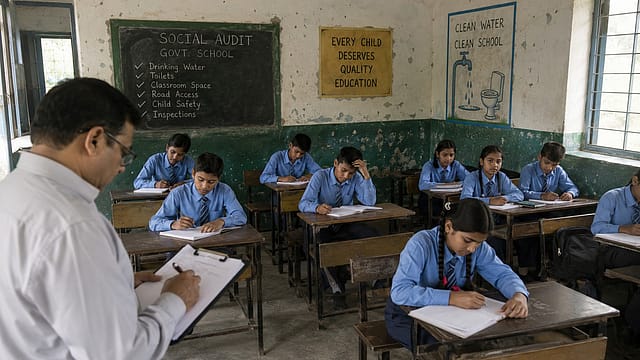
A social audit of 444 schools has found significant gaps in basic infrastructure, student safety, sanitation, accessibility and academic monitoring. The findings were presented at a public hearing in Theog attended by more than 2,100 people, including parents, teachers, School Management Committee members, elected representatives and education officials.
The audit was conducted by a Himachal Pradesh University team led by Aparna Negi and Randhir Singh Ranta. HPU's own faculty records confirm that Negi heads its Department of Interdisciplinary Studies and Ranta is an Assistant Professor in Rural Development.

Losing Memory
16 Oct 2026 - Vol 05 | Issue 42
The making of a medical and social emergency
So, what exactly did the audit find?
How serious is the drinking water problem?
Start with one of the most basic things a school needs: water.
According to the social-audit findings presented at Theog, 81% of the surveyed schools did not have clean drinking-water facilities.
That is roughly four out of every five schools covered by the first phase of the Shimla district audit.
The finding is particularly striking because Himachal Pradesh's official policy framework places water and sanitation among the state's basic education and welfare priorities. The state's Economic Survey also records ongoing work to improve water supply in several towns, including Theog.
But a tap on paper and safe drinking water at school are not necessarily the same thing.
Are students studying without proper classrooms and furniture?
In many cases, yes.
The audit found nearly 47% of schools lacked adequate classroom space, including sufficient rooms for teaching and non-teaching staff.
Furniture was another major gap. Around 78% of the surveyed schools had inadequate or only partial furniture, according to the audit.
Think about what that means on an ordinary school day.
Children arrive. Lessons begin. And in some classrooms, there simply aren't enough desks and chairs for everyone.
The issue also comes at a time when the Shimla education authorities have been seeking details of student-desk requirements for government schools for the 2026-27 academic session.
What about student safety?
This is where the findings become particularly uncomfortable.
More than 43% of the surveyed schools did not have boundary walls or fencing, according to the audit.
A school boundary is not merely about appearance. It separates a campus from roads, slopes, fields and other surrounding areas — a particularly important consideration in a mountainous district.
The state's education department has separately issued directions for comprehensive safety audits of school buildings, showing that school safety remains an active administrative concern.
Why does the road to school matter?
Because in the hills, distance can become a safety and accessibility issue.
The audit found that nearly 79% of the schools surveyed were in areas without motorable road access.
That can mean long walks for students and staff. It can also make access considerably harder for children with disabilities.
And that raises a bigger question: what does “inclusive education” mean if getting to school itself is difficult?
The audit specifically flagged inadequate facilities for children with special needs, suggesting that accessibility problems extend beyond roads and into the school environment.
Are toilets and menstrual hygiene facilities adequate?
Not everywhere.
The audit found that around 23% of schools did not have functional toilets for girls, while about 30% lacked functional toilets for boys.
Around 5% did not have separate kitchens for the Mid-Day Meal programme.
Menstrual hygiene was another concern. The audit team said more than 13% of schools did not provide sanitary pads to adolescent girls.
That matters for more than comfort or dignity. When basic menstrual hygiene facilities are missing, attending school regularly can become harder for adolescent girls.
What happens if a child has a complaint?
This is another weak spot.
According to the audit, School Safety Committees had not been constituted in nearly 58% of the surveyed schools.
Complaint and suggestion boxes were missing in roughly three-fourths of the schools.
And perhaps most strikingly, none of the surveyed schools had access to professional counselling services, according to the findings.
So the problem is not simply that some buildings need repairs.
The audit points to missing systems through which children and parents can raise concerns, seek help or report problems.
Who is checking whether schools meet the rules?
The audit also questioned administrative monitoring.
More than 26% of schools were found not to meet prescribed library norms and standards, while the team said inspections by education officials were below the required level.
Devender Sharma, co-head of the social-audit team, said lower-level education officials were falling short of prescribed inspection requirements.
The audit team reported that inspection visits by Block Elementary Education Officers and other officials were 47% below the prescribed level, which it said was contributing to a “non-serious academic climate”.
That is a particularly important finding because infrastructure can be fixed with money.
But monitoring requires something else: someone showing up, checking what is wrong and making sure it gets fixed.
What did the government say?
Education Minister Rohit Thakur acknowledged the gaps highlighted by the audit.
“Our state has many achievements in education and ranks fifth in overall performance in the country, but we have many shortcomings as well, which have been pointed out in this social audit report. We will overcome all these deficiencies and gaps in the coming times,” he said at the public hearing.
The government's response will now be important because the audit is not the end of the process.
The findings are expected to be sent to the Education Department for corrective action.
Is this the full picture of Shimla's schools?
No — and that distinction matters.
The 444 schools represent only the first phase of the Shimla district assessment. The district has around 2,068 schools, according to the information provided for the audit, meaning the remaining institutions are to be covered in four subsequent phases.
So these findings should not be read as a verdict on every school in Shimla district.
But they are still difficult to ignore.
The social-audit exercise is designed precisely to expose the gap between what policies promise and what students experience on the ground. Himachal's own education system uses social audits and community discussions as part of its broader monitoring framework.
And that may be the most important part of what happened in Theog.
More than 2,100 people gathered. Parents spoke. Teachers spoke. Officials listened. Problems that can remain buried in paperwork were put in a public forum.
Now comes the harder part.
Can the state turn 444 schools' worth of complaints into 444 schools' worth of fixes?
Because for a child sitting on a classroom bench — or waiting for one — the difference between a policy and a working school is very simple.
It is whether the water is clean, the toilet works, the road is safe, the boundary is there and someone is listening when something goes wrong.
(With inputs from ANI)