Security and Trade are bedrock of India-ASEAN ties
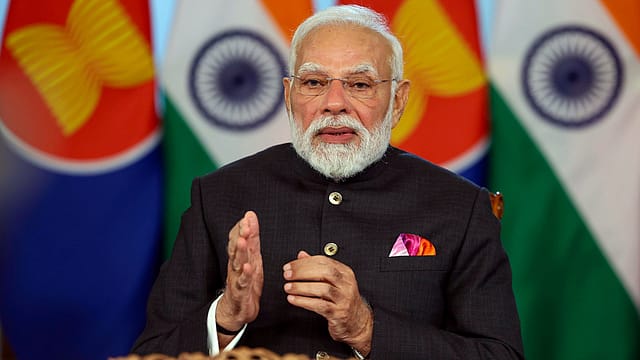
While the possibility of a meeting of QUAD (Quadrilateral Security Dialogue) leaders at Manila on the sidelines of the ASEAN (Association of South-East Asian Nations) has attracted attention, discussions at the East Asia summit remain crucial given India’s belief that an ASEAN-centered regional architecture is crucial to the security and commerce in the Indo-Pacific.
The current chair of the EAS Philippines has prioritized “peace and security,” “prosperity corridors” and “people empowerment” and this sits closely with India’s engagement and objectives in the Indo-Pacific. “India attaches great importance to EAS as a premier leaders-led forum and sees it as a logical platform to promote a free, open, transparent, rules-based, peaceful and prosperous Indo-Pacific,” a backgrounder notes.

The Wealth Issue 2026
06 Nov 2026 - Vol 05 | Issue 45
Portraits of Dreamers and Doers under 35
Arc of Interests
The EAS participating nations present a broad arc of geographies and interests including the 11 ASEAN members with Timor Leste being the latest addition and invitees Australia, China, India, Japan, Korea, New Zealand, Russia and the United States. Prime Minister Narendra Modi has participated in every ASEAN summit since 2014 except in 2022 and has sought to deepen the relationship at institutional levels.
There is a strong complementarity between India’s Indo-Pacific Oceans Initiative (IPOI) and the ASEAN Outlook om the Indo-Pacific (AOIP) and this provides a solid platform for cooperation and the base for practical cooperation. The summit dialogue is important as it covers the gamut of strategic, political and economic issues affecting the vast expanses of the Indo-Pacific. India sees the EAS as an open, inclusive and forward-looking forum.
Maritime Security
The ASEAN-India maritime exercise in Philippines and MILAN 2026, the biennial multilateral naval exercise hosted by India at Visakhapatnam, point to the growing momentum in maritime engagement. The seventh EAS conference on maritime security cooperation was hosted by India at Kochi in October.
The third ASEAN-India scale hub held in Bali in July brought together 330 participants, including growth-stage start-ups and scale-ups from India and ASEAN along with investors, policy-makers and technology developers. The event made it possible for participating to find business complementarities, investment opportunities and collaboration in deep-tech, artificial intelligence, digital transformation and innovation. An official brief underlines the shared objective of facilitating market access and scaling up of businesses across India and ASEAN.
Deep Tech and Innovation
The discussions in Manila will see the conclusion of negotiations for the ASEAN digital economy framework agreement (DEFA) which opens new opportunities for cooperation in digital trade, integration and innovation. India has considerable experience to share in digital public infrastructure, UPI, digital payments and FinTech.
Cooperation on disaster preparedness and humanitarian assistance has increased and is an important pillar of the India-ASEAN partnership. The people-to-people connections and cultural links have always undergirded relations and this continues to provide a strong foundation for contemporary ties. The ancient connections of trade, maritime routes, religion, language and the arts have encouraged academic, cultural and political exchanges.