Wedded to the Dynasty
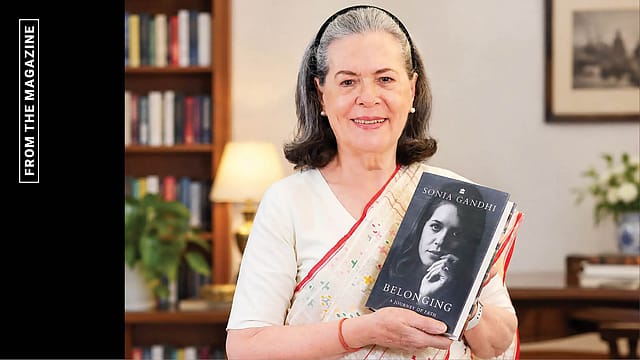
In Sonia Gandhi’s telling of the tense days following the Allahabad High Court’s decision unseating Indira Gandhi from Lok Sabha, she and her husband Rajiv Gandhi felt that resigning as prime minister would be the best course of action. But the opposition’s plans to bring the nation to a standstill assumed alarming proportions. Indira Gandhi was not her “normal self” and believed Jayaprakash Narayan (JP), the font of the anti-government mobilisation, had “fallen prey” to the designs of the Rashtriya Swayamsevak Sangh (RSS). Indira also felt that the great powers were unreconciled to an independent-minded leader who had exploded a nuclear device.
“If I resign, the party will split and scatter, and the RSS will have its way... How can we allow it? We fought them throughout the freedom movement. We fought them all these years. They are going to destroy the country,” Sonia quotes Indira in her autobiography, Belonging: A Journey of Love. In the end, the threat of an RSS authoritarian takeover of India is a key factor in Indira Gandhi’s decision to suspend civil liberties and imprison opposition leaders after imposing a state of Emergency in June 1975. RSS, writes Sonia, saw Congress as a “stumbling block” in its design of a Hindu nation. “When Congress freedom fighters were enduring assaults and imprisonment at the hands of the British, RSS ideologues like Vinayak Damodar Savarkar were writing mercy petitions to their colonial masters.”
The uncomplimentary reference to Savarkar typically fails to mention his long years of incarceration in the Andamans’ infamous Cellular Jail, appropriately referred to as “kala pani” (black waters), an ordeal that no senior Congress leader suffered. It is not the only instance of Sonia glossing over an inconvenient fact or two, but it is striking how often she returns to the theme of RSS and the Bharatiya Janata Party (BJP) representing a “communal threat” to the nation, and how scanty is the mention of other parties and leaders, or of in-house rebels like VP Singh and Rajiv’s cousin Arun Nehru, who ousted the party from office in the 1989 Lok Sabha polls. “To resign at this juncture would go against her fiercely held conviction that the country had to be protected at all costs against communal and right-wing forces,” Sonia writes about Indira Gandhi’s choices without a trace of irony.
The “communal” threat of RSS is never far from Sonia’s thoughts as she dwells on her marriage and her career as a leader of Congress. In the context of the Congress old guard’s opposition to Indira Gandhi in 1969 too, the shadow of BJP’s precursor, the Jana Sangh, was seen to lurk behind the revolt. “RSS was the ideological nerve center of several Hindu nationalist formations, prominent amongst them was the communal party that came to be known as Jan Sangh... In Mrs Gandhi’s view, seeking the support of such parties (as the Congress seniors allegedly did) was a betrayal of Congress’s stand against right-wing and communal forces,” she writes, outlining a virtuous cause in what was a bare-knuckled fight for power.
When Sonia returns to the protests in Gujarat and Bihar that racked the nation in 1974, she notes that the dissolution of the Bihar Assembly was the only instance in independent India of an elected government brought down by street violence. This, she says, was brought about by the very forces, now in office, that crush peaceful protests. If the “regime change” slogans marking the current protests suggest a parallel to the events of 1974, the association has clearly escaped Sonia. She instead cites a reference to RSS in Indira’s letters to Jawaharlal Nehru: “The growth of this organization is so amazingly like the Brown Shirts in Germany, that if we are not quick on our toes it will grow beyond our control and the control of the industrialists who are now financing it.” The stain of Emergency is therefore partly explained by the need to contain RSS, with the rest pretty much attributed to Sanjay Gandhi. “What is undeniable, however, is that he (Sanjay) had a significant decision-making role despite lacking a constitutional locus standi for some of his political interventions,” Sonia says, absolving Indira Gandhi of culpability.
It is to her credit that Sonia Gandhi, despite initial misgivings, imbibed the values of the political family she married into. There is a ring of credibility to her narration of the Gandhi family’s history and her determination to preserve that legacy
Interestingly enough, Sonia returns to the role of RSS even when asserting that Rajiv Gandhi would never have “authorised” the heinous anti-Sikh riots of 1984 following the assassination of Indira Gandhi. While accepting that criminal proceedings were initiated against several Congress members, she says, “Several cases were also registered against members of the RSS who took part in the killings.” This is a startling claim in the absence of any credible mention of BJP or RSS members being tried in a court of law. “Even after four commissions, nine committees, and two special investigation teams, cases continue to drag on in the courts. Justice has been hard to come by for the victims,” Sonia observes, omitting that Congress was in office after Indira’s death. The cases were all but buried, and it was only due to efforts during intervals of opposition rule, mainly when BJP was in office, that a handful of cases made it to the courts and a few convictions were obtained. The Bofors defence scandal, which brought down Rajiv Gandhi’s government despite its super-majority in Parliament, barely occupies a page-and-a-half, but here too the vindictive actions of BJP find mention alongside the Delhi High Court’s 2004 order quashing the Bofors case. It can hardly be a coincidence that one of the first decisions of the Congress-led United Progressive Alliance (UPA) government was to de-freeze the London accounts of Sonia’s family friend Ottavio Quattrocchi, a key link to the Bofors case.
RSS-BJP were on Sonia’s mind again as she considered the need to plunge into active politics in 1996-97, at a time when Congress appeared to be dissipating. “There had been for several years clear indications that the BJP-RSS and their affiliates were single-mindedly advancing their divisive agenda. The tragic demolition of the Babri Masjid were pointers... (they) were gaining confidence to create a groundswell against secular values...” she writes, and adds: “How could I sit at home and let their (Gandhi family) sacrifices go in vain?” The call to duty was heeded, though the machinations of the Sangh Parivar apparently did not cease. In 2012, when UPA was confronted by Anna Hazare’s India Against Corruption movement, the usual suspects reappeared. “Some of its prominent participants have stated that it was covertly organized and supported by BJP and RSS.”
It is to her credit that Sonia Gandhi, despite initial misgivings, completely imbibed the values and traditions of the political family she married into. There is a ring of credibility in her narration of the Gandhi family’s history and her determination to preserve that legacy. Of all the anti-Congress forces, only BJP has never joined hands with the party. Sonia’s repeated references to the “communal threat” are recognition that it is BJP that poses the most significant threat to the Gandhi political tradition and heritage. Under Prime Minister Narendra Modi, the threat to the political and cultural architecture that has sustained the Gandhis, with a supporting cast of Lutyens’ elites, has become acute. In her understanding of family duty, Sonia sees sustaining the Gandhi inheritance and preserving Congress as synonymous. The assertion that this is also a matter of national good is an obvious corollary. Family connections and loyalty are intertwined, and the gilded set of school buddies, relatives and cultural mavens who are part of this charmed circle need to be aware at all times that access does not amount to familiarity.
While Sonia’s autobiography provides details and insights into her life, its value does not lie in just what she tells or chooses to omit. Confirmation of the primacy of the Gandhi political legacy fuses the personal and the political

It is quite a surprise how little is known about a person who has been in the public eye since the late 1960s. But while Sonia’s autobiography provides details and insights into her life, its value does not lie in just what she tells or chooses to omit. Confirmation of the primacy of the Gandhi political legacy fuses the personal and the political. She has been sedulously faithful to the cause and is clear-eyed in recognising that Congress and, indeed, politics are but a vehicle in this family saga. Her decision that Rahul Gandhi would be the political heir is integral to the story she tells. The elder daughter-in-law is a faithful bearer of family tradition, which subsumes all other concerns, including those of wayward members of the clan who forgot that loyalty comes before all else. It is hardly a surprise that RSS-BJP come in for repeated mention, as Sonia correctly identifies them as the most consequential threat to the future of the Gandhi clan, given that the Sangh Parivar’s opposition is rooted in a radically different political vision and is not just a scramble for loaves of office.