Scholar links kanwariya aggression to rising economic inequality, uncertainties
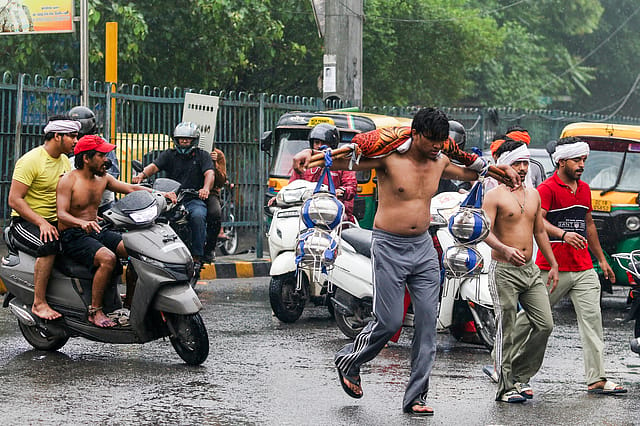
Dr Vikash Singh of US-based Montclair State University has closely studied the pilgrimage of Kanwar Yatra undertaken by kanwariyas who are Siva devotees from various places such as Haridwar, Gaumukh and Gangotri. They carry on their shoulders water from the Ganga typically stored in sealed pots or containers hung from a bamboo pole to hundreds of kilometres to local Siva shrines. That is the western leg of the pilgrimage. In the eastern leg, it starts at Sultanganj in Bihar and ends in Deoghar, Jharkhand.
Singh, Associate Professor, Sociology, Criminology, and Justice Studies at the College of Humanities and Social Sciences at Montclair State University, had himself undertaken the pilgrimage to study the rituals and people and had written a book titled “Uprising of the Fools: Pilgrimage as Moral Protest in Contemporary India” in 2017.
Rise of the Pivotal Power
18 Sep 2026 - Vol 05 | Issue 38
The BRICS declaration is a strategic victory for Modi
An alumnus of US-based Rutgers University, Singh speaks to Open about India's largest annual religious pilgrimage in which millions take part, the aggression of the participants, the violence they unleash at times, and the reasons behind such actions, their socio-economic backgrounds and more. “It is hard to imagine a harder transition to adulthood anywhere in the world than it is for the bulk of India's young men -- adored by their families, but without a future,” he points out. Edited excerpts:
Your 2017 book “Uprising of the Fools: Pilgrimage as Moral Protest in Contemporary India” perhaps needs to be re-read in the wake of rising violence perpetrated by kanwariyas this year in India. You had said that this pilgrimage is an occasion for many of its participants to “delimit, and to rejuvenate from, an existentially overwhelming, distressing, almost inhuman (or, perhaps, all too human) life of labour and suffering”. You note that these are men left behind by a globalised economy. In that sense, is the fact that they are seen as a nuisance on our expressways and cities, their hooliganism and violence a stark reminder of India’s growing inequalities?
India’s inequalities, the socio-cultural differences between and within urban and rural India, oppressive hierarchies of everyday living are all real, and so are the consequent resentments. But no less important than the relative inequities, I suppose, is the poverty, the difficulties of life: life is a struggle, jobs are scarce, competition is severe, and the future is very uncertain. It is hard to imagine a harder transition to adulthood anywhere in the world than it is for the bulk of India's young men -- adored by their families, but without a future. Childhood dreams seem to painfully evaporate in the crucible of reality; I wonder if it is getting harder now as software jobs -- the one reliable avenue for the last thirty odd years -- dry up. All there is, is government jobs, and there is likely less than one for a thousand. Could conditions be any harder? What do they do, but rebel and seek refuge in Siva?

In my book I say that the pilgrimage provides an alternate, vaunted field to prove oneself and one's resilience in one’s own eyes, in God's eyes, and in the eyes of one’s loved ones. I haven’t followed the hooliganism news much, but our young men are suffering; they are crying for help. When you are hurt, it can transfer to hurting others too, an emotion that the politics around religion waits on to capitalise. But again, of course, with humans it is never a linear cause-effect; the politics is entrenched in the subjectivities, although here I remain a materialist... economic pain and uncertainty are likely the primary causes.
What can governments do about it, especially as regards containing violence? In Lucknow, kanwariyas vandalised a school van. In Hapur, a Muslim driver died after being beaten up by them following a road accident. More videos have surfaced of a section of kanwariyas themselves stating that the majority of those who hit the road claiming to be kanwariyas are those under the influence of cannabis and various kinds of drugs and perpetrate violence. They tend to target even women and children. Do they have the licence to be violent?
As a sociologist, I wouldn't blame the individuals here... the structural conditions of the Indian economy, an endless situation of anomie is what we see. In anomic situations, as the sociologist Durkheim saw it, rates of violence will go up. A frustrated soul will be aggressive; and such aggression has ready buyers in the political market.
Your book states that “as a festival of the dominant Hindu community identifying with the nation, the Kanwar pilgrimage may therefore--especially under right-wing political influence--easily turn out to be an expression in exclusion and symbolic repression of other communities.” Has the situation become far worse than you had imagined?
The aggression was on display a decade ago too. I am not sure if something has fundamentally changed; if it has, I would just say perhaps the economic conditions are even worse. Is this the early stages of the AI pain? It could get even worse, unless stable jobs can be created at a mass level. Nationalism and religion will continue to provide the ideological smokescreen and scapegoats.
You invoke Walter Benjamin in the book to talk about the use of drugs and the outcome. But does it not appear that these kinds of drug-induced spectacles that kanwariyas perform are done with a certain knowledge of an impunity they enjoy in today’s India?
I guess they are acting as sovereigns here, asserting their sovereignty for a limited space and time. The ideological state has to give them that room, as its own claim to sovereignty ratified through elections depends on them. If you don't give them that limited space to assert their sovereignty, you are going to lose moral claim on their votes and electoral support.
Do you see participation in the Kanwar Yatra expand beyond Delhi’s neighbouring states of Uttar Pradesh, Haryana, and Rajasthan, which you acknowledge contribute a disproportionate share of the participants?
It is possible. Also, please note that the south has its own version: the kavadai pilgrimage devoted to Murugan (Kartikeya, Siva’s son). There are versions in the diaspora as well – Réunion, Mauritius, Singapore, etc. They are more individualised; however, I believe it works as a rite of passage in these places too.