Roads to cities are growth highways
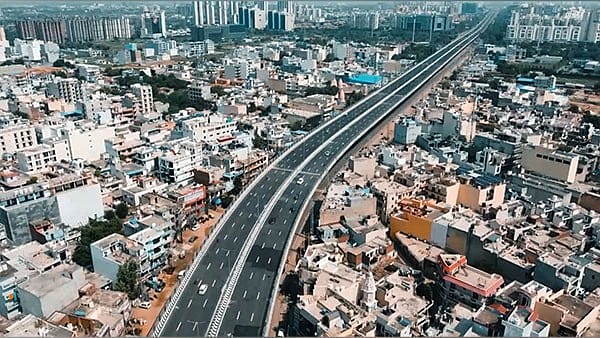
A road is easy to measure. What it enables is harder: the time it saves, markets it opens, jobs it brings within reach. In its first term, the Modi government built systems to build India’s roads faster. In its second, it turned to factories. Since 2024, the two have begun to converge in cities and that is where returns on these investments to the citizenry will be determined.
In the Lok Sabha in February 2024, Prime Minister Narendra Modi described his first term as addressing potholes and the second as laying out the foundation for a new India.
Roads 2014–19
Roads are not just asphalt and concrete, they are also sinews an economy runs on: transport, energy and finance. The national highway network grew from 91,287 km in April 2014 to 1,32,499 km by March 2019, as the pace of construction rose from 12 km a day to 29.7 km. Saubhagya, launched in October 2017, connected 2.63 crore households to electricity within 18 months. Ujjwala, launched in May 2016, met its target of 5 crore LPG connections before its March 2019 deadline. The solar energy adoption targets promised to the world were met five years early. Jan Dhan, launched in August 2014, had opened 35.27 crore bank accounts by March 2019. These infrastructure initiatives were complemented by expansion and improvement in delivery of benefit schemes for pensions, women and children, and farmers, which provided the pathways and confidence for more Indians to participate in the modern economy.

The Era of Forever Wars
30 Oct 2026 - Vol 05 | Issue 44
Coping with an explosive Middle East
Factories: the second term, 2019–24
The second term used these connections to pursue foundations of manufacturing. In September 2019, the government cut the base corporate tax rate from 30% to 22%, and to 15% for new manufacturing companies. The Production Linked Incentive scheme followed in 2020. By March 2024, it had attracted ₹1.23 lakh crore in investment and generated around 8 lakh jobs. Mobile phone exports rose from ₹22,870 crore in 2020–21 to about ₹1.29 lakh crore in 2023–24. Over the same period, electronics rose from 2.7% of merchandise exports in FY19 to 6.7% in FY24, creating a new pillar of economic growth.
Cities 2024 onwards
Roads and factories now meet in cities. In August 2024, the Union Cabinet approved 12 industrial smart cities across 10 States. They are planned along six corridors on the Golden Quadrilateral and join first-term roads to second-term factories. The same month, the Cabinet approved the second phase of Pradhan Mantri Awas Yojana-Urban to support one crore urban families.
The government's first official estimate of logistics costs, released by DPIIT in September 2025, put them at 7.97% of GDP in 2023–24. That was down from 8.84% a year earlier and well below the 13 to 14% long cited before an official study existed.
Urban areas already contribute around 60% of GDP, according to NITI Aayog in 2022. The Economic Survey 2025–26, citing the World Bank, expects that share to reach almost 70% by 2036. By then, 600 million Indians, or 40% of the population, will live in towns and cities, up from 31% in 2011.
Financing Cities
City finances have not kept pace. According to the Reserve Bank of India, the revenue receipts of India's 232 municipal corporations, including transfers, were budgeted at 0.6% of GDP in 2023–24. That was unchanged from 2019–20 and far below the Centre's 9.2% and the States' 14.6%. Property tax, the corporations' largest own tax, made up just over 16% of their receipts.
A highway may bring a factory closer to its market. City-level friction can still erase the gain.
The larger constraints are authority and responsibility, not money. The 74th Constitutional Amendment of 1992 gave urban local bodies a list of functions, yet many States still hold the revenue, staff and decisions those functions require. Central urban funding offers a lever: tie
releases to devolution, so that cities controlling their own property-tax rates and building approvals receive more. This devolution is now urgently required, and its delay constrains future growth. Roads built the connections. Factories built the capacity. Cities must now make both work. A road is easy to measure. The harder task is to ensure that the city at either end makes the journey worthwhile.
(Anuj Gupta is Managing Director at BowerGroup Asia. Mudit Narain is an entrepreneur with a background in public policy and national program design and management. Views expressed are personal.)