Rain and Shame: As Gurugram drowns every monsoon, the real problem is governance
EVERY YEAR AROUND this time, I write some version of this piece. And every year, I hope it would be the last. It never is.
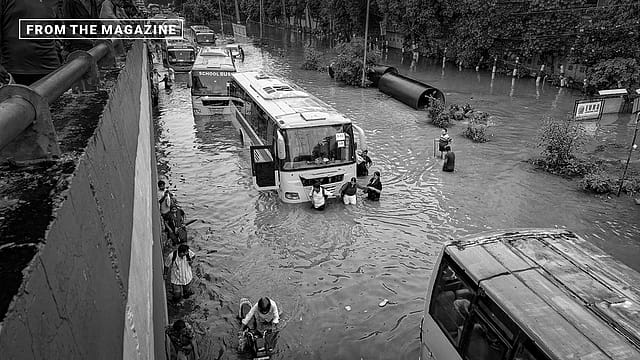
This week, once again, Gurugram drowned. Not metaphorically but literally. An IMD red alert, a few hours of determined monsoon rain, and the self-styled Millennium City folded like a cheap umbrella. Sector 47. Subhash Chowk. Rail Vihar. All under knee-deep water. School buses, sent home early as a precaution, were still stuck in gridlock by evening.
Children, some barely old enough to tie their own shoelaces, sat in stationary buses for hours, handed biscuit packets by harried attendants because there was nothing else to give. That is not an emergency. That is Tuesday in Gurugram.
I have said this before, in this very publication and several others, and I will say it again—because apparently repetition is the only currency this city’s administration understands, even if it never acts on it: Gurugram is not a city. It is a real-estate project that got lucky with corporate tenants.
We built glass towers first and drains never. We invited the Fortune 500 to set up shop, congratulated ourselves on the skyline, and never once asked the boring, unglamorous question of who would ensure the stormwater had somewhere to go. The answer, 12 monsoons running, has been: nowhere. It goes into your basement, your car, your child’s school bus, and eventually, into a WhatsApp forward that everyone shares and nobody acts on.

What galls me most is the sheer predictability of it all. This isn’t a freak cloudburst nobody saw coming. Gurugram gets exactly the amount of rain any NCR city gets in August. The municipal corporation knows this. The Gurugram Metropolitan Development Authority (GMDA) knows this. Every August, for at least a decade, some combination of Sohna Road, MG Road, Golf Course Extension Road, and the Delhi–Jaipur Expressway turns into a chain of interconnected ponds. And every year, the explanation is a variant of the same three words: drains weren’t cleaned.
If your city’s civic failure has become as ritualistic and predictable as Diwali, you no longer have an infrastructure problem. You have a governance problem—and a fairly contemptuous one at that. Contempt is precisely what it takes to watch this happen year after year and do nothing more than issue a “yellow alert” and a press statement.
And spare me the talk of world-class aspirations. You cannot have a Cyber Hub and a cesspool on the same street and call yourself a global city.
Every multinational that has quietly begun asking its India leadership whether Gurugram is truly the best base for operations is making a rational decision based on what it saw on August 24: an executive’s child stuck on a bus for three hours because nobody had thought to build a drainage system that could survive an August 25 thunderstorm.
Here is what should happen—and won’t, because I have made this argument before to deaf ears in both Chandigarh and Gurugram:
• An independent, empowered drainage authority with a single point of accountability, not the Municipal Corporation of Gurugram (MCG) blaming the GMDA, the GMDA blaming the builders, and the builders blaming the government in the same tired circle we perform every July and August.
• A published, audited, pre-monsoon readiness report made public, so citizens can hold someone—one name, one office—responsible when it fails.
• An honest reckoning with the fact that every additional high-rise approved without matching stormwater capacity is a decision that will eventually be paid for by an eight-year-old sitting in a stalled bus, eating biscuits, waiting for a city that promised to be a Millennium City to simply survive one afternoon of monsoon.
We will forget this by the end of the week, as we always do, until it rains again. That, more than the flooding itself, is Gurugram’s real failure.