Politics of Union Budget 2026: A Charter of Duties Binds Modi Govt with Key Political Constituencies
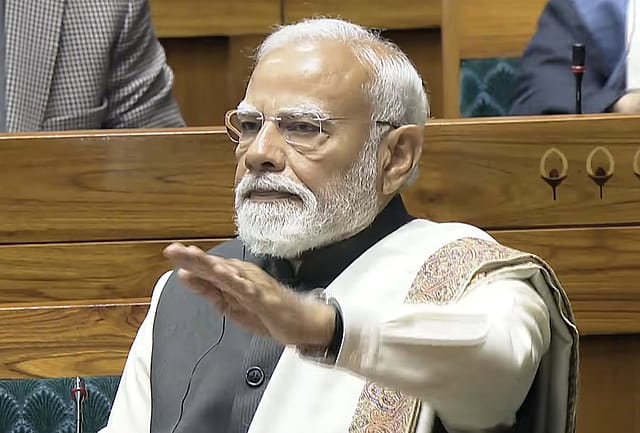
Finance minister Nirmala Sitharaman’s Budget speech got underway without even the token sloganeering that usually precedes the occasion. This might be explained, at least in part, by Bharatiya Janata Party’s recent electoral successes, or a sense of acceptance that the FM was not to be deterred by any heckling. They were not wrong. Sitharaman could be heard saying “one and a half hours” at the end of a speech studded with announcements intended to promote the goal of an economy that is both “atmanirbhar (self-reliant)” and modern.
The finer points of the Budget reveal the comprehensiveness of the political and economic reasoning infusing the Budget. A new initiative to strengthen handloom, khadi and handicrafts is named the Mahatma Gandhi Gram Swaraj. Nothing remarkable about associating rural development with Gandhi but the decision indicates that criticism over “dropping” Gandhi’s name from the rural guarantee employment schemes now called “G-RAM-G” has been taken note of and addressed with a thoughtful inclusion.

Zeroing In on ECI
09 Oct 2026 - Vol 05 | Issue 41
Constitutional legitimacy versus political opportunism
The goal of Viksit Bharat
Setting out the context of a Budget marked by bold strokes as well as careful attention to fiscal prudence, the FM minced no words in stating that trade and multi-lateralism are “imperiled” and access to supply chains and resources is disrupted. It is in these challenging circumstances that Sitharaman pointed out “three duties” or “kartavyas” – sustain growth and encourage competitiveness, build social capital and ensure equity in access to resources and opportunities. The ideation, linked to Prime Minister Narendra Modi’s “Viksit Bharat (developed India) vision, runs through the entire Budget.
Pharma has been a success story but the Budget zones in “bio pharma,” promising to promote an eco-system of “biologic medicines” – medications developed from living organisms like proteins and genes – with a Rs 10,000 crore outlay over five years. Support to semi-conductors and electronics continues with the addition of rare earths. There are specific initiatives for hi-tech tools and manufacturing of containers and construction equipment. There is a SME (small and medium enterprises) growth fund of a similar amount to re-fit and modernize 200 “legacy” industrial clusters, a vital exercise to improve the quality and skills of this sector.
There are measures to boost textiles, fisheries, farm industries and plan for carbon capture utilization and storage technologies at scale. The thought process aligns with the need to protect and strengthen sectors most affected by the Trump tariffs but also build capacity for these labour-intensive businesses to take advantage of access to new markets envisaged by the India-EU Free Trade Agreement and other trade deals with developed nations like Australia, New Zealand and United Kingdom. There is an element of “tough love” as well as FM has indicated that “atmanirbharta” does not mean being shielded from competition for all time.
Connectivity and regional integration
The commitment to government capital expenditure is matched by a plan for “corporate mitras” to help MSMEs in tier II and III cities meet compliance costs, reflecting an understanding of frictions that slow down the economy. An infrastructure risk guarantee fund is an intervention at the other end of the scale, intended to provide comfort to lenders backing infrastructure projects. The heightened focus on freight corridors, waterways and even sea planes are markers of economic development that also, importantly enough, integrate and connect regions.
The city economic regions announcement acknowledges the public disgruntlement over poor civic amenities and the potential of urban agglomerations to be hubs of innovation and knowledge. The Rs 5000 crore outlay seems an initial offering but the pledge to offer an incentive of Rs 100 crore on issuance of a single bond of more than ₹1000 crore is serious effort to improve municipal financing. The incentives to bonds up to Rs 200 crore will also continue.
As the government seeks to incentivize manufacturing, it has recognized the importance of services as exports and in the domestic economy. Aware that services are major job providers, the FM announced a panel to draw a path for “education, employment, enterprise” to make good the Budget promise to work for “yuva shakti (youth power)” and the committee will map jobs and skills in the light of emerging technologies. Institutional support for “allied health professionals” and the development of a “care economy” are all job creating initiatives.
Getting rid of red tape
The objectives of skilling and employment are embedded in initiatives to promote medical tourism, AYUSH, trekking and hiking circuits in Himachal Pradesh, Uttarakhand and Jammu and Kashmir and Buddhist religious destinations in the north east and a pilot to upskill 20,000 tourist guides in 20 tourist sites – the last being a praiseworthy project as guides are a vital interface with visitors both India and foreign. Credit linked subsidies for improving livestock, enhancement of high value agriculture and use of AI to integrate agri-stacks serves rural India and key voter base that has supported the Modi government.
Pages 24 to 32 of FM speech that deal with Part B, or the direct and indirect taxes, offer a vision of easing compliance and reducing tax burdens along with tighter scrutiny in some volatile segments of the market. Sitharaman makes a distinction between penalties and fees and seeks to de-stigmatize the latter. There is a promise of expansion of duty free limits and easier baggage clearance during international travel. There are specific duty relaxations such as fish catch on high seas, seamless cargo clearance, duty deferrals for certain authorized economic operators and customs and excise duty is proposed to be done away for manufacture of aircraft, biogas blended CNG, critical minerals and nuclear power.
There is a specific mention about attracting global business and investment to enable critical infrastructure and increase investment in data centers. “I propose to provide tax holiday till 2047 to any foreign company that provides cloud services to customers globally by using data centre services from India. It will, however, need to provide services to Indian customers through an Indian reseller entity,” the FM said. There are incentives for skilled foreign individuals as part of an effort to get them to live and work in India.